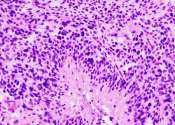
Glioblastoma

Progression of Lou Gehrig's disease explained

Researchers in Uruguay and Oregon have discovered a previously unknown type of neural cell that appears to be closely linked to the progression of amytrophic lateral sclerosis, or Lou Gehrig's disease, that they believe will ...

Medical research created Oct 17, 2011 | popularity 5 / 5 (2) | comments 0 | with audio podcast

Cold plasma successful against brain cancer cells

For the first time, physicists from the Max Planck Institute for Extraterrestrial Physics (MPE), biologists and physicians demonstrated the synergistic effect of cold atmospheric plasma - a partly ionized ...

Cancer created May 23, 2013 | popularity 5 / 5 (4) | comments 1 | with audio podcast

Researchers find possible 'master switch' in deadly brain cancer

(Medical Xpress)—Researchers at the University of Virginia School of Medicine have identified a promising target for treating glioblastoma, one that appears to avoid many of the obstacles that typically frustrate efforts ...

Cancer created May 23, 2013 | popularity 3.5 / 5 (2) | comments 0 | with audio podcast

Scientists find mutation driving pediatric brain tumors

A type of low-grade but sometimes lethal brain tumor in children has been found in many cases to contain an unusual mutation that may help to classify, diagnose and guide the treatment of the tumors, report scientists at ...

Genetics created Apr 30, 2013 | popularity 5 / 5 (1) | comments 0 | with audio podcast

Genetic master controls expose cancers' Achilles' heel

In a surprising finding that helps explain fundamental behaviors of normal and diseased cells, Whitehead Institute scientists have discovered a set of powerful gene regulators dubbed "super-enhancers" that control cell state ...

Cancer created Apr 11, 2013 | popularity 4.8 / 5 (6) | comments 0 | with audio podcast

Researchers use a type of stem cells from human adipose tissue to chase migrating cancer cells

In laboratory studies, Johns Hopkins researchers say they have found that stem cells from a patient's own fat may have the potential to deliver new treatments directly into the brain after the surgical removal of a glioblastoma, ...

Cancer created Mar 12, 2013 | popularity 5 / 5 (2) | comments 0 | with audio podcast

Hope in stopping melanoma from spreading: Study shows that inhibiting key protein prevents metastasis to lungs in mice

(Medical Xpress)—Researchers have identified a critical protein role in the metastasis of melanoma, the most serious form of skin cancer. Inhibition of the protein known as adenosine diphosphate ribosylation ...

Cancer created Mar 05, 2013 | popularity 5 / 5 (1) | comments 0 | with audio podcast

Novel combination therapy shuts down escape route, killing glioblastoma tumor cells

Glioblastoma, the most common and lethal form of brain tumor in adults, is challenging to treat because the tumors rapidly become resistant to therapy. As cancer researchers are learning more about the causes of tumor cell ...

Cancer created Feb 26, 2013 | popularity 5 / 5 (1) | comments 2 | with audio podcast

New method is first to predict brain cancer outcome and quickly show if therapy is effective

The critical question shortly after a brain cancer patient starts treatment: how well is it working? But there hasn't been a good way to gauge that.

Cancer created Jan 23, 2013 | popularity not rated yet | comments 0 | with audio podcast

Vaccines might become another way to fight cancer

(HealthDay)—Most people think of the flu when the word "vaccine" comes up in conversation, but several vaccines also exist to help prevent cancers.

Cancer created Jan 19, 2013 | popularity 4.2 / 5 (5) | comments 0 | with audio podcast

Study finds new targets for drugs to defeat aggressive brain tumor

University of Pittsburgh Cancer Institute (UPCI) researchers have identified over 125 genetic components in a chemotherapy-resistant, brain tumor-derived cell line, which could offer new hope for drug treatment to destroy ...

Cancer created Dec 14, 2012 | popularity not rated yet | comments 0 | with audio podcast

Research identifies targeted molecular therapy for untreatable NF1 tumors

Researchers conducting a preclinical study in mice successfully used targeted molecular therapy to block mostly untreatable nerve tumors that develop in people with the genetic disorder Neurofibromatosis 1 (NF1).

Cancer created Dec 10, 2012 | popularity 5 / 5 (2) | comments 0 | with audio podcast

Metabolic protein launches sugar feast that nurtures brain tumors

Researchers at The University of Texas MD Anderson Cancer Center have tracked down a cancer-promoting protein's pathway into the cell nucleus and discovered how, once there, it fires up a glucose metabolism pathway on which ...

Cancer created Nov 26, 2012 | popularity not rated yet | comments 0 | with audio podcast

Researchers identify novel metabolic programs driving aggressive brain tumors

Researchers at Moffitt Cancer Center have identified metabolic signatures that may pave the way for personalized therapy in glioma, a type of tumor that starts in the brain.

Cancer created Nov 09, 2012 | popularity 4 / 5 (1) | comments 0 | with audio podcast

Team uses antisense technology that exploits gene splicing mechanism to kill cancer cells

Cancer cells grow fast. That's an essential characteristic of what makes them cancer cells. They've crashed through all the cell-cycle checkpoints and are continuously growing and dividing, far outstripping our normal cells. ...

Cancer created Oct 31, 2012 | popularity 5 / 5 (1) | comments 0 | with audio podcast


Glioblastoma multiforme (GBM) is the most common and most aggressive malignant primary brain tumor in humans, involving glial cells and accounting for 52% of all functional tissue brain tumor cases and 20% of all intracranial tumors. Despite being the most prevalent form of primary brain tumor, GBMs occur in only 2–3 cases per 100,000 people in Europe and North America. According to the WHO classification of the tumors of the central nervous system‎, the standard name for this brain tumor is "glioblastoma"; it presents two variants: giant cell glioblastoma and gliosarcoma. Glioblastomas are also an important brain tumor in canines, and research continues to use this as a model for developing treatments in humans.

Treatment can involve chemotherapy, radiation, radiosurgery, corticosteroids, antiangiogenic therapy, surgery and experimental approaches such as gene transfer.

With the exception of the brainstem gliomas, glioblastoma has the worst prognosis of any central nervous system (CNS) malignancy, despite multimodality treatment consisting of open craniotomy with surgical resection of as much of the tumor as possible, followed by concurrent or sequential chemoradiotherapy, antiangiogenic therapy with bevacizumab, gamma knife radiosurgery, and symptomatic management with corticosteroids. Prognosis is poor, with a median survival time of approximately 14 months.

This text uses material from Wikipedia and is available under the GNU Free Documentation License.

Latest Spotlight News

New immune system discovered

(Medical Xpress)—A research team, led by Jeremy Barr, a biology post-doctoral fellow, unveils a new immune system that protects humans and animals from infection.

Brain can be trained in compassion, study shows

Until now, little was scientifically known about the human potential to cultivate compassion—the emotional state of caring for people who are suffering in a way that motivates altruistic behavior.

Hormone levels may provide key to understanding psychological disorders in women

Women at a particular stage in their monthly menstrual cycle may be more vulnerable to some of the psychological side-effects associated with stressful experiences, according to a study from UCL.

Do salamanders hold the solution to regeneration?

Salamanders' immune systems are key to their remarkable ability to regrow limbs, and could also underpin their ability to regenerate spinal cords, brain tissue and even parts of their hearts, scientists have ...

Multiple research teams unable to confirm high-profile Alzheimer's study

Teams of highly respected Alzheimer's researchers failed to replicate what appeared to be breakthrough results for the treatment of this brain disease when they were published last year in the journal Science.

Controlling mood through the motions of mitochondria

(Medical Xpress)—Regulating the distribution of power in neurons is done by a system that makes the national electric grid look simple by comparison. Each neuron has several thousand mitochondria confined ...

Motion quotient: IQ predicted by ability to filter motion (w/ video)

A brief visual task can predict IQ, according to a new study. This surprisingly simple exercise measures the brain's unconscious ability to filter out visual movement. The study shows that individuals whose ...

Brain uses internal 'average voice' prototype to identify who is talking

(Medical Xpress)—The human brain is able to identify individuals' voices by comparing them against an internal 'average voice' prototype, according to neuroscientists.

The compound in the Mediterranean diet that makes cancer cells 'mortal'

New research suggests that a compound abundant in the Mediterranean diet takes away cancer cells' "superpower" to escape death. By altering a very specific step in gene regulation, this compound essentially re-educates cancer ...

Slowing the aging process—only with antibiotics

Swiss scientists reveal the mechanism responsible for aging hidden deep within mitochondria—and dramatically slow it down in worms by administering antibiotics to the young.