(Medical Xpress)—Two clinical studies have shown that the monoclonal antibody eculizumab is effective in treating patients with atypical hemolytic uremic syndrome (aHUS), a life-threatening, chronic, and progressive inflammatory ...
Rice University researchers have found an unexpected link between a protein that triggers the formation of blood clots and other proteins that are essential for the body's immune system. The find could lead ...
Certain gene mutations affect individuals' risk of developing a serious kidney condition, as well as their prognosis after being diagnosed with the disease, according to a study appearing in an upcoming issue of the Journal of ...
In the E coli outbreak in Germany in May 2011, treatment with azithromycin was associated with a lower frequency of long-term carriage of the bacteria and shorter duration of shedding of the bacteria in stool specimens, accord ...
Ever since the water supply in Walkerton, Ont., was contaminated by E. coli in 2000, Dr. Philip Marsden has been trying to figure out just how a toxin released by that particular strain of the bacteria causes kidney damage ...
Scientists of the Medical Faculty of the University Munster and the University Hospital Munster in collaboration with scientists of the enterprise 'Life Technologies Corporation' were the first to release a draft genome sequence ...
(AP) -- A 78-year-old French woman died early Saturday morning from complications of E. coli infection but a doctor said she was not suffering from the strain that has infected many other people in France and Germany.
The outbreak of a new foodborne bacterial strain wreaking havoc in Germany is a reminder of the fast-changing nature of microbes and the dangers they pose to society. University of Arizona researchers are ...
(Medical Xpress) -- Over the centuries, many unexpected things have come to the United States from Germany and caught on -- lager beer, sauerkraut, bratwurst and the Volkswagen Beetle are a few that come to mind -- but don't ...
The recent outbreak of an E. coli infection in Germany has resulted in serious concerns about the potential appearance of a new deadly strain of bacteria. In response to this situation, and immediately after the reports of dea ...
In the online version of the New England Journal of Medicine, physicians and scientists in Heidelberg, Montreal, and Paris reported on the successful treatment of three young children who were suffering from a severe hemoly ...
May 31, 2011
not rated yet |
0
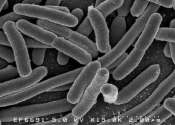
Hemolytic-uremic syndrome (or haemolytic-uraemic syndrome), abbreviated HUS, is a disease characterized by hemolytic anemia (anemia caused by destruction of red blood cells), acute kidney failure (uremia) and a low platelet count (thrombocytopenia). It predominantly, but not exclusively, affects children. Most cases are preceded by an episode of infectious, sometimes bloody, diarrhea caused by E. coli O157:H7, which is acquired as a foodborne illness or from a contaminated water supply. It is a medical emergency and carries a 5–10% mortality; of the remainder, the majority recover without major consequences but a small proportion develop chronic kidney disease and become reliant on renal replacement therapy. HUS was first defined as a syndrome in 1955.
(Medical Xpress)—A team of combined researchers from Columbia Business School and Singapore Management University has found that people who have learned a second language become less proficient at speaking ...
Inside each of us is our own internal timing device. It drives everything from sleep cycles to metabolism, but the inner-workings of this so-called "circadian clock" are complex, and the molecular processes behind it have ...
Behind the common expression "you can't compare apples to oranges" lies a fundamental question of neuroscience: How does the brain recognize that apples and oranges are different? A group of neuroscientists ...
Recent research has shown that cancer cells have a much different – and more complex – metabolism than normal cells. Now, scientists at The University of Texas at Dallas have found that exploiting these differences might ...
Researchers have discovered and mapped the signaling network between two previously unconnected proteins, exposing a link that, if broken, could cut off cancer cell growth at its starting point.
Men who lose sleep during the work week may be able to lower their risk of developing Type 2 diabetes by getting more hours of sleep, according to Los Angeles Biomedical Research Institute (LA BioMed) research findings presented ...
Aspirin is known to lower risk for some cancers, and a new study led by a UC San Francisco scientist points to a possible explanation, with the discovery that aspirin slows the accumulation of DNA mutations in abnormal cells ...
(Medical Xpress)—Calories in, calories out. Any dieter is familiar with the two sides of the equation for weight loss, usually reduced to eating less and exercising more. But what controls the body's balance ...
Dawn triggers basic biological changes in the waking human body. As the sun rises, so does heart rate, blood pressure and body temperature. The liver, the kidneys and many natural processes also begin shifting ...
(Medical Xpress)—When people think about genes and their relationship to cancer, most probably think about a person's hereditary cancer risk, especially after Angelina Jolie's recent news about her inherited ...