Kidney Stones
Nobel prize to Briton, Japanese for stem cell work (Update 4)
Two scientists from different generations won the Nobel Prize in medicine Monday for the groundbreaking discovery that cells in the body can be reprogrammed into completely different kinds, work that reflects ...
Medical research
Oct 08, 2012 |
5 / 5 (3) |
5
How much will I be charged? Study examines patient bills for top 10 visits to the emergency room
It's a basic, reasonable question: How much will this cost me? For patients in the emergency room, the answer all too often is a mystery.
Health
Feb 27, 2013 |
not rated yet |
1
|
Endocrine disorder is most common cause of elevated calcium levels
Unusually high calcium levels in the blood can almost always be traced to primary hyperparathyroidism, an undertreated, underreported condition that affects mainly women and the elderly, according to a new study by UCLA researchers.
Diseases, Conditions, Syndromes
Feb 21, 2013 |
4 / 5 (1) |
0
|
Gut microbes could determine the severity of melamine-induced kidney disease
Microbes present in the gut can affect the severity of kidney disease brought on by melamine poisoning, according to an international study led by Professor Wei Jia at the University of North Carolina in collaboration with ...
Diseases, Conditions, Syndromes
Feb 14, 2013 |
not rated yet |
0
|
Vitamin C supplements linked to kidney stones
New research from Karolinska Institutet in Sweden shows that men who take vitamin C supplements regularly run a higher risk of developing kidney stones. The study, which is published in the scientific periodical JAMA Internal Me ...
Health
Feb 04, 2013 |
3.7 / 5 (3) |
2
|
Could chemical in dishware raise your risk for kidney stones?
(HealthDay)—A chemical called melamine that's found in some dishware might raise your risk for kidney stones, a small new study suggests.
Health
Jan 21, 2013 |
4.6 / 5 (5) |
0
|
'Smart stethoscope' advance in monitoring treatment of kidney stones
A new listening device, developed by scientists from the University of Southampton, is being used to monitor the effectiveness of the treatment of kidney stones - saving patients unnecessary repeat therapy ...
Medical research
Dec 12, 2012 |
5 / 5 (1) |
0
Women twice as likely to suffer infection with kidney stones and other urinary blockages
While more men than women develop kidney stones and other obstructions in the urinary tract, women are more than twice as likely to suffer infections related to the condition, according to a new study led by Henry Ford Hospital ...
Diseases, Conditions, Syndromes
Sep 26, 2012 |
not rated yet |
1
|
Diets high in salt could deplete calcium in the body: research
The scientific community has always wanted to know why people who eat high-salt diets are prone to developing medical problems such as kidney stones and osteoporosis.
Health
Jul 24, 2012 |
5 / 5 (1) |
1
|
Calcium supplements linked to significantly increased heart attack risk
Calcium supplements might increase the risk of having a heart attack, and should be "taken with caution," concludes research published in the online issue of the journal Heart.
Cardiology
May 23, 2012 |
5 / 5 (3) |
2
|
Prevalence of kidney stones doubles in wake of obesity epidemic
The number of Americans suffering from kidney stones between 2007 and 2010 nearly doubled since 1994, according to a study by researchers at the University of California, Los Angeles (UCLA) and RAND.
Diseases, Conditions, Syndromes
May 23, 2012 |
not rated yet |
0
|
Comprehensive report documents impact of urologic diseases on American public
Urologic conditions like urinary tract infections, kidney stones, and prostate cancer are a major economic burden on Americans, resulting in health care costs of close to $40 billion annually, according to a newly released ...
Diseases, Conditions, Syndromes
May 18, 2012 |
not rated yet |
0
|
Kidney stone mystery solved
Kidney stones strike an estimated 1 million Americans each year, and those who have experienced the excruciating pain say it is among the worst known to man (or woman).
Diseases, Conditions, Syndromes
Apr 18, 2012 |
5 / 5 (2) |
0
|
Twinkle, twinkle kidney stone: With a push you could be gone
Just the mention of kidney stones can cause a person to cringe. They are often painful and sometimes difficult to remove, and 10 percent of the population will suffer from them. In space, the risk of developing ...
Other
Jan 31, 2012 |
not rated yet |
0
|
Shock therapy to help erectile dysfunction
(Medical Xpress) -- A new study published in the Journal of Sexual Medicine shows that a little shock to the penis may help treat severe erectile dysfunction that does not respond well to prescription drug treatments.
Other
Nov 01, 2011 |
4.5 / 5 (6) |
6
|
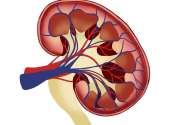
A kidney stone, also known as a renal calculus (from the Latin ren, "kidney" and calculus, "pebble") is a solid concretion or crystal aggregation formed in the kidneys from dietary minerals in the urine. Urinary stones are typically classified by their location in the kidney (nephrolithiasis), ureter (ureterolithiasis), or bladder (cystolithiasis), or by their chemical composition (calcium-containing, struvite, uric acid, or other compounds). Kidney stones are a significant source of morbidity. 80% of those with kidney stones are men. Men most commonly experience their first episode between age 30–40 years, while for women the age at first presentation is somewhat later.
Kidney stones typically leave the body by passage in the urine stream, and many stones are formed and passed without causing symptoms. If stones grow to sufficient size (usually at least 3 millimeters (0.12 in)) they can cause obstruction of the ureter. Ureteral obstruction causes postrenal azotemia and hydronephrosis (distension and dilation of the renal pelvis and calyces), as well as spasm of the ureter. This leads to pain, most commonly felt in the flank (the area between the ribs and hip), lower abdomen and groin (a condition called renal colic). Renal colic can be associated with nausea, vomiting, fever, blood in the urine, pus in the urine, and painful urination. Renal colic typically comes in waves lasting 20 – 60 minutes, beginning in the flank or lower back and often radiating to the groin or genitals. The diagnosis of kidney stones is made on the basis of information obtained from the history, physical examination, urinalysis, and radiographic studies. Ultrasound examination and blood tests may also aid in the diagnosis.
When a stone causes no symptoms, watchful waiting is a valid option. For symptomatic stones, pain control is usually the first measure, using medications such as non-steroidal anti-inflammatory drugs (NSAIDs) or opioids. More severe cases may require surgical intervention. For example, some stones can be shattered into smaller fragments using extracorporeal shock wave lithotripsy (ESWL). Some cases require more invasive forms of surgery. Examples of these are cystoscopic procedures such as laser lithotripsy, or percutaneous techniques such as percutaneous nephrolithotomy. Sometimes, a tube (ureteral stent) may be placed in the ureter to bypass the obstruction and alleviate the symptoms, as well as to prevent ureteral stricture after ureteroscopic stone removal.
This text uses material from Wikipedia and is available under the GNU Free Documentation License.
Latest Spotlight News
Ketamine shows significant therapeutic benefit in people with treatment-resistant depression
Patients with treatment-resistant major depression saw dramatic improvement in their illness after treatment with ketamine, an anesthetic, according to the largest ketamine clinical trial to-date led by researchers from the ...
Consuming coffee linked to lower risk of detrimental liver disease, study finds
Regular consumption of coffee is associated with a reduced risk of primary sclerosing cholangitis (PSC), an autoimmune liver disease, Mayo Clinic research shows. The findings were being presented at the Digestive Disease ...
Temporal processing in the olfactory system
The neural machinery underlying our olfactory sense continues to be an enigma for neuroscience. A recent review in Neuron seeks to expand traditional ideas about how neurons in the olfactory bulb might encode information about ...
New research identifies risks, interventions for children's GI health
An increasing number of U.S. children are experiencing gastrointestinal issues that require interventions to resolve, according to research presented at Digestive Disease Week (DDW).
Melon focus headband turns to Kickstarter for rollout plans
(Medical Xpress)—What if the quality of your work depends more on your focus on the piano keys or canvas or laptop than your musical or painting or computing skills? If target users can be convinced, they ...
How serotonin receptors can shape drug effects, from LSD to migraine medication
New findings by researchers carrying out experiments at the U.S. Department of Energy Office of Science's Advanced Photon Source (APS) help explain why some drugs that interact with two kinds of human serotonin ...
AIDS science at 30: 'Cure' now part of lexicon
Big names in medicine are set to give an upbeat assessment of the war on AIDS on Tuesday, 30 years after French researchers identified the virus that causes the disease.
For combat veterans suffering from post-traumatic stress disorder, 'fear circuitry' in the brain never rests
Chronic trauma can inflict lasting damage to brain regions associated with fear and anxiety. Previous imaging studies of people with post-traumatic stress disorder, or PTSD, have shown that these brain regions can over-or ...
Awakening to new drugs against sleeping sickness
Sleeping sickness kills tens of thousands of people in Africa each year. Current chemotherapies are subject to various limitations, including resistance. Rhodesain, an enzyme of the parasites that cause this ...
Gut microbe battles obesity
(Medical Xpress)—Akkermansia muciniphila is one of the many microbes that live in our intestines. This bacterium, which feeds on the intestine's mucus lining, comprises between 3 and 5 percent of the gut microbes of hea ...