Journal of Neuroscience
Research reveals possible reason for cholesterol-drug side effects
The U.S. Food and Drug Administration and physicians continue to document that some patients experience fuzzy thinking and memory loss while taking statins, a class of global top-selling cholesterol-lowering ...
Medical research
May 10, 2013 |
4.4 / 5 (12) |
13
|
Drugs found to both prevent and treat Alzheimer's disease in mice
Researchers at USC have found that a class of pharmaceuticals can both prevent and treat Alzheimer's Disease in mice.
Alzheimer's disease & dementia
May 21, 2013 |
5 / 5 (7) |
0
|
Reducing caloric intake delays nerve cell loss
Activating an enzyme known to play a role in the anti-aging benefits of calorie restriction delays the loss of brain cells and preserves cognitive function in mice, according to a study published in the May ...
Neuroscience
May 21, 2013 |
5 / 5 (7) |
0
|
Theta brainwaves reflect ability to beat built-in bias
Vertebrates are predisposed to act to gain rewards, and to lay low to avoid punishment. Try to teach chickens to back away from food in order to obtain it, and you'll fail, as researchers did in 1986. But ...
Neuroscience
May 07, 2013 |
4.8 / 5 (6) |
2
|
Serotonin mediates exercise-induced generation of new neurons
Mice that exercise in running wheels exhibit increased neurogenesis in the brain. Crucial to this process is serotonin signaling. These are the findings of a study by researchers at the Max Delbrück Center ...
Neuroscience
May 13, 2013 |
4.8 / 5 (4) |
0
Grammar errors? The brain detects them even when you are unaware
Your brain often works on autopilot when it comes to grammar. That theory has been around for years, but University of Oregon neuroscientists have captured elusive hard evidence that people indeed detect ...
Neuroscience
May 13, 2013 |
4 / 5 (4) |
0
|
Anti-smoking ads with strong arguments, not flashy editing, trigger part of brain involving behavior change
Researchers from the Perelman School of Medicine at the University of Pennsylvania have shown that an area of the brain that initiates behavioral changes had greater activation in smokers who watched anti-smoking ads with ...
Neuroscience
Apr 23, 2013 |
5 / 5 (2) |
0
|
Binge eating curbed by deep brain stimulation in animal model, study shows
(Medical Xpress)—Deep brain stimulation (DBS) in a precise region of the brain appears to reduce caloric intake and prompt weight loss in obese animal models, according to a new study led by researchers at the University ...
Neuroscience
Apr 24, 2013 |
5 / 5 (2) |
0
|
Turning Alzheimer's fuzzy signals into high definition
Scientists at the Virginia Tech Carilion Research Institute have discovered how the predominant class of Alzheimer's pharmaceuticals might sharpen the brain's performance.
Neuroscience
May 07, 2013 |
4.5 / 5 (2) |
0
|
Cellular environment controls formation and activity of neuronal connections
Environment moulds behaviour - and not just that of people in society, but also at the microscopic level. This is because, for their function, neurons are dependent on the cell environment, the so-termed ...
Neuroscience
May 06, 2013 |
4 / 5 (2) |
1
Decoding touch
With their whiskers rats can detect the texture of objects in the same way as humans do using their fingertips. A study, in which some scientists of SISSA have taken part, shows that it is possible to understand ...
Neuroscience
Apr 23, 2013 |
5 / 5 (1) |
0
Brain biology tied to social reorientation during entry to adolescence
A specific region of the brain is in play when children consider their identity and social status as they transition into adolescence—that often-turbulent time of reaching puberty and entering middle school, ...
Neuroscience
Apr 23, 2013 |
5 / 5 (1) |
1
|
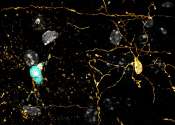
Neon exposes hidden ALS cells
A small group of elusive neurons in the brain's cortex play a big role in ALS (amyotrophic lateral sclerosis), a swift and fatal neurodegenerative disease that paralyzes its victims. But the neurons have always been difficult ...
Neuroscience
Apr 30, 2013 |
5 / 5 (1) |
0
|
tPA: Clot buster and brain protector
(Medical Xpress)—Ever since its introduction in the 1990s, the "clot-busting" drug tPA has been considered a "double-edged sword" for people experiencing a stroke. It can help restore blood flow to the ...
Neuroscience
May 07, 2013 |
5 / 5 (1) |
0
|
Rats take high-speed multisensory snapshots
When animals are on the hunt for food they likely use many senses, and scientists have wondered how the different senses work together. New research from the laboratory of CSHL neuroscientist and Assistant Professor Adam ...
Neuroscience
May 07, 2013 |
5 / 5 (1) |
0
|