Ancestry project reveals students' genetic histories
Daniel Klein '11 always considered himself a European with an Ashkenazi Jewish heritage. But after receiving DNA results from the Cornell Genetic Ancestry Project, Klein got a big surprise.
He learned that his father's ancestors migrated to the Middle East from Africa 45,000 to 50,000 years ago and that the DNA results are consistent with being a descendant of Abraham, who is considered the father of Judaism, Christianity and Islam, and of the Israelites, Ishmaelites, Edomites and the Midianites, according to both the Hebrew Bible and the Quran.
"I was rather astonished," Klein said, speaking via phone to the audience attending the Cornell Genetic Ancestry Reveal event April 14 in Call Auditorium in Kennedy Hall.
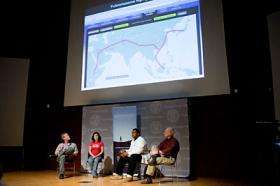
At the event, Spencer Wells, co-director of the project and a Frank H.T. Rhodes Class of '56 Professor at Cornell, summarized the analyses of the lineages and migration stories revealed in the DNA of 200 random Cornell undergraduates tested in February. He showed how they fit into the picture of humanity's migration history.
The project, which focuses exclusively on deep ancestry genetic markers and has no medical or clinical relevance, provides a great opportunity to teach the public about genetics, said Charles Aquadro, director of the Cornell Center for Comparative and Population Genomics, who co-led the project and presentation. With the current advances in life sciences, "genetics is going to become part of the fabric of our lives very quickly," he said.
According to Wells, modern humans apparently first migrated from Africa some 60,000 to 200,000 years ago, and then continued in a number of subsequent migratory waves. Results from students' DNA showed a diverse set of lineages with 57 percent of European descent; 5 percent African; 14 percent East Asian; 8 percent Middle Eastern; 5 percent Native American; and 11 percent South Asian.
The researchers trace ancestry by looking for common single nucleotide polymorphisms, which are mutations to a single base pair, distinct "typos" that occur in individuals when DNA is copied; such mutations occur at a rate of about 100 per genome per generation, and "if you inherit one of these markers from someone in the past, that means you share ancestry with the person who first had that change in their DNA," said Wells.
For example, Mackenzie Malia '13, whose father is European and mother Bolivian, was surprised to learn that her mother stems from one of the founding lineages of Native Americans. Her family thought her mother's ancestors had traveled from Spain, and "as far as she knew, we didn't have any native Bolivian in us at all," said Malia. "I love it, I've always felt very connected to the Bolivian culture."
Emile Chang '12, whose mother is African-American, learned that his mother's ancestors were among the earliest to leave East Africa and migrate into central and western Africa, some 80,000 years ago. "I [had] no idea where my mom's side of the family comes from; she didn't know," Chang said. "As far as we knew we were African-Americans, slaves from Georgia," he added. A few years ago, Chang had independently had his father's genetic lineage tested, which verified what he already knew, that his great-grandfather had moved from China to Jamaica.
During the event, clips from a student-produced documentary from senior lecturer Marilyn Rivchin's Documentary Workshop class were shown, depicting various students' participation in the project, their personal stories and some of the controversies that surround genetic ancestry testing.


