New clue found for Fragile X syndrome-epilepsy link
April 12, 2011 in Medical research
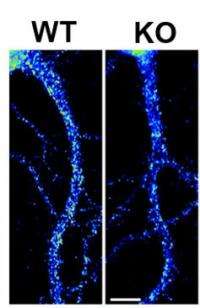
Kv4.2, which regulates electrical signals, is lower in cells from mice missing FMRP ("KO") compared to wild-type ("WT"). Credit: Christina Gross
Individuals with fragile X syndrome, the most common inherited form of intellectual disability, often develop epilepsy, but so far the underlying causes are unknown. Researchers have now discovered a potential mechanism that may contribute to the link between epilepsy and fragile X syndrome.
The protein that is missing in fragile X syndrome, FMRP, controls the production of a protein that regulates electrical signals in brain cells, scientists at Emory University School of Medicine have found. The results were published April 13 in the Journal of Neuroscience.
Individuals with fragile X syndrome tend to have a hyperexcitable nervous system, which can be displayed in several ways: hyperactivity, anxiety, increased sensory sensitivity, and epileptic seizures in 20 percent of all cases. The Emory team's findings suggest that a therapeutic strategy against fragile X syndrome now being tested in clinical trials could also address this aspect of the disease.
"The link between fragile X syndrome and epilepsy was not well understood," says senior author Gary Bassell, PhD, professor of cell biology and neurology at Emory University School of Medicine. "This finding might provide a molecular explanation that could also give some clues on therapeutic strategies."
The co-first authors of the paper are postdoctoral fellow Christina Gross and PhD candidate Xiaodi Yao. They and their colleagues found that in mice missing FMRP a model for humans with fragile X syndrome brain cells produce less of a protein called Kv4.2.
FMRP is known to regulate several genes, and it's possible that changes in others besides Kv4.2 contribute to the development of epilepsy. For many of the genes that FMRP controls, it normally acts as a brake, by interfering with the step in which RNA is made into protein. In FMRP's absence, this leads to runaway protein production at synapses the junctions between brain cells where chemical communication occurs. Kv4.2 appears to be an exception, because in FMRP's absence, less Kv4.2 protein is produced.
The protein Kv4.2 is an ion channel, which allows electrical charge to flow out of neurons when they are stimulated. Kv4.2 is the major ion channel regulating the excitability of neurons in the hippocampus, a region of the brain important for learning and memory. A mutation of the gene encoding Kv4.2 leads to temporal lobe epilepsy in humans.
In laboratory tests, drugs that tamp down glutamate signaling could partially restore levels of the Kv4.2 protein in mice missing the fragile X protein. This suggests that drugs that act against glutamate signaling, which are now in clinical trials, could reduce hyperexcitability in humans with fragile X syndrome.
Another strategy could be to identify drugs that target the Kv4.2 protein's function directly, Bassell says.
Not all individuals with fragile X syndrome develop epilepsy. The loss of FMRP doesn't shut Kv4.2 production off completely, and other genetic variations and environmental factors probably contribute to the development of epilepsy in individuals with fragile X syndrome, Bassell says.
More information: C. Gross, X. Yao, D.L. Pong, A. Jeromin and G.J. Bassell. Fragile X Mental Retardation Protein Regulates Protein Expression and mRNA Translation of the Potassium Channel Kv4.2. J. Neurosci, 31
Provided by
Emory University
-
Scientists identify new drug strategy against fragile X syndrome
Aug 10, 2010 |
not rated yet |
0
-
Fragile X protein loss alters brain pathways responsible for learning and memory
Apr 08, 2010 |
not rated yet |
0
-
Mechanism may explain aspects of brain impairment seen in Fragile X Syndrome
Jun 09, 2008 |
not rated yet |
0
-
Crucial progress in understanding Fragile X mental retardation protein
Jun 06, 2007 |
not rated yet |
0
-
Measuring intellectual disability
Jun 24, 2009 |
not rated yet |
0
-
Motion perception revisited: High Phi effect challenges established motion perception assumptions
Apr 23, 2013 |
3 / 5 (2) |
2
-
Anything you can do I can do better: Neuromolecular foundations of the superiority illusion (Update)
Apr 02, 2013 |
4.5 / 5 (11) |
5
-
The visual system as economist: Neural resource allocation in visual adaptation
Mar 30, 2013 |
5 / 5 (2) |
9
-
Separate lives: Neuronal and organismal lifespans decoupled
Mar 27, 2013 |
4.9 / 5 (8) |
0
-
Sizing things up: The evolutionary neurobiology of scale invariance
Feb 28, 2013 |
4.8 / 5 (10) |
14
-
Pressure-volume curve: Elastic Recoil Pressure don't make sense
May 18, 2013
-
If you became brain-dead, would you want them to pull the plug?
May 17, 2013
-
MRI bill question
May 15, 2013
-
Ratio of Hydrogen of Oxygen in Dessicated Animal Protein
May 13, 2013
-
Alcohol and acetaminophen
May 13, 2013
-
Marie Curie's leukemia
May 13, 2013
- More from Physics Forums - Medical Sciences
More news stories
Computational tool translates complex data into simplified 2-dimensional images
In their quest to learn more about the variability of cells between and within tissues, biomedical scientists have devised tools capable of simultaneously measuring dozens of characteristics of individual ...
Medical research
5 hours ago |
5 / 5 (1) |
0
|
Now we know why old scizophrenia medicine works on antibiotics-resistant bacteria
In 2008 researchers from the University of Southern Denmark showed that the drug thioridazine, which has previously been used to treat schizophrenia, is also a powerful weapon against antibiotic-resistant bacteria such as ...
Medical research
May 17, 2013 |
3.7 / 5 (3) |
0
|
SUMO wrestling cells reveal new protective mechanism target for stroke
Scientists investigating the interaction of a group of proteins in the brain responsible for protecting nerve cells from damage have identified a new target that could increase cell survival.
Medical research
May 17, 2013 |
5 / 5 (1) |
0
How serotonin receptors can shape drug effects, from LSD to migraine medication
New findings by researchers carrying out experiments at the U.S. Department of Energy Office of Science's Advanced Photon Source (APS) help explain why some drugs that interact with two kinds of human serotonin ...
Medical research
May 17, 2013 |
4 / 5 (1) |
0
|
Preventing blood poisoning
Peptide molecules derived from the body's natural immune system can help boost the body's defence against life-threatening blood poisoning, joint University research has uncovered.
Medical research
May 17, 2013 |
4 / 5 (1) |
0
|
Researchers identify a potential new risk for sleep apnea: Asthma
Researchers at the University of Wisconsin have identified a potential new risk factor for obstructive sleep apnea: asthma. Using data from the National Institutes of Health (Heart, Lung, and Blood Institute)-funded Wisconsin ...
Study finds that sleep apnea and Alzheimer's are linked
A new study looking at sleep-disordered breathing (SDB) and markers for Alzheimer's disease (AD) risk in cerebrospinal fluid (CSF) and neuroimaging adds to the growing body of research linking the two.
New theory on genesis of osteoarthritis comes with successful therapy in mice
Scientists at Johns Hopkins have turned their view of osteoarthritis (OA) inside out. Literally. Instead of seeing the painful degenerative disease as a problem primarily of the cartilage that cushions joints, ...
Ginger compounds may be effective in treating asthma symptoms
Gourmands and foodies everywhere have long recognized ginger as a great way to add a little peppery zing to both sweet and savory dishes; now, a study from researchers at Columbia University shows purified components of the ...
'Gap' for HIV vaccine efforts after latest setback
The hunt for an HIV vaccine has gobbled up $8 billion in the past decade, and the failure of the most recent efficacy trial has delivered yet another setback to 26 years of efforts.
Alzheimer's leaves bilingual victims stranded in Canada
The devastating effect of Alzheimer's disease on bilingual people has been thrown into focus in Canada, where the sudden loss of a second language can leave sufferers feeling like strangers in their own country.