New study sheds light on evolution of 2009 pandemic influenza A(H1N1) virus in Japan
April 25, 2011 in Diseases, Conditions, Syndromes
New study sheds light on evolution of 2009 pandemic influenza A(H1N1) virus in Japan

Enlarge

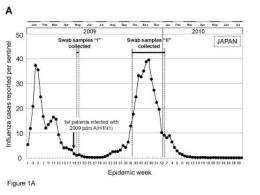
This figure shows the number of influenza cases reported per sentinel provider in Japan and the collection of swab samples from outpatients in Osaka, Tokyo, and Chiba areas. Swab samples were collected during initial and pandemic periods that are indicated by “I” (May 16 to May 20, 2009) and “II” (October 13, 2009, to January 6, 2010), respectively. In Japan, the first patients (three Japanese men) infected with the 2009 pdm A(H1N1) were discovered on May 9 (week 19), 2009. Credit: RIKEN

Analysis of mutations of the 2009 pandemic influenza A(H1N1) virus by researchers at the RIKEN Omics Science Center (OSC) has revealed major genetic differences between the virus in its early phase of infection in Japan and in its peak phase. While yielding valuable clues on the genetic origins of drug resistance, the findings also pave the way toward the development of new diagnostic kits for detecting and preventing the spread of global pandemic diseases.

A unique triple combination of bird, swine and human flu viruses, the A(H1N1) , first detected in April of 2009, quickly spread from Mexico to locations across the world. By April 2010, outbreaks of the disease at both local and global scales had resulted in roughly 18,000 deaths worldwide, causing serious damage both to human health and on the global economy.

In Japan, the first case of the pandemic was reported on May 9, 2009, thereafter spreading to hundreds of people in Osaka and Kobe and eventually leading to more than 200 deaths in the country. Existing research on the spread of the virus in Japan has provided valuable information on local strains during the early phase of infection and on their classification into different groups. How the pandemic evolved to reach its peak phase of contagion, however, is not yet well understood.

To clarify the for this evolution, the OSC group studied 253 samples of the virus collected from the Osaka area during the initial phase (May, 2009) and from the Kansai and Kanto areas during the peak phase (October, 2009 to January 2010) of contagion. Of 20 different mutation groups identified in the peak infection group, analysis revealed that 12 were entirely new to Japan. Rapid mutation of the virus strains was traced to a genome with an extremely high evolutionary rate.
New study sheds light on evolution of 2009 pandemic influenza A(H1N1) virus in Japan
Enlarge

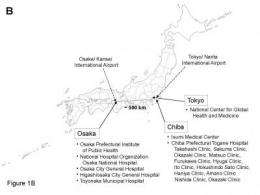
This map shows the hospitals, clinics, and public health institutes that contributed to the collection of swab samples from influenza patients. Credit: RIKEN

Among the variety of mutants discovered, the researchers were able to pinpoint two mutations which clearly differentiate the early phase and peak phase viruses. They also identified mutations in some viruses which confer resistance to Oseltamivir (Tamiflu), one of the most widely-used antiviral drugs. Published in the journal PLoS ONE, the findings together mark a major advance in efforts to understand the of the 2009 A(H1N1) virus, and a key step in OSC-centered efforts to develop on-site detection techniques for controlling infection of deadly pandemics.

Provided by RIKEN search and more info website

not rated yet  

Rank not rated yet
Related Stories
Relevant PhysicsForums posts

More news stories

Woman with flesh-eating disease takes own breaths

(AP) -- The father of a young Georgia woman fighting a flesh-eating bacteria says his daughter is now breathing on her own.

Diseases, Conditions, Syndromes created 52 minutes ago | popularity 5 / 5 (1) | comments 0

Epidemiology of rosacea described in United Kingdom

(HealthDay) -- The incidence of rosacea in the United Kingdom is 1.65 per 1,000 person-years, with alcohol consumption linked to a modest increase in risk and current smoking linked to an decreased risk, according to a study ...

Diseases, Conditions, Syndromes created 3 hours ago | popularity not rated yet | comments 0

High prevalence of bone disease in patients referred for pulmonary rehabilitation

There is a very high prevalence of osteopenia/osteoporosis among male patients with pulmonary disease, according to a new study from researchers in California.

Diseases, Conditions, Syndromes created 15 hours ago | popularity not rated yet | comments 0

First, do no harm: Study finds danger in standard treatment for a serious lung disease

A combination of three drugs used worldwide as the standard of care for a serious lung disease puts patients in danger of death or hospitalization, and should not be used together to treat the disease, called ...

Diseases, Conditions, Syndromes created 20 hours ago | popularity not rated yet | comments 0 | with audio podcast

Study evaluates use of inhaled saline for young children with cystic fibrosis

Margaret Rosenfeld, M.D., M.P.H., of Seattle Children's Hospital, and colleagues conducted a study to examine if hypertonic saline would reduce the rate of pulmonary exacerbations in children younger than 6 years of age with ...

Diseases, Conditions, Syndromes created 21 hours ago | popularity not rated yet | comments 0


Building a drug delivery platform to regenerate heart tissue

(Medical Xpress) -- While current heart-attack treatments mainly try to preserve healthy heart tissue, scientists have been finding compounds that can stimulate growth of new tissue – either by getting heart muscle ...

Internet porn bad for adolescent health

Emerging evidence indicates that internet pornography is strongly associated with risky sexual behavior among adolescents, according a review from UNSW's Kirby Institute.

Probing Question: What is mindfulness?

Ancient wisdom tells us to "stop and smell the roses" and to "live for the moment." Given our busy lives, it's no surprise that this advice is often easier said than done. Many of us multitask not only our ...

Study debunks idea that foreign health aid rife with waste

(Medical Xpress) -- When a 2010 study concluded that about half the money given to international governments for providing health-care services isn’t used as intended, skeptics who argued that foreign aid is largely ...

To prevent skin cancer: Vigilant watch - plus sunscreen

(Medical Xpress) -- Kelly Bathgate’s mother was vigilant. She had three daughters, all fair-haired and fair-skinned, and the family spent several years living in Hawaii and the Philippines. “My mom ...

Research holds out hope for stroke patients

(Medical Xpress) -- People with a curious condition that causes them to apply make-up on only one side of their face, or ignore food on half of their plate, are playing a new role in understanding stroke recovery.