Filters that reduce 'brain clutter' identified
April 14, 2011 in Neuroscience
Filters that reduce 'brain clutter' identified

Enlarge

(PhysOrg.com) -- McGill researchers suggest malfunctions in neurons that filter visual information may be responsible for diseases such as ADHD and schizophrenia.

Until now, it has been assumed that people with diseases like ADHD, , and schizophrenia – all of whom characteristically report symptoms of ”brain clutter” – may suffer from anomalies in the brain’s prefrontal cortex.

Damage to this brain region is often associated with failure to focus on relevant things, loss of inhibitions, impulsivity and various kinds of inappropriate behaviour. So far, exactly what makes the prefrontal cortex so essential to these aspects of behaviour has remained elusive, hampering attempts to develop tools for diagnosing and treating these patients.

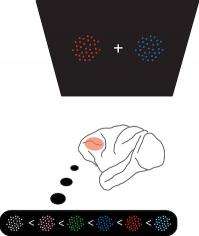
But new research by Julio Martinez-Trujillo, a professor in McGill University’s Department of Physiology and Canada Research Chair in Visual Neuroscience, has brought new hope to these patients. He believes the key to the “brain clutter” and impulsivity shown by individuals with dysfunctional prefrontal cortices lies in a malfunction of a specific type of brain cell. Martinez-Trujilo and his team have identified in the dorsolateral sub-region of the primate prefrontal cortex that selectively filter out important from unimportant . The key to the normal functioning of these “filter neurons” is their ability to, in the presence of visual clutter, selectively and strongly inhibit the unimportant information, giving the rest of the brain access to what is relevant.

“Contrary to common beliefs, the brain has a limited processing capacity. It can only effectively process about one per cent of the visual information that it takes in,” Martinez-Trujilo said. “This means that the neurons responsible for perceiving objects and programming actions must constantly compete with one another to access the important information.

“What we found when we looked at the behaviour of the neurons in the prefrontal cortex, was that an animal’s ability to successfully accomplish a single action in the presence of visual clutter, was dictated by how well these units suppressed distracting information.”

These results could be highly relevant for identifying the causes and improving the diagnosis and treatments of a wide range of mental disorders including ADHD and .

The study will be published in Neuron.

More information: http://www.elsevie … #description

Provided by McGill University search and more info website

4 /5 (1 vote)  

Rank 4 /5 (1 vote)
Relevant PhysicsForums posts
  • A couple of questions about schizophrenia
    createdMay 17, 2012
  • Paralyzed woman uses thoughts to move robotic arm
    createdMay 17, 2012
  • Coffee Decreases Risk of Death
    createdMay 17, 2012
  • Understanding the mechanisms of disease .
    createdMay 14, 2012
  • Short burst of hypersensitivity disorder?
    createdMay 13, 2012
  • Copper aspirinate
    createdMay 12, 2012
  • More from Physics Forums - Medical Sciences

More news stories

Research holds out hope for stroke patients

(Medical Xpress) -- People with a curious condition that causes them to apply make-up on only one side of their face, or ignore food on half of their plate, are playing a new role in understanding stroke recovery.

Neuroscience created 1 hour ago | popularity 5 / 5 (1) | comments 0 | with audio podcast

Songbirds' learning hub in brain offers insight into motor control

To learn its signature melody, the male songbird uses a trial-and-error process to mimic the song of its father, singing the tune over and over again, hundreds of times a day, making subtle changes in the pitch of the notes. ...

Neuroscience created 19 hours ago | popularity 5 / 5 (4) | comments 0 | with audio podcast

Acid in the brain: Team develops new way to look at brain function

University of Iowa neuroscientist John Wemmie, M.D., Ph.D., is interested in the effect of acid in the brain. His studies suggest that increased acidity or low pH, in the brain is linked to panic disorders, ...

Neuroscience created May 18, 2012 | popularity 5 / 5 (6) | comments 0 | with audio podcast

With fat: What's good or bad for the heart, may be the same for the brain

It has been known for years that eating too many foods containing "bad" fats, such as saturated fats or trans fats, isn't healthy for your heart. However, according to new research from Brigham and Women's Hospital (BWH), ...

Neuroscience created May 18, 2012 | popularity 5 / 5 (3) | comments 2 | with audio podcast

Various metabolic risk factors could be linked to diabetes-related pain with major implications for treatment

Around 1 in 50 people in the general population and 1 in 6 of those aged over 40 years experience neuropathy (damage to the nerves of the peripheral nervous system), which can cause numbness, tingling, pain, or weakness. ...

Neuroscience created May 17, 2012 | popularity not rated yet | comments 0


Building a drug delivery platform to regenerate heart tissue

(Medical Xpress) -- While current heart-attack treatments mainly try to preserve healthy heart tissue, scientists have been finding compounds that can stimulate growth of new tissue – either by getting heart muscle ...

Internet porn bad for adolescent health

Emerging evidence indicates that internet pornography is strongly associated with risky sexual behavior among adolescents, according a review from UNSW's Kirby Institute.

Probing Question: What is mindfulness?

Ancient wisdom tells us to "stop and smell the roses" and to "live for the moment." Given our busy lives, it's no surprise that this advice is often easier said than done. Many of us multitask not only our ...

Study debunks idea that foreign health aid rife with waste

(Medical Xpress) -- When a 2010 study concluded that about half the money given to international governments for providing health-care services isn’t used as intended, skeptics who argued that foreign aid is largely ...

Woman with flesh-eating disease takes own breaths

(AP) -- The father of a young Georgia woman fighting a flesh-eating bacteria says his daughter is now breathing on her own.

To prevent skin cancer: Vigilant watch - plus sunscreen

(Medical Xpress) -- Kelly Bathgate’s mother was vigilant. She had three daughters, all fair-haired and fair-skinned, and the family spent several years living in Hawaii and the Philippines. “My mom ...