April 21, 2011 report
Israeli engineers build artificial device capable of detecting cancer in breath
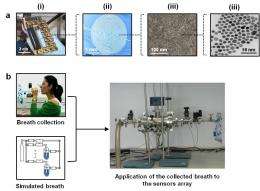
(PhysOrg.com) -- Professor Hossam Haick of the Israel Institute of Technology, at Technion, and his team have built an artificial nose which is capable of detecting molecules in human breath that signal the presence of head and neck cancers in people. In a paper published in the British Journal of Cancer, Haick describes how he and his colleagues set to work on coming up with a device that could mimic the ability that dogs have demonstrated in detecting certain types of cancers.
Such a device is critical for the millions of cancer victims the world over, as head and neck cancers are notoriously difficult to detect until they’ve reached an advanced stage when they are difficult to treat.
Called the Nanoscale Artificial Nose (NA-NOSE), by its developers, the device consists of five gold nanoparticle sensors and some imaginative software that is able to pick out and detect the patterns of molecules that exist in the breath of people with head, neck or even lung cancer. The sensors are so small, just a few of the molecules they’re looking for can change the electrical properties of the materials, signaling a result, which means that they are capable of detecting very low concentrations of such compounds, which is critical due to the fact that human breath is 80% water vapor.
The NA-NOSE was tested using 80 volunteers, most of whom had various head and neck cancers, such as those of the mouth, lips, sinuses, larynx or salivary glands. Head and neck cancers comprise the eighth most common kind worldwide, and in some countries, such as the US, they can account for up to 5% of all cancer cases reported. Also included in the test were some patients with lung cancer. The NA-NOSE was able to discern the difference between patients with head and neck cancers versus those that were cancer free, between those who had head and neck cancers versus those who had lung cancer and between those who had lung cancer compared to those who were cancer free.
While the results of the test were clearly remarkable, the NA-NOSE still needs to go through much more rigorous testing before it will be deemed suitable for use as an actual diagnosis tool in doctor’s offices around the world, but as Haick notes, so far, the results are very promising.
More information: Diagnosis of head-and-neck cancer from exhaled breath, British Journal of Cancer advance online publication 19 April 2011; doi: 10.1038/bjc.2011.128
Abstract
background: Head-and-neck cancer (HNC) is the eighth most common malignancy worldwide. It is often diagnosed late due to a lack of screening methods and overall cure is achieved in <50% of patients. Head-and-neck cancer sufferers often develop a second primary tumour that can affect the entire aero-digestive tract, mostly HNC or lung cancer (LC), making lifelong follow-up necessary.
methods: Alveolar breath was collected from 87 volunteers (HNC and LC patients and healthy controls) in a cross-sectional clinical trial. The discriminative power of a tailor-made Nanoscale Artificial Nose (NA-NOSE) based on an array of five gold nanoparticle sensors was tested, using 62 breath samples. The NA-NOSE signals were analysed to detect statistically significant differences between the sub-populations using (i) principal component analysis with ANOVA and Student's t-test and (ii) support vector machines and cross-validation. The identification of NA-NOSE patterns was supported by comparative analysis of the chemical composition of the breath through gas chromatography in conjunction with mass spectrometry (GC–MS), using 40 breath samples.
results: The NA-NOSE could clearly distinguish between (i) HNC patients and healthy controls, (ii) LC patients and healthy controls, and (iii) HNC and LC patients. The GC–MS analysis showed statistically significant differences in the chemical composition of the breath of the three groups.
conclusion: The presented results could lead to the development of a cost-effective, fast, and reliable method for the differential diagnosis of HNC that is based on breath testing with an NA-NOSE, with a future potential as screening tool.
© 2010 PhysOrg.com


