Liver-cell transplants show promise in reversing genetic disease affecting liver, lungs
April 22, 2011 in Medical research
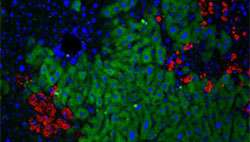
Immunofluorescent staining of liver two months after normal liver cells (green) were transplanted into a transgenic mouse model of alpha-1 antitrypsin disease. Red indicates the mutated protein that has accumulated in the host liver cells, and clusters of blue cells (concentrated in upper left) are the transplanted cells that have markedly proliferated.
Transplanting cells from healthy adult livers may work in treating a genetic liver-lung disorder that affects millions of people worldwide, according to an animal study in the April 18 online edition of the Journal of Clinical Investigation. Jayanta Roy-Chowdhury, M.D., professor of medicine and of genetics at Albert Einstein College of Medicine of Yeshiva University, is the studys senior author.
The genetic disorder, alpha-1 antitrypsin (AAT) deficiency, is the most common potentially lethal hereditary disease among Caucasians, affecting an estimated 100,000 people in the United States and 3.4 million people worldwide. AAT is a protein made by the liver that is essential for lung health. In AAT deficiency, the liver produces a misshapen form of AAT that cannot enter the bloodstream and instead gets stuck inside liver cells, causing two major problems:
AAT accumulates in the liver, leading to fibrosis (development of scar tissue) and liver failure;
Too little AAT reaches the lungs, where its needed to rein in elastase, an enzyme produced by white blood cells. Elastase helps kill bacteria in the lungs, but uncontrolled elastase activity can damage lung tissue and lead to severe emphysema (chronic obstructive pulmonary disease).
In the study, Dr. Roy-Chowdhury and his colleagues tested cell therapy on transgenic mice whose liver cells (hepatocytes) had been engineered to produce mutant human AAT, resulting in liver fibrosis. When the mice were given infusions of hepatocytes harvested from the livers of healthy mice, the transplanted cells proliferated in the host liver, progressively replacing diseased hepatocytes. Most importantly, said Dr. Roy-Chowdhury, the transplanted cells reversed the fibrosis that had developed.
Current therapy for AAT deficiency consists of life-long injections of a genetically engineered version of AAT called Prolastin. This very expensive therapy slows progression of the lung disease in some patients but does not have any beneficial effect on the liver disease, said Dr. Roy-Chowdhury. The only other therapy for AAT deficiency is combined lung-liver transplantation, which is reserved for the sickest patients.
These promising results in animals indicate that it may be worthwhile to investigate the usefulness of hepatocyte transplantation for AAT deficiency as well as a variety of other inherited liver-based disorders, said Dr. Roy-Chowdhury.
The title of the paper is Spontaneous hepatic repopulation in transgenic mice expressing mutant human alpha 1-anti-trypsin by wildtype donor hepatocytes. Other Einstein researchers involved in the study are Jianqiang Ding, M.D., Ph.D., Namita Roy-Chowdhury, Ph.D., Yesim Avsar, M.D., and Chandan Guha, M.B., B.S., Ph.D. The research was supported by the National Institutes of Health, the National Institute of Diabetes, Digestive and Kidney Diseases, the New York Stem Cell Foundation, the Oxalosis and Hyperoxaluria Foundation, and the United States Department of Defense.
Provided by
Albert Einstein College of Medicine
-
AAT protein restores blood glucose in type 1 diabetes model
Oct 14, 2008 |
not rated yet |
0
-
NSAID increases liver damage in mice carrying mutant human gene
Nov 09, 2006 |
not rated yet |
0
-
Beyond liver transplants: Acutely damaged livers may be repaired via transplanted hepatocytes
Feb 01, 2010 |
not rated yet |
0
-
FDA approves trial for type 1 diabetes treatment
Jun 29, 2010 |
not rated yet |
0
-
New chimeric mouse model for human liver diseases, drug testing
Dec 04, 2007 |
not rated yet |
0
-
Motion perception revisited: High Phi effect challenges established motion perception assumptions
Apr 23, 2013 |
3 / 5 (2) |
2
-
Anything you can do I can do better: Neuromolecular foundations of the superiority illusion (Update)
Apr 02, 2013 |
4.5 / 5 (11) |
5
-
The visual system as economist: Neural resource allocation in visual adaptation
Mar 30, 2013 |
5 / 5 (2) |
9
-
Separate lives: Neuronal and organismal lifespans decoupled
Mar 27, 2013 |
4.9 / 5 (8) |
0
-
Sizing things up: The evolutionary neurobiology of scale invariance
Feb 28, 2013 |
4.8 / 5 (10) |
14
-
Pressure-volume curve: Elastic Recoil Pressure don't make sense
May 18, 2013
-
If you became brain-dead, would you want them to pull the plug?
May 17, 2013
-
MRI bill question
May 15, 2013
-
Ratio of Hydrogen of Oxygen in Dessicated Animal Protein
May 13, 2013
-
Alcohol and acetaminophen
May 13, 2013
-
Marie Curie's leukemia
May 13, 2013
- More from Physics Forums - Medical Sciences
More news stories
Computational tool translates complex data into simplified 2-dimensional images
In their quest to learn more about the variability of cells between and within tissues, biomedical scientists have devised tools capable of simultaneously measuring dozens of characteristics of individual ...
Medical research
9 hours ago |
5 / 5 (2) |
0
|
Now we know why old scizophrenia medicine works on antibiotics-resistant bacteria
In 2008 researchers from the University of Southern Denmark showed that the drug thioridazine, which has previously been used to treat schizophrenia, is also a powerful weapon against antibiotic-resistant bacteria such as ...
Medical research
May 17, 2013 |
4 / 5 (4) |
0
|
SUMO wrestling cells reveal new protective mechanism target for stroke
Scientists investigating the interaction of a group of proteins in the brain responsible for protecting nerve cells from damage have identified a new target that could increase cell survival.
Medical research
May 17, 2013 |
5 / 5 (1) |
0
How serotonin receptors can shape drug effects, from LSD to migraine medication
New findings by researchers carrying out experiments at the U.S. Department of Energy Office of Science's Advanced Photon Source (APS) help explain why some drugs that interact with two kinds of human serotonin ...
Medical research
May 17, 2013 |
4 / 5 (1) |
0
|
Preventing blood poisoning
Peptide molecules derived from the body's natural immune system can help boost the body's defence against life-threatening blood poisoning, joint University research has uncovered.
Medical research
May 17, 2013 |
4 / 5 (1) |
0
|
Researchers identify a potential new risk for sleep apnea: Asthma
Researchers at the University of Wisconsin have identified a potential new risk factor for obstructive sleep apnea: asthma. Using data from the National Institutes of Health (Heart, Lung, and Blood Institute)-funded Wisconsin ...
New theory on genesis of osteoarthritis comes with successful therapy in mice
Scientists at Johns Hopkins have turned their view of osteoarthritis (OA) inside out. Literally. Instead of seeing the painful degenerative disease as a problem primarily of the cartilage that cushions joints, ...
Study finds that sleep apnea and Alzheimer's are linked
A new study looking at sleep-disordered breathing (SDB) and markers for Alzheimer's disease (AD) risk in cerebrospinal fluid (CSF) and neuroimaging adds to the growing body of research linking the two.
'Gap' for HIV vaccine efforts after latest setback
The hunt for an HIV vaccine has gobbled up $8 billion in the past decade, and the failure of the most recent efficacy trial has delivered yet another setback to 26 years of efforts.
Ginger compounds may be effective in treating asthma symptoms
Gourmands and foodies everywhere have long recognized ginger as a great way to add a little peppery zing to both sweet and savory dishes; now, a study from researchers at Columbia University shows purified components of the ...
Ketamine shows significant therapeutic benefit in people with treatment-resistant depression
Patients with treatment-resistant major depression saw dramatic improvement in their illness after treatment with ketamine, an anesthetic, according to the largest ketamine clinical trial to-date led by researchers from the ...