Neuroscientists discover new 'chemical pathway' in the brain for stress
April 20, 2011 in Neuroscience
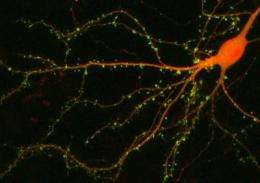
Nerve cells (red) reach out and communicate with each other at junctions called synapses (green) that release chemicals to promote anxiety. Credit: University of Leicester
A team of neuroscientists at the University of Leicester, UK, in collaboration with researchers from Poland and Japan, has announced a breakthrough in the understanding of the 'brain chemistry' that triggers our response to highly stressful and traumatic events.
The discovery of a critical and previously unknown pathway in the brain that is linked to our response to stress is announced today in the journal Nature. The advance offers new hope for targeted treatment, or even prevention, of stress-related psychiatric disorders.
About 20% of the population experience some form of anxiety disorder at least once in their lives. The cumulative lifetime prevalence of all stress-related disorders is difficult to estimate but is probably higher than 30%.
Dr Robert Pawlak, from the University of Leicester who led the UK team, said: "Stress-related disorders affect a large percentage of the population and generate an enormous personal, social and economic impact. It was previously known that certain individuals are more susceptible to detrimental effects of stress than others. Although the majority of us experience traumatic events, only some develop stress-associated psychiatric disorders such as depression, anxiety or posttraumatic stress disorder. The reasons for this were not clear."
Dr Pawlak added that a lack of correspondence between the commonness of exposure to psychological trauma and the development of pathological anxiety prompted the researchers to look for factors that may make some individuals more vulnerable to stress than others.
"We asked: What is the molecular basis of anxiety in response to noxious stimuli? How are stress-related environmental signals translated into proper behavioural responses? To investigate these problems we used a combination of genetic, molecular, electrophysiological and behavioural approaches. This resulted in the discovery of a critical, previously unknown pathway mediating anxiety in response to stress."
The study found that the emotional centre of the brain the amygdala reacts to stress by increasing production of a protein called neuropsin. This triggers a series of chemical events which in turn cause the amygdala to increase its activity. As a consequence, a gene is turned on that determines the stress response at a cellular level.
"We then examined behavioural consequences of the above series of cellular events caused by stress in the amygdala," said Dr Pawlak. "Studies in mice revealed that upon feeling stressed, they stayed away from zones in a maze where they felt unsafe. These were open and illuminated spaces they avoid when they are anxious."
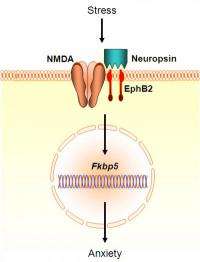
Newly discovered neurochemical cascade promoting stress-induced anxiety. Neuropsin interacts with cell membrane proteins NMDA and EphB2 to induce expression of the Fkbp5 gene. Credit: University of Leicester
"However when the proteins produced by the amygdala were blocked either pharmacologically or by gene therapy the mice did not exhibit the same traits. The behavioural consequences of stress were no longer present. We conclude that the activity of neuropsin and its partners may determine vulnerability to stress."Neuropsin was previously discovered by Professor Sadao Shiosaka, a co-author of the paper. This research, for which the bioinformatics modelling was done by Professor Ryszard Przewlocki and his team, has for the first time characterized its mechanism of action in controlling anxiety in the amygdala.
The study took four years to complete, during which scientists from the Department of Cell Physiology and Pharmacology collaborated with colleagues from the Medical Research Council Toxicology Unit at the University of Leicester, the Department of Molecular Neuropharmacology, Polish Academy of Sciences in Krakow, Poland and Nara Institute of Science and Technology in Japan. The work was supported by the European Union, the Medical Research Council and Medisearch the Leicestershire Medical Research Foundation. The first author, Benjamin Attwood, sponsored by Medisearch, took 3 years off from his medical studies curriculum to complete the necessary experiments. He commented: "It has been a thoroughly absorbing project to uncover how our experiences can change the way we behave. Hopefully this will lead to help for people that have to live with the damaging consequences of traumatic experiences."
Dr Pawlak added: "We are tremendously excited about these findings. We know that all members of the neuropsin pathway are present in the human brain. They may play a similar role in humans and further research will be necessary to examine the potential of intervention therapies for controlling stress-induced behaviours."
"Although research is now needed to translate our findings to the clinical situation, our discovery opens new possibilities for prevention and treatment of stress-related psychiatric disorders such as depression and posttraumatic stress disorder."
More information: Neuropsin cleaves EphB2 in the amygdala to control anxiety, DOI: 10.1038/nature09938
Provided by
University of Leicester
-
Study to investigate how fear and anxiety are formed in the brain
Sep 01, 2006 |
not rated yet |
0
-
Turning off stress
Feb 08, 2011 |
not rated yet |
0
-
Biological link between stress, anxiety and depression identified for the first time (w/ Video)
Apr 11, 2010 |
not rated yet |
0
-
New Study Examines 'Brain's Own Marijuana'
May 16, 2007 |
not rated yet |
0
-
Higher anxiety, depression among women may have basis in cell signals
Jun 15, 2010 |
not rated yet |
0
-
Motion perception revisited: High Phi effect challenges established motion perception assumptions
Apr 23, 2013 |
3 / 5 (2) |
2
-
Anything you can do I can do better: Neuromolecular foundations of the superiority illusion (Update)
Apr 02, 2013 |
4.5 / 5 (11) |
5
-
The visual system as economist: Neural resource allocation in visual adaptation
Mar 30, 2013 |
5 / 5 (2) |
9
-
Separate lives: Neuronal and organismal lifespans decoupled
Mar 27, 2013 |
4.9 / 5 (8) |
0
-
Sizing things up: The evolutionary neurobiology of scale invariance
Feb 28, 2013 |
4.8 / 5 (10) |
14
-
Why is zone 1 in liver more prone to ischemic injury?
May 23, 2013
-
How can there be villous adenoma in colon, if there are no villi there
May 22, 2013
-
How can there be a term called "intestinal metaplasia" of stomach
May 21, 2013
-
Pressure-volume curve: Elastic Recoil Pressure don't make sense
May 18, 2013
-
If you became brain-dead, would you want them to pull the plug?
May 17, 2013
-
MRI bill question
May 15, 2013
- More from Physics Forums - Medical Sciences
More news stories
New neuron formation could increase capacity for new learning, at the expense of old memories
New research presented today shows that formation of new neurons in the hippocampus - a brain region known for its importance in learning and remembering - could cause forgetting of old memories by causing a reorganization ...
Neuroscience
May 24, 2013 |
4 / 5 (4) |
0
Help at hand for people with schizophrenia
How can healthy people who hear voices help schizophrenics? Finding the answer for this is at the centre of research conducted at the University of Bergen.
Neuroscience
May 24, 2013 |
4 / 5 (2) |
2
Japanese research organizations contribute to Human Brain Project
One of the major frontiers of modern science is a comprehensive understanding of the human brain and its functions to guide the development of new technologies in information and communication. In a major announcement for ...
Neuroscience
May 24, 2013 |
3.7 / 5 (3) |
0
Controlling mood through the motions of mitochondria
(Medical Xpress)—Regulating the distribution of power in neurons is done by a system that makes the national electric grid look simple by comparison. Each neuron has several thousand mitochondria confined ...
Neuroscience
May 23, 2013 |
4.9 / 5 (10) |
0
|
Brain uses internal 'average voice' prototype to identify who is talking
(Medical Xpress)—The human brain is able to identify individuals' voices by comparing them against an internal 'average voice' prototype, according to neuroscientists.
Neuroscience
May 23, 2013 |
3.7 / 5 (3) |
3
|
First drug to improve heart failure mortality in over a decade
Coenzyme Q10 decreases all cause mortality by half, according to the results of a multicentre randomised double blind trial presented today at Heart Failure 2013 congress. It is the first drug to improve heart failure mortality ...
Heart failure accelerates male 'menopause'
Heart failure accelerates the aging process and brings on early andropausal syndrome (AS), according to research presented today at the Heart Failure Congress 2013. AS, also referred to as male 'menopause', was four times ...
Seniors more likely to crash when driving with pet, study finds
(HealthDay)—Animals make great companions for senior citizens, but elderly people who always drive with a pet in the car are far more likely to crash than those who never drive with a pet, researchers have ...
New immune system discovered
(Medical Xpress)—A research team, led by Jeremy Barr, a biology post-doctoral fellow, unveils a new immune system that protects humans and animals from infection.
Brain can be trained in compassion, study shows
Until now, little was scientifically known about the human potential to cultivate compassion—the emotional state of caring for people who are suffering in a way that motivates altruistic behavior.
Death highest in heart failure patients admitted in January, on Friday, and overnight
Mortality and length of stay are highest in heart failure patients admitted in January, on Friday, and overnight, according to research presented today at the Heart Failure Congress 2013. The analysis of nearly 1 million ...

Apr 21, 2011
Rank: 3 / 5 (1)
It's good to know that the reaction can be blocked. Question is whether it can be done through reprogramming the thought patterns. Another question is whether the pharmacological interventions are permanent or only temporary - meaning that we'll have expensive drug regimes with lots of side-effects making someone very rich.