'RiceWrist' robot helps spinal-cord injury victim (w/ video)
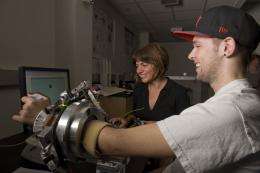
Randy Childers' path to a laboratory at Rice University began on a motocross track in West Beaumont, Texas. The professional rider was injured in an accident while leading the last race of the day at Cowboy Badlands. Childers, then 24, suffered broken ribs, a compound fracture of the wrist and a crushed vertebra in his neck. A helicopter transported him to Houston, where surgeons inserted an artificial vertebra and fused two other vertebrae together during a 12-hour operation.
That was last April. By October, after months of therapy, Childers had recovered enough to walk -- though slowly -- into Professor Marcia O'Malley's basement laboratory on the Rice campus. Here he took part in a single-patient trial of a robotic device that advanced his recovery and gave hope to those who suffer from spinal-cord injuries the world over. O'Malley will present the results of her work with Childers at the IEEE International Conference on Rehabilitation Robotics, part of Rehab Week in Zurich June 27-July 1.
The robotic device Childers used in rudimentary form has since been enhanced and moved from Rice to the University of Texas Physical Medicine and Rehabilitation Motor Recovery Lab at The Institution for Rehabilitation and Research (TIRR) -- Memorial Hermann Hospital, the world-renowned facility where U.S. Rep. Gabrielle Giffords is recovering from a gunshot wound to the head.
The robot, called the RiceWrist, is a fully articulated exoskeleton worn by the patient that mimics the joints of a limb from shoulder to hand.
It will be the centerpiece of human trials to prove its value as a tool that gently retrains the motor neuron pathways of spinal-cord injury victims. "This is not just an exercise machine," said O'Malley, an associate professor of mechanical engineering and materials science and director of Rice's Mechatronics and Haptic Interfaces Laboratory.
The research follows other high-profile studies by O'Malley. One concentrated on stroke rehabilitation using a joystick-driven computer interface. Another was a virtual learning technology for a variety of skills that made unique use of a Wii videogame's motion-capture abilities.
"This device targets more joints in a controlled way," she said of the RiceWrist. "With a joystick, you get a lot of compensatory movement -- you can actually move the joystick with your shoulder or even with your torso as well as the wrist you're trying to measure." Such ancillary movement skews test results, she said.
The RiceWrist combines advanced computation with mechanics far more sophisticated than current rehabilitation devices. The key to patients' success, she said, is that they must be motivated to recover.
O'Malley's lab developed the RiceWrist with a fully customizable "assist-as-needed architecture" that allows patients to complete a task to the best of their ability, but can also take over a task when the patients reach their limit. Currently, the therapist dictates the degree of assistance; future iterations of the control architecture will automate the assistance level provided based on real-time performance assessment.
"We want the patients to move independently," she said. "When they're unable to complete a movement or reach the end of a workspace, the robot kicks in. But the literature supports the idea that there needs to be some intentional movement to really reap the rewards of rehabilitation."
O'Malley said researchers determined in the '90s that the brain has enough plasticity to overcome the effects of a stroke -- a finding that had previously been considered impossible. More recent research suggests spinal cords that have not been completely severed can, in the same way, be rewired through repetitive movement.
"Certainly, if patients are severely impaired and don't have any capability, moving them through a range of motion is going to help. But if you really want to reconnect those motor pathways, they need to have the intent," O'Malley said. "They need the brain thinking about moving and the limbs moving at the same time. That firing in the brain and the spinal cord leads to remapping.
"As in the context of stroke rehabilitation, we're basing our work on the well-accepted theory that 'neurons that fire together wire together.'"
Even while cajoling patients through a regimen, the device captures a rich set of data from every one of its joints. O'Malley said clinicians who were once limited to occasional assessments of a patient's progress -- sometimes months apart -- can now get real-time feedback. "Part of the research is to discover what we need to compute about a patient's movement that tells us about his progress," she said.
Childers got an inside look at the device in development at Rice. "In the time he was here, we tracked his trajectories and his velocity profiles," O'Malley said. "His movements became much smoother and so did his functional tasks."
After two weeks, she said, Childers was doing most of the work. "The device is designed to be what we call 'back-drivable,' so when it's powered down, he can move all the joints but we can still read the data," she said.
"Even though we were only rehabilitating his forearm and wrist, he improved in his functional tasks, things like card-turning and picking up pennies," O'Malley said. "It was very gratifying."
The RiceWrist is currently being evaluated by clinicians at TIRR for its efficacy in treating other patients with spinal-cord injury, and additional controlled studies are planned. The device will require approval by the Food and Drug Administration before it will be available commercially.
The Rice team developing the RiceWrist includes graduate student and lead designer Utku Pehlivan; postdoctoral researcher Zahra Kadivar; undergraduate students Sangyoon Lee, Michelle Pyle and Daniel McBride; and machine shop technician and design adviser Joe Gesenhues.


