Giving tumor vaccines a proper introduction
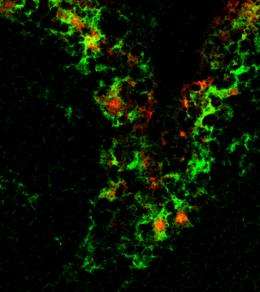
Figure 1: CD169-positive macrophages (green) residing within the lymph sinuses rapidly consume the dead tumor cells (red) that make their way through the lymphatic system following subcutaneous injection. Credit: Reproduced, with permission, from Ref. 1 © 2011 Elsevier
Given how effectively the immune system can eliminate foreign threats such bacteria and viruses, hopes are high for the development of strategies that might turn these same defense mechanisms against cancerous targets. However, attempts to train the immune system to recognize malignancies via the intravenous injection of vaccines that present tumor-derived antigens have fallen short.
According to Kenichi Asano, a researcher with Masato Tanakas group at the RIKEN Center for Allergy and Immunology in Yokohama, this is the result of tolerance mechanisms that protect against autoimmune disease. Billions of cells die every day, and cell corpses must be removed swiftly from our body in order not to induce detrimental effects, he says. In this scenario, macrophage cells in the spleen clean house by devouring such debris in a process known as phagocytosis, thereby preventing dead cells from triggering an inflammatory response.
Tumor cells delivered into the lymphatic system via subcutaneous injection, however, can successfully elicit a strong immune response, and new research from Asano and colleagues explains why this is the case1. In order to rouse an effective reaction, phagocytic cells must present recognizable chunks of those dead cells to tumor-killing cytotoxic T lymphocytes (CTLs). The researchers identified a very specific subset of macrophages within the lymph nodes that perform this task.
Intriguingly, these cells, which are distinguishable by their expression of the cell-surface protein CD169, are non-migratory and reside stably within the sinuses of the lymph node, awaiting their prey like spiders in a web. Dead cancer cells delivered to these sinuses via the lymphatic system are rapidly digested by the macrophages (Fig. 1), which in turn cross-present the resulting antigens to CTLs. By selectively killing off these macrophages with diphtheria toxin, the researchers were able to essentially disable the immune response. Without CD169 macrophages, tumor-directed T cells were no longer activatedthat means these cells dominate anti-tumor immunity after tumor cell death, says Asano.
These findings help explain why the dead cells that slough off of tumors into the lymphatic system during radiation or chemotherapy are sometimes sufficient to provoke an immune response, and could provide the foundation for far more effective cancer immunotherapy strategies. I believe it is very promising to mount anti-tumor immunity in patients with solid tumors by delivering tumor antigens specifically to CD169 macrophages, says Asano. It's my dream to invent artificial materials that possess the characteristics of dead cells and are safe for administration to patients.
More information: Asano, K., et al. CD169-positive macrophages dominate antitumor immunity by crosspresenting dead cell-associated antigens. Immunity 34, 8595 (2011)
Provided by
RIKEN
-
Tumor wizardry wards off attacks from the immune system
Jul 14, 2006 |
not rated yet |
0
-
Study: Tumors inhibit immune system
May 29, 2006 |
not rated yet |
0
-
Gene that suppresses cell's immune activation identified
Mar 24, 2011 |
not rated yet |
0
-
Call of the riled: Stress signal in cancer cells triggers similar response in other cells, aiding tumor growth
Apr 04, 2011 |
not rated yet |
0
-
New strategies work to put cancer on the firing line
Jan 03, 2008 |
not rated yet |
0
-
Motion perception revisited: High Phi effect challenges established motion perception assumptions
Apr 23, 2013 |
3 / 5 (2) |
2
-
Anything you can do I can do better: Neuromolecular foundations of the superiority illusion (Update)
Apr 02, 2013 |
4.5 / 5 (11) |
5
-
The visual system as economist: Neural resource allocation in visual adaptation
Mar 30, 2013 |
5 / 5 (2) |
9
-
Separate lives: Neuronal and organismal lifespans decoupled
Mar 27, 2013 |
4.9 / 5 (8) |
0
-
Sizing things up: The evolutionary neurobiology of scale invariance
Feb 28, 2013 |
4.8 / 5 (10) |
14
-
Why is zone 1 in liver more prone to ischemic injury?
15 hours ago
-
How can there be villous adenoma in colon, if there are no villi there
May 22, 2013
-
How can there be a term called "intestinal metaplasia" of stomach
May 21, 2013
-
Pressure-volume curve: Elastic Recoil Pressure don't make sense
May 18, 2013
-
If you became brain-dead, would you want them to pull the plug?
May 17, 2013
-
MRI bill question
May 15, 2013
- More from Physics Forums - Medical Sciences
More news stories
Research identifies a way to make cancer cells more responsive to chemotherapy
Breast cancer characterized as "triple negative" carries a poor prognosis, with limited treatment options. In some cases, chemotherapy doesn't kill the cancer cells the way it's supposed to. New research from Western University ...
Cancer
1 hour ago |
5 / 5 (2) |
0
Mayo Clinic genomic analysis lends insight to prostate cancer
Mayo Clinic researchers have used next generation genomic analysis to determine that some of the more aggressive prostate cancer tumors have similar genetic origins, which may help in predicting cancer progression. The findings ...
Cancer
1 hour ago |
not rated yet |
0
When oxygen is short, EGFR prevents maturation of cancer-fighting miRNAs
Even while being dragged to its destruction inside a cell, a cancer-promoting growth factor receptor fires away, sending signals that thwart the development of tumor-suppressing microRNAs (miRNAs) before it's dissolved, researchers ...
Cancer
2 hours ago |
not rated yet |
0
|
Improved chemo regimen for childhood leukemia may offer high survival, no added heart toxicity
Treating pediatric leukemia patients with a liposomal formulation of anthracycline-based chemotherapy at a more intense-than-standard dose during initial treatment may result in high survival rates without causing any added ...
Cancer
6 hours ago |
not rated yet |
0
Protein preps cells to survive stress of cancer growth and chemotherapy
Scientists have uncovered a survival mechanism that occurs in breast cells that have just turned premalignant-cells on the cusp between normalcy and cancers-which may lead to new methods of stopping tumors.
Cancer
7 hours ago |
not rated yet |
0
|
Statin use is linked to increased risk of developing diabetes, warn researchers
Treatment with high potency statins (especially atorvastatin and simvastatin) may increase the risk of developing diabetes, suggests a paper published today in BMJ.
Consumers largely underestimating calorie content of fast food
People eating at fast food restaurants largely underestimate the calorie content of meals, especially large ones, according to a paper published today in BMJ.
Dual-source cardiac CT IDs CAD in hard-to-image patients
(HealthDay)—In patients who have previously been considered difficult to image, dual-source cardiac (DSC) computed tomography (CT) can identify clinically significant coronary artery disease, according ...
Controlling mood through the motions of mitochondria
(Medical Xpress)—Regulating the distribution of power in neurons is done by a system that makes the national electric grid look simple by comparison. Each neuron has several thousand mitochondria confined ...
WHO: Scientific red tape mars efforts vs. virus
International efforts to combat a new pneumonia-like virus that has now killed 22 people are being slowed by unclear rules and competition for the potentially profitable rights to disease samples, the head ...
Future doctors unaware of their obesity bias
Two out of five medical students have an unconscious bias against obese people, according to a new study by researchers at Wake Forest Baptist Medical Center. The study is published online ahead of print in the Journal of ...