Researchers complete whole-exome sequencing of skin cancer
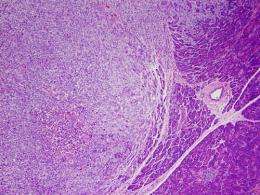
A team led by researchers at the National Institutes of Health is the first to systematically survey the landscape of the melanoma genome, the DNA code of the deadliest form of skin cancer. The researchers have made surprising new discoveries using whole-exome sequencing, an approach that decodes the 1-2 percent of the genome that contains protein-coding genes. The study appears in the April 15, 2011, early online issue of Nature Genetics.
Melanoma is the most serious form of skin cancer and its incidence is increasing faster than any other cancer. A major cause is thought to be overexposure to the sun, particularly ultraviolet radiation, which can damage DNA and lead to cancer-causing genetic changes within skin cells.
"It is now clear that genomic analysis will have a major impact on our ability to diagnose and treat cancer," said National Human Genome Research Institute Director Eric D. Green, M.D., Ph.D. "This study represents a collaboration of basic science, clinical research, genome sequencing and data analysis at its best."
The researchers conducted a comprehensive genome analysis and explored the melanoma genome's functional components, especially gene alterations, or mutations. They studied advanced disease — the metastatic stage — when cells have the highest accumulation of gene mutations.
"Melanoma is one of the most challenging solid cancers to work with because it has such a high rate of mutation," said senior author Yardena Samuels, Ph.D., investigator in the Cancer Genetics Branch of the NHGRI's Division of Intramural Research. "Whole-exome sequencing will help us identify the most important changes."
NHGRI researchers and a colleague from the Johns Hopkins Kimmel Cancer Center in Baltimore designed and analyzed the new study, while National Cancer Institute (NCI) researchers and colleagues from the University of Texas MD Anderson Cancer Center in Houston and the University of Colorado Denver School of Medicine collected melanoma tumor samples.
"This study is an example of the vital utility of preserving high-quality tumor samples that include clinical information," said study coauthor Steven Rosenberg, M.D., Ph.D., chief of surgery at the NCI. "Furthermore, it is a powerful example of the importance of bridging basic science and clinical medicine."
As a first step in the study, NHGRI researchers obtained 14 metastatic melanoma tumor samples and matching blood samples from a collection maintained at NCI. Whole-exome sequencing of the 28 samples was performed at the NIH Intramural Sequencing Center.
The exome sequence data required a number of analytic steps to separate functionally important mutations from a large number of total results. The first of these analyses differentiated the mutations that occur sporadically in the tumor, called somatic mutations, from inherited mutations. It entailed a comparison between the mutations observed in the blood samples and those from the tumor cells of the same individual. Researchers eliminated from further analysis any tumor mutations that also occurred in normal tissue.
Within that large set of somatic mutations, the sequence contained thousands of mutations that occur but are presumed to have no role in tumor development, called passenger mutations, since they likely are just along for the ride. Researchers derived a rate for occurrence of passenger mutations versus driver mutations, known as the background mutation rate. This statistic differs for each cancer type. In their study, the authors provide the most comprehensive data to date about this aspect of melanoma mutation analysis.
The researchers excluded from further analysis any inherited genetic alterations already annotated in such datasets as the Single Nucleotide Polymorphism database, or dbSNP, and the 1,000 Genomes Project. Additionally, bioinformatic analysis looking at genes conserved across species suggested which mutations were worth additional functional investigation. "Most of the mutations are passenger mutations, which means they don't have a functional role in melanoma," Dr. Samuels said.
Once the passenger mutations were ruled out, the team could focus on those most likely to cause melanoma. The researchers identified 68 genetic changes that appeared to be somatically mutated at elevated frequency. They then identified 16 genes deemed to be melanoma driver mutations, factoring for both the background mutation rate and the numbers of respective mutations found in the tumors in this study. Of the 16, only the oncogene BRAF had ever been implicated in melanoma.
The ionotropic glutamate receptor gene, GRIN2A, was the most highly mutated of the genes newly implicated in melanoma. It contained mutations in 33 percent of an NCI sample set and in 25 percent of a larger set of samples that combined those maintained by NCI and two other collections. The researchers suggest that this gene is important because of its role in the signaling pathway. "There are some indications that suggest that this is a tumor-suppressor gene," Dr. Samuels said, "but we still need to prove that using functional studies." Tumor-suppressor genes typically act like a brake, preventing uncontrolled cell growth characteristic of cancer.
Next, the researchers looked for recurrent, or hot-spot, mutations that occurred in multiple patient tumors. The BRAF gene with a hotspot mutation previously implicated in melanoma led a list of nine additional genes with mutations that occurred in more than one tumor. Mutations in seven of the nine genes caused protein-coding changes. These seven hot-spot mutations led the researchers to look precisely for these mutations in 153 additional melanoma tumors.
Mutations in one particular gene, known as TRRAP, emerged as remarkable for occurring at the exact position in six separate individuals with melanoma. TRRAP harbors a recurrent mutation clustered in one position along the string of DNA code in about 4 percent of cases.
"These data suggest that TRRAP is a driver and probably an oncogene," said Dr. Samuels. Oncogenes are cancer-causing genes that enable the cell to survive despite stressful conditions, rather than die off normally. "This was one of the most important discoveries in the study since we never expected to identify novel hot-spot mutations," she said.
TRRAP is found in many species, suggesting its importance in normal function and that mutations in this gene would detrimentally affect protein function. To confirm a possible cell-survival function for TRRAP, the researchers disrupted the gene in mutant cell lines. The cells had an increase in cell death over time. Cancer cells normally fail to undergo cell death, which allows them to become immortal and cause disease. The test showed that TRRAP is a cancer-causing oncogene, because the mutant cell is clearly dependent on it. Dr. Samuels cautioned that while this discovery is exciting, it remains a basic science finding and does not necessarily suggest a therapy.
Lastly, the researchers used cell signaling pathway analysis, identifying glutamate signaling as a pathway involved in melanoma. "We are starting to explore what mutations do to the glutamate pathway," said Dr. Samuels, noting that ongoing research will entail complex biochemistry. She added that NIH colleagues published a study in the April 21, 2003, issue of Nature Genetics almost exactly eight years ago, implicating the glutamate signaling pathway in melanoma.
"This work demonstrates that our intramural researchers are on the front line of genomics and bioinformatics, providing high quality data and analysis to address important questions about health and disease," said NHGRI Scientific Director Daniel Kastner, M.D., Ph.D.
As part of their sequencing analysis, NISC investigators developed a statistical tool named Most Probable Genotype. The tool calculates reliability of data produced in the sequencing process. "This paper is not only about biology," said Dr. Samuels. "We are providing an effective tool for the other researchers who conduct exome sequencing so they too are able to validate which DNA alternations are reliably detected."


