Brain cell networks recreated with new view of activity behind memory formation
May 25, 2011 in Medical research
Pitt team recreates brain cell networks with new view of activity behind memory formation

Enlarge

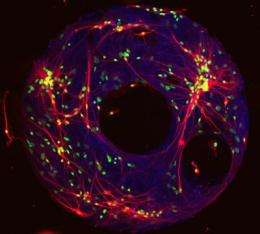
A fluorescent image of the neural network model developed at Pitt reveals the interconnection (red) between individual brain cells (blue). Adhesive proteins (green) allow the network to be constructed on silicon discs for experimentation. Credit: U. Pittsburgh

University of Pittsburgh researchers have reproduced the brain's complex electrical impulses onto models made of living brain cells that provide an unprecedented view of the neuron activity behind memory formation.

The team fashioned ring-shaped networks of that were not only capable of transmitting an electrical impulse, but also remained in a state of persistent associated with , said lead researcher Henry Zeringue [zuh-rang], a bioengineering professor in Pitt's Swanson School of Engineering. Magnetic resonance images have suggested that working memories are formed when the , or outer layer of the brain, launches into extended after the initial stimulus, Zeringue explained. But the brain's complex structure and the diminutive scale of mean that observing this activity in real time can be nearly impossible, he added.

The Pitt team, however, was able to generate and prolong this excited state in groups of 40 to 60 brain cells harvested from the of rats—the part of the brain associated with memory formation. In addition, the researchers produced the networks on glass slides that allowed them to observe the cells' interplay. The work was conducted in Zeringue's lab by Pitt bioengineering doctoral student Ashwin Vishwanathan, who most recently reported the work in the Royal Society of Chemistry (UK) journal, Lab on a Chip. Vishwanathan coauthored the paper with Zeringue and Guo-Qiang Bi, a neurobiology professor in Pitt's School of Medicine. The work was conducted through the Center for the Neural Basis of Cognition, which is jointly operated by Pitt and Carnegie Mellon University.

To produce the models, the Pitt team stamped adhesive proteins onto silicon discs. Once the proteins were cultured and dried, cultured hippocampus cells from embryonic rats were fused to the proteins and then given time to grow and connect to form a natural network. The researchers disabled the cells' inhibitory response and then excited the neurons with an electrical pulse.

Zeringue and his colleagues were able to sustain the resulting burst of network activity for up to what in neuronal time is 12 long seconds. Compared to the natural duration of .25 seconds at most, the model's 12 seconds permitted an extensive observation of how the neurons transmitted and held the electrical charge, Zeringue said.

Unraveling the mechanics of this network communication is key to understanding the cellular and molecular basis of memory creation, Zeringue said. The format developed at Pitt makes neural networks more accessible for experimentation. For instance, the team found that when activity in one neuron is suppressed, the others respond with greater excitement.

"We can look at neurons as individuals, but that doesn't reveal a lot," Zeringue said. "Neurons are more connected and interdependent than any other cell in the body. Just because we know how one neuron reacts to something, a whole network can react not only differently, but sometimes in the complete opposite manner predicted."

Zeringue will next work to understand the underlying factors that govern network communication and stimulation, such as the various electrical pathways between cells and the genetic makeup of individual cells.

Provided by University of Pittsburgh

5 /5 (1 vote)  

Filter


Move the slider to adjust rank threshold, so that you can hide some of the comments.


Display comments: newest first

Jaeherys
May 25, 2011

Rank: 5 / 5 (2)
Wow that is cool! I really hope I am around when we finally understand how the brain works. It feels as if we are getting to a point where it will start to snowball even more. As methods for watching brain activity become closer and closer to real-time, our understanding of the mechanics behind the network will significantly increase.
Rank 5 /5 (1 vote)
Related Stories
Relevant PhysicsForums posts
  • Poor nutrition leading to overeating?
    created4 hours ago
  • Math and dyslexia?
    createdMay 21, 2012
  • portable metabolism meter?
    createdMay 21, 2012
  • Rare medical conditions on 20/20 tonight
    createdMay 18, 2012
  • "Good" Cholesterol in Doubt
    createdMay 17, 2012
  • A couple of questions about schizophrenia
    createdMay 17, 2012
  • More from Physics Forums - Medical Sciences

More news stories

Array of light for early disease detection?

A special feature in this week's issue of the journal Science highlights protein array technology, touching on research conducted by Joshua LaBaer, director of the Biodesign Institute's Virginia G. Piper ...

Medical research created 11 hours ago | popularity not rated yet | comments 0 | with audio podcast

Researchers spearhead groundbreaking research into treatment of brain swelling

Researchers at Trinity College Dublin have reported the results of groundbreaking research into the prevention of cerebral oedema or swelling of the brain, a major cause of death in people who have sustained a traumatic injury ...

Medical research created 15 hours ago | popularity not rated yet | comments 0 | with audio podcast

FDA clears test for mastocytosis diagnosis

The Food and Drug Administration has approved a new test to help physicians diagnose a group of rare cell disorders. The test, or assay, was developed by an expert at Virginia Commonwealth University in the field of mast ...

Medical research created 16 hours ago | popularity not rated yet | comments 0

Novel biomarkers reveal evidence of radiation exposure

Researchers at the Medical College of Wisconsin have identified novel biomarkers that could be used to confirm exposure to damaging radiation in large groups of people potentially exposed to unknown and variable doses for ...

Medical research created 16 hours ago | popularity not rated yet | comments 0

Stem cell research paves way for progress on dealing with Fragile X retardation

Researchers at the Hebrew University of Jerusalem have achieved, for the first time, the generation of neuronal cells from stem cells of Fragile X patients. The discovery paves the way for research that will examine restoration ...

Medical research created 18 hours ago | popularity not rated yet | comments 0


Scientists turn patients' skin cells into heart muscle cells to repair their damaged hearts

For the first time scientists have succeeded in taking skin cells from heart failure patients and reprogramming them to transform into healthy, new heart muscle cells that are capable of integrating with existing heart tissue.

Scientists start explaining Fat Bastard's vicious cycle

Fat Bastard's revelation "I eat because I'm depressed and I'm depressed because I eat" in the Austin Powers film series may be explained by sophisticated neuroscience research being undertaken by scientists affiliated with ...

Socioeconomics may affect toddlers' exposure to flame retardants

A Duke University-led study of North Carolina toddlers suggests that exposure to potentially toxic flame-retardant chemicals may be higher in nonwhite toddlers than in white toddlers.

Pathological aging brains contain the same amyloid plaques as Alzheimer's disease

Pathological aging (PA) is used to describe the brains of people which have Alzheimer's disease (AD)-like pathology but where the person showed no signs of cognitive impairment whilst they were alive. New research, published ...

Breast MRI helps predict chemotherapy's effectiveness

Magnetic resonance imaging (MRI) provides an indication of a breast tumor's response to pre-surgical chemotherapy significantly earlier than possible through clinical examination, according to a new study published online ...

Kids suffer long-term from parents' smoking: study

Children exposed to their parents' cigarette smoke are at greater risk of suffering serious cardiovascular health problems later in life, a study showed Wednesday.