Cells talk more in areas Alzheimer's hits first, boosting plaque component
May 2, 2011 By Michael C. Purdy in Neuroscience
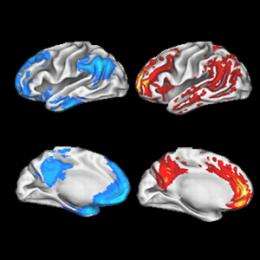
Scientists at Washington University School of Medicine in St. Louis have shown that brain cells in the default mode network, highlighted in blue on the left, communicate with each other more often than other brain areas. This may help explain why these same areas are often hit first by Alzheimer's plaques, which are highlighted in red in the brain images on the right.
(Medical Xpress) -- Higher levels of cell chatter boost amyloid beta in the brain regions that Alzheimers hits first, researchers at Washington University School of Medicine in St. Louis report. Amyloid beta is the main ingredient of the plaque lesions that are a hallmark of Alzheimers.
These brain regions belong to a network that is more active when the brain is at rest. The discovery that cells in these regions communicate with each other more often than cells in other parts of the brain may help explain why these areas are frequently among the first to develop plaques, according to the researchers.
Working with mice genetically engineered to develop Alzheimers type-brain changes, scientists reduced the size and number of plaques by decreasing brain cell activity in certain regions.
The results, appearing May 1 in Nature Neuroscience, are the latest to hint at a resolution to lines of evidence that have suggested busier brain cells can both contribute to and prevent Alzheimers. According to a new theory, which brain cells are kept busy may make all the difference.
Engaging the brain in tasks like reading, socializing or studying may be helpful because they reduce activity in susceptible regions and increase activity in regions that seem to be less vulnerable to Alzheimers plaque deposition, says David M. Holtzman, MD, the Andrew B. and Gretchen P. Jones Professor and head of the Department of Neurology. I suspect that sleep deprivation and increased stress, which may affect Alzheimers risk, may also increase activity levels in these vulnerable regions.
The susceptible regions of the brain highlighted in the new study belong to the default mode network, a group of brain regions that become more active when the brain is not engaged in a cognitively demanding task. Co-author Marcus Raichle, MD, professor of neurology, of radiology and of neurobiology, was among the first to describe the default mode network.
In a paper published in 2005, Washington University researchers showed that regions in the default mode network are often among the first to develop Alzheimers plaques. To understand why, Adam Bero, a graduate student in Holtzmans lab, analyzed the brain chemistry of mice. He found that the mouse brain regions analogous to those in the human default mode network had similarly high levels of early amyloid plaque deposits when compared to other areas.
Next, Bero showed in younger mice that the high-plaque regions had increased amyloid beta levels. In a third experiment, he found that the greater amyloid beta levels were caused by increased nerve cell communication in the affected regions.
To further prove the relationship between plaque formation and cell communication, scientists trimmed the whiskers on one side of a group of mice and kept them short for one month.
Because mice are nocturnal and their eyesight is poor, whiskers are an important way for them to sense where they are in their environment, Holtzman explains. By cutting the whiskers back on one side, we reduced neuronal activity in the region of the brain that senses whisker movement.
Loss of this input resulted in smaller and less numerous plaques on the side of the brain connected to the pruned whiskers. In a separate experiment, when researchers regularly stimulated whiskers with a cotton swab, amyloid beta levels increased.
According to Holtzman, the results demonstrate the direct connection between amyloid plaque formation and growth and changes in brain cell activity levels in various parts of the brain. He plans further investigations of the mechanisms that regulate default brain activity, their connections to phenomena such as sleep, and their potential effects on Alzheimers disease.
More information: Bero AW, Yan P, Roh JH, Cirrito JR, Stewart FR, Raichle ME, Lee J-M, Holtzman DM. Neuronal activity regulates the regional vulnerability to amyloid-beta deposition. Nature Neuroscience, May 1, 2011.
Provided by
Washington University School of Medicine in St. Louis
-
Brain changes in people at genetic risk for Alzheimer's revealed in MRI scans
Dec 15, 2010 |
not rated yet |
0
-
Putting top brains to the test with Alzheimer's protein
Jan 31, 2011 |
not rated yet |
0
-
Low levels of brain protein may lead to Alzheimer's
Feb 15, 2011 |
not rated yet |
0
-
Development of a safer vaccine for Alzheimer’s disease
Nov 17, 2010 |
not rated yet |
0
-
Imaging study reveals rapid formation of Alzheimer's-associated plaques
Feb 06, 2008 |
not rated yet |
0
-
Motion perception revisited: High Phi effect challenges established motion perception assumptions
Apr 23, 2013 |
3 / 5 (2) |
2
-
Anything you can do I can do better: Neuromolecular foundations of the superiority illusion (Update)
Apr 02, 2013 |
4.5 / 5 (11) |
5
-
The visual system as economist: Neural resource allocation in visual adaptation
Mar 30, 2013 |
5 / 5 (2) |
9
-
Separate lives: Neuronal and organismal lifespans decoupled
Mar 27, 2013 |
4.9 / 5 (8) |
0
-
Sizing things up: The evolutionary neurobiology of scale invariance
Feb 28, 2013 |
4.8 / 5 (10) |
14
-
Why is zone 1 in liver more prone to ischemic injury?
May 23, 2013
-
How can there be villous adenoma in colon, if there are no villi there
May 22, 2013
-
How can there be a term called "intestinal metaplasia" of stomach
May 21, 2013
-
Pressure-volume curve: Elastic Recoil Pressure don't make sense
May 18, 2013
-
If you became brain-dead, would you want them to pull the plug?
May 17, 2013
-
MRI bill question
May 15, 2013
- More from Physics Forums - Medical Sciences
More news stories
New neuron formation could increase capacity for new learning, at the expense of old memories
New research presented today shows that formation of new neurons in the hippocampus - a brain region known for its importance in learning and remembering - could cause forgetting of old memories by causing a reorganization ...
Neuroscience
12 hours ago |
3.7 / 5 (3) |
0
Help at hand for people with schizophrenia
How can healthy people who hear voices help schizophrenics? Finding the answer for this is at the centre of research conducted at the University of Bergen.
Neuroscience
12 hours ago |
4 / 5 (2) |
2
Japanese research organizations contribute to Human Brain Project
One of the major frontiers of modern science is a comprehensive understanding of the human brain and its functions to guide the development of new technologies in information and communication. In a major announcement for ...
Neuroscience
13 hours ago |
3 / 5 (2) |
0
Controlling mood through the motions of mitochondria
(Medical Xpress)—Regulating the distribution of power in neurons is done by a system that makes the national electric grid look simple by comparison. Each neuron has several thousand mitochondria confined ...
Neuroscience
May 23, 2013 |
4.9 / 5 (9) |
0
|
Brain uses internal 'average voice' prototype to identify who is talking
(Medical Xpress)—The human brain is able to identify individuals' voices by comparing them against an internal 'average voice' prototype, according to neuroscientists.
Neuroscience
May 23, 2013 |
3 / 5 (2) |
3
|
Engineered cytomegalovirus protects monkeys from HIV equivalent
(Medical Xpress)—A new study by researchers in the US has shown that an ancient virus can be modified to help in the fight against the simian immunodeficiency virus SIV, which is the equivalent in monkeys ...
Researchers identify first drug targets in childhood genetic tumor disorder
Two mutations central to the development of infantile myofibromatosis (IM)—a disorder characterized by multiple tumors involving the skin, bone, and soft tissue—may provide new therapeutic targets, according to researchers ...
Hormone levels may provide key to understanding psychological disorders in women
Women at a particular stage in their monthly menstrual cycle may be more vulnerable to some of the psychological side-effects associated with stressful experiences, according to a study from UCL.
Going live: Immune cell activation in multiple sclerosis
Biological processes are generally based on events at the molecular and cellular level. To understand what happens in the course of infections, diseases or normal bodily functions, scientists would need to ...
Driving and hands-free talking lead to spike in errors, study shows
Talking on a hands-free device while behind the wheel can lead to a sharp increase in errors that could imperil other drivers on the road, according to new research from the University of Alberta.
Depression raises diabetics' risk of severe low blood sugar episodes
(Medical Xpress)—Patients with diabetes who are depressed are much more likely to develop episodes of dangerously low blood sugars, or hypoglycemia, than are those who are not depressed, a new study has ...