New test may help distinguish between vegetative and minimally conscious state
May 13, 2011
by Deborah Braconnier
in Neuroscience
(PhysOrg.com) -- In a new study published in Science, researchers from the University of Liege in Belgium, led by Dr. Melanie Boly, share the discovery of a new test that could aid physicians in differentiating between vegetative and minimally conscious states in patients with brain damage.
It is currently difficult to differentiate between a vegetative state where patients lack cognitive function yet display wakefulness and those in a minimally conscious state. Recent awareness to this issue arose in the Terri Schiavo case in Florida. Shiavo had been in a vegetative state for 15 years and on life support before a judge issued a court order to take her off life support. The question of brain function and the possibility of recovery was an issue in the court battle and this test could aid physicians in making that determination.
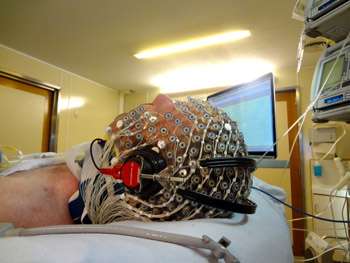
Using an electroencephalogram to record brain activity, Boly and her team looked at brain activity in 43 patients with 22 healthy individuals and 21 brain-damaged patients. The patients ranged in age from 16-83. Of the brain-damaged patients, 13 were in a minimally conscious state and 8 were in a vegetative state.
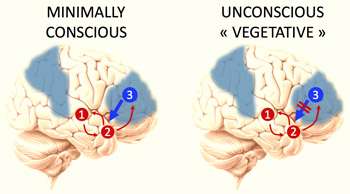
The subjects were played a series of tones, varying in pitch. With the change in pitch being a surprising event, the temporal cortex of the brain would send the frontal cortex a message for it to consider a reaction. This occurred in all of the subjects, regardless of the level of brain-damage. After the frontal cortex receives the message, it should send back a message to the temporal cortex. However, while this did occur in the healthy and minimally conscious patients, those in a vegetative state did not show that backwards communication.
Combined with the current Coma Recovery Scale, an assessment test currently administered to determine the level of consciousness, Boly hopes to be able to better distinguish between the actual level of consciousness.
More information: "Preserved feedforward but impaired top-down processes in the vegetative state" Boly M, Garrido MI, Gosseries O, Bruno MA, Boveroux P Schnakers C, Massimini M, Litvak V, Laureys S, Friston K, Science 13 May 2011. DOI: 10.1126/science.1202043
ABSTRACT
Frontoparietal cortex is involved in the explicit processing (awareness) of stimuli. Frontoparietal activation has also been found in studies of subliminal stimulus processing. We hypothesized that an impairment of top-down processes, involved in recurrent neuronal message-passing and the generation of long-latency electrophysiological responses, might provide a more reliable correlate of consciousness in severely brain-damaged patients, than frontoparietal responses. We measured effective connectivity during a mismatch negativity paradigm and found that the only significant difference between patients in a vegetative state and controls was an impairment of backward connectivity from frontal to temporal cortices. This result emphasizes the importance of top-down projections in recurrent processing that involve high-order associative cortices for conscious perception.
© 2010 PhysOrg.com
-
Scientists find that individuals in vegetative states can learn
Sep 20, 2009 |
not rated yet |
0
-
Misdiagnosis of disorders of consciousness still commonplace
Jul 21, 2009 |
not rated yet |
0
-
Paralyzed Belgian patient can't talk after all
Feb 19, 2010 |
not rated yet |
0
-
Patient presumed vegetative communicates via brain scan: study
Feb 03, 2010 |
not rated yet |
0
-
The brain can rapidly reorganise to recover from damage
May 04, 2007 |
not rated yet |
0
-
Motion perception revisited: High Phi effect challenges established motion perception assumptions
Apr 23, 2013 |
3 / 5 (2) |
2
-
Anything you can do I can do better: Neuromolecular foundations of the superiority illusion (Update)
Apr 02, 2013 |
4.5 / 5 (11) |
5
-
The visual system as economist: Neural resource allocation in visual adaptation
Mar 30, 2013 |
5 / 5 (2) |
9
-
Separate lives: Neuronal and organismal lifespans decoupled
Mar 27, 2013 |
4.9 / 5 (8) |
0
-
Sizing things up: The evolutionary neurobiology of scale invariance
Feb 28, 2013 |
4.8 / 5 (10) |
14
-
Why is zone 1 in liver more prone to ischemic injury?
May 23, 2013
-
How can there be villous adenoma in colon, if there are no villi there
May 22, 2013
-
How can there be a term called "intestinal metaplasia" of stomach
May 21, 2013
-
Pressure-volume curve: Elastic Recoil Pressure don't make sense
May 18, 2013
-
If you became brain-dead, would you want them to pull the plug?
May 17, 2013
-
MRI bill question
May 15, 2013
- More from Physics Forums - Medical Sciences
More news stories
New neuron formation could increase capacity for new learning, at the expense of old memories
New research presented today shows that formation of new neurons in the hippocampus - a brain region known for its importance in learning and remembering - could cause forgetting of old memories by causing a reorganization ...
Neuroscience
4 hours ago |
5 / 5 (2) |
0
Help at hand for people with schizophrenia
How can healthy people who hear voices help schizophrenics? Finding the answer for this is at the centre of research conducted at the University of Bergen.
Neuroscience
5 hours ago |
3 / 5 (1) |
2
Japanese research organizations contribute to Human Brain Project
One of the major frontiers of modern science is a comprehensive understanding of the human brain and its functions to guide the development of new technologies in information and communication. In a major announcement for ...
Neuroscience
5 hours ago |
1 / 5 (1) |
0
Controlling mood through the motions of mitochondria
(Medical Xpress)—Regulating the distribution of power in neurons is done by a system that makes the national electric grid look simple by comparison. Each neuron has several thousand mitochondria confined ...
Neuroscience
20 hours ago |
4.9 / 5 (9) |
0
|
Brain uses internal 'average voice' prototype to identify who is talking
(Medical Xpress)—The human brain is able to identify individuals' voices by comparing them against an internal 'average voice' prototype, according to neuroscientists.
Neuroscience
May 23, 2013 |
3 / 5 (2) |
2
|
About one in four uninsured could be excluded from ACA
(HealthDay)—More than one in four of those eligible for new premium assistance tax credits under the Affordable Care Act (ACA) do not have a checking account and will not be able to receive premiums from ...
Comorbidities common with alopecia areata
(HealthDay)—Comorbid conditions often accompany alopecia areata, according to a study published online May 22 in JAMA Dermatology.
Pollen count apps for smartphones are nothing to sneeze at
Kate O'Reilly's spring allergy survival kit includes the usual stuff - nasal sprays, allergy pills and a box of tissues. This season, she's added a new weapon to her line of defense: an app on her smartphone.
Hormone levels may provide key to understanding psychological disorders in women
Women at a particular stage in their monthly menstrual cycle may be more vulnerable to some of the psychological side-effects associated with stressful experiences, according to a study from UCL.
Engineered cytomegalovirus protects monkeys from HIV equivalent
(Medical Xpress)—A new study by researchers in the US has shown that an ancient virus can be modified to help in the fight against the simian immunodeficiency virus SIV, which is the equivalent in monkeys ...
Going live: Immune cell activation in multiple sclerosis
Biological processes are generally based on events at the molecular and cellular level. To understand what happens in the course of infections, diseases or normal bodily functions, scientists would need to ...