Estrogen-lowering drugs reduce mastectomy rates for breast cancer patients
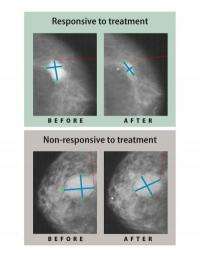
In the first large trial of its kind in the United States, researchers have shown that estrogen-lowering drugs can shrink tumors and reduce mastectomy rates for patients with stage 2 or 3 breast cancer.
Patients with these larger breast tumors have two options, says Matthew J. Ellis, MD, PhD, of Washington University School of Medicine in St. Louis and principal investigator of the trial conducted by the American College of Surgeons Oncology Group. "One option is to undergo mastectomy. The second is to receive medication before surgery to reduce the size of the tumor so that breast-conserving surgery becomes possible," he says.
Those who choose the second option usually receive chemotherapy. But now, Ellis and colleagues have shown that post-menopausal women with estrogen-receptor positive breast cancer can benefit from a class of drugs called aromatase inhibitors that lower the amount of estrogen in the body. Since estrogen-receptor positive breast cancers feed off estrogen, aromatase inhibitors can slow or stop the growth of these tumors in women who have undergone menopause.
Though estrogen no longer comes from the ovaries, post-menopausal women still make small amounts of estrogen with the enzyme aromatase. Aromatase inhibitors block this enzyme, eliminating the body's remaining estrogen. Because aromatase inhibitors don't stop the ovaries from making estrogen, they only work in post-menopausal women.
The results appear online May 9, in the Journal of Clinical Oncology.
Of the 159 women in the trial who were originally told they required mastectomy, 81 or slightly more than half saw sufficient tumor shrinkage after 16 weeks of aromatase inhibitor treatment to undergo breast-conserving surgery instead.
"At the beginning, all of these patients were going to get mastectomy and at the end of the trial only half got mastectomy," says Ellis, also an oncologist who treats patients at the Alvin J. Siteman Cancer Center at Washington University and Barnes-Jewish Hospital. "That's a very substantial improvement in surgical outcomes."
In addition, of the 189 women originally considered "marginal" for breast conservation (because it would likely be disfiguring), 83 percent saw enough tumor regression to undergo breast conserving-surgery rather than mastectomy. And of the four patients originally classified as inoperable (because mastectomy would not remove all the cancer), three saw enough tumor regression to undergo breast-conserving surgery and only one received mastectomy.
Beyond these benefits, aromatase inhibitors do not have the toxic side effects of traditional chemotherapy. And for this particular group of patients, Ellis says it is well established that aromatase inhibitors are more active in preventing relapses than chemotherapy.
In all, 352 women were randomly assigned to receive one of three FDA-approved aromatase inhibitors – letrozole, anastrozole and exemestane. Letrozole and anastrozole were slightly better than exemestane in shrinking tumors. But there were no other differences between the three drugs in surgery rates and in a key measure of how well the drugs stopped cancer cells from dividing, called the Ki67 cell proliferation biomarker.
"These aromatase inhibitors were subject to a lot of debate as to whether one was better than another," Ellis says. "We found some minor differences in the amount of tumor shrinkage the patients experienced. But there was no difference between the three drugs in terms of how effectively they stopped the tumor growing."
Ellis points out that this smaller trial came to the same conclusions as much larger, more expensive trials designed to compare the same drugs. Instead of looking at the final outcome for the patient in the larger trials, Ellis stresses the importance of using biomarkers such as the Ki67 measure of cell division to look at the tumors' biological response to the drugs.
"If we can show the drugs are biologically equivalent with a few hundred patients, we should not waste our time with superiority trials involving thousands of patients comparing the same agents," he says.
But according to Ellis, if one drug is shown to be superior in the smaller trial, then a larger trial to test the outcomes for patients becomes worthwhile.
"This concept is critical in terms of how we target our research investments. Large trials that find no difference between drugs should be avoided as much as possible given the tens of millions of dollars required to complete these studies," he says.
Despite the improved surgical outcomes for some patients in this trial, Ellis points out that many women still required mastectomy because their tumors did not respond adequately to the aromatase inhibitor treatment.
"The biggest question in my mind is how best to treat the aromatase inhibitor-resistant patients," he says. "These patients have poor outcomes and currently there is no known targeted therapy for them. The question of aromatase inhibitor resistance is a critical issue to understand and address therapeutically."
In an effort to find out why certain tumors are resistant to these drugs, Ellis and colleagues at Washington University's Genome Institute just reported the complete tumor and healthy DNA sequences of 50 breast cancer patients enrolled in this trial. Twenty-six of the 50 tumors responded to treatment and 24 tumors did not.
"The patients gifted a sample of their tumor to the study and, because we know whether a tumor is responsive or resistant, we can start doing really profound studies to understand the molecular basis for variation in response," he says. "Ultimately, we hope the genomics instruct which new drugs to use to develop more effective treatment strategies."
More information: Ellis MJ, et al. Randomized phase II neoadjuvant comparison between letrozole, anastrozole, and exemestane for postmenopausal women with estrogen receptor-rich stage II to III breast cancer: clinical and biomarker outcomes and the predictive value of the baseline PAM50-based intrinsic subtype – ACOSOG Z1031. Journal of Clinical Oncology. May 9, 2011


