Guilt, cooperation linked by neural network
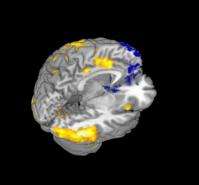
(Medical Xpress) -- Economic models backed up by fMRI scans offer new insights on why people choose to cooperate rather than act selfishly.
A team of researchers at the University of Arizona has brought a high-tech tool to bear on the study of a familiar and age-old emotion – guilt.
What makes the investigation unique is the use of fMRI scans to target the regions of the brain associated with guilt. It also opens a new avenue in understanding behavioral disorders associated with guilt, such as depression and anxiety.
The study, "Triangulating the Neural, Psychological and Economic Bases of Guilt Aversion," is published by CELL today in the journal Neuron.
The authors – Luke Chang, Alec Smith, Martin Dufwenberg and Alan Sanfey – also come from two seemingly disparate areas: cognitive neuroscience and economics.
Sanfey is a recognized neuroscientist who also has an appointment at the Donders Institute at Radboud University in The Netherlands, and Chang is a doctoral student in the UA psychology department.
Dufwenberg is a behavioral economist in the UA Eller College of Management. Smith, a former doctoral student in Eller's economics department, is now a post-doctoral scholar in economics at the California Institute of Technology.
The collaboration began when Dufwenberg and Smith were "reaching out for people who would be interested" in cross-disciplinary partnerships when they met and teamed up with Sanfey and Chang.
Guilt, in this case the failure to live up to the expectations of others. It is an emotion that likely has its roots in the evolutionary history of humans. And the aversion to guilt is a factor in motivating cooperative behavior.
The thrust of the study, said Chang, is trying to understand why people cooperate.
"One idea is that most people cooperate because it feels good to do it. And there is some brain imaging data that shows activity in reward-related regions of the brain when people are cooperating.
"But there is a whole other world of motivation to do good because you don't want to feel bad. That is the idea behind guilt aversion," Chang said.
To test this, 30 volunteers played a game appropriate for testing a mathematical theory of guilt aversion that Dufwenberg devised. In it, "investors" were asked to award a certain amount of money to a "trustee," whose expectations regarding how much the investor expected to get back were elicited. The trustees were then scanned using fMRI while deciding how much money should be returned to their investors.
"The theory will then operate on the expectations the players have," said Dufwenberg. "I would feel guilt if I give you less than I believe that you expect that you will get. Then we measure expectations in the experimental situation. The theory predicts when people will experience guilt. Then we see how that correlates with brain activity."
The fMRI scans identified regions in the brain involved in guilt-motivated cooperation while test subjects made their decisions whether or not to honor a partner's trust. Different areas of the brain became active during those decisions based on their choosing to cooperate, or to abuse the trust and maximize their own financial gain.
The report said the results show that "a neural system previously implicated in expectation processing plays a critical role in assessing moral sentiments that in turn can sustain human cooperation in the face of temptation."
Civilized society is based on cooperation and trust, from behaviors a simple and informal as opening a door for someone carrying heavy packages or tipping a restaurant server to complex legal agreements between corporations or countries. Understanding the neural structures behind these behaviors promises to offer new insights into complex behaviors of trust and reciprocity.
Chang said the collaboration among economists, psychologists and neuroscientists is instrumental in understanding the biological mechanisms underlying complex social behavior, such as guilt, and has real world implications for understanding clinical disorders such as depression anxiety and psychopathy.
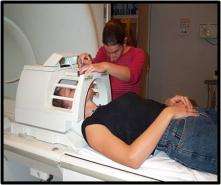
Alan Sanfey, the senior author of the study, said "the study demonstrates the potential in cross-disciplinary collaborations of this nature, for example, in developing more complete models of how people make decisions in complex social situations."
As a behavioral economist, Dufwenberg argues that factors such as emotions may be important drivers of economic outcomes, and that the mathematical models that economists use can be augmented to include such psychological aspects.
"In the end, it's a two-way exchange. Economists take inspiration from the richer concept of man usually considered in psychology, but at the same time they have something to offer psychologists through their analytical tools.
"Remember how guilt depends on beliefs about beliefs about outcomes? These are hard to observe, hard to test. I'm excited about the idea of using neuroscience tools to test economic theory."
More information: www.cell.com/neuron/abstract/S0896-6273%2811%2900299-6


