Implant jab could solve the misery of back pain
May 19, 2011 in Medical research

Implant jab could solve the misery of back pain

Enlarge

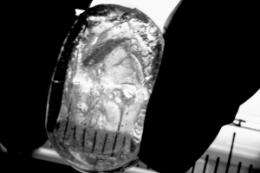
(PhysOrg.com) -- University of Manchester scientists have developed a biomaterial implant which could finally bring treatment, in the form of a jab, for chronic back pain.

Chronic is a major problem for society – behind only headaches as the most common neurological ailment – and is frequently caused by degeneration of the intervertebral disc.

Researchers have worked for many years to find a way of repairing the wear and tear on the lower back.

Now, in results published in the journal Soft Matter, they have discovered how to permanently replace the workings of the invertebral disc.

It is estimated that back affects 80% of people at some point in their lives. In the United States it is the most common cause of job-related disability, a leading contributor to people missing work.

The University of Manchester cross-faculty team have been working with microgel particles, which are swellable nanoscopic polymer particles, for a number of years.

Previously, they have demonstrated that an injectable fluid of these particles could transform into a gel that restored the mechanical properties of damaged model intervertebral discs.

Lead researcher Dr Brian Saunders, of the School of Materials, and his team have now succeeded in linking the microgel particles together to form injectable durable, elastic gels capable of sustaining large permanent changes in shape without breaking.

These improved injectable gels have much better mechanical properties than the first generation and should now display the necessary long-term durability required for an implanted device.

In this study the researchers – who include PhD student Amir Milani and Dr Ruixue Liu – have achieved an important milestone for producing injectable gels for minimally-invasive repair of IVD degeneration.

Dr Saunders said: ““Our team has made a breakthrough through innovative materials design that brings the prospect of an injectable gel for treating degeneration of the intervertebral disc a step closer.

Professor Tony Freemont, Head of Research in the School of Biomedicine, and co-author on the paper, added:
“Degeneration of the intervertebral disc results in which costs the country billions of pounds per annum and causes untold misery for sufferers and their families.

“We have been working for 25 years to identify methods for treating degeneration of the intervertebral disc.”

More information: Doubly crosslinked pH-responsive microgels prepared by particle inter-penetration: swelling and mechanical properties, by Ruixue Liu, Amir H. Milani, Tony J. Freemont and Brian R. Saunders, Soft Matter.

Provided by University of Manchester search and more info website

5 /5 (5 votes)  

Rank 5 /5 (5 votes)
Relevant PhysicsForums posts

More news stories

Study reveals new mechanism for estrogen suppression of liver lipid synthesis

By discovering the new mechanism by which estrogen suppresses lipid synthesis in the liver, UC Irvine endocrinologists have revealed a potential new approach toward treating certain liver diseases.

Medical research created May 23, 2013 | popularity not rated yet | comments 0 | with audio podcast

MRI-based measurement helps predict vascular disease in the brain

Aortic arch pulse wave velocity, a measure of arterial stiffness, is a strong independent predictor of disease of the vessels that supply blood to the brain, according to a new study published in the June issue the journal ...

Medical research created May 23, 2013 | popularity not rated yet | comments 0

Antibiotics: A new understanding of sulfonamide nervous system side effects

Since the discovery of Prontosil in 1932, sulfonamide antibiotics have been used to combat a wide spectrum of bacterial infections, from acne to chlamydia and pneumonia. However, their side effects can include serious neurological ...

Medical research created May 23, 2013 | popularity not rated yet | comments 0 | with audio podcast

Scientists discover molecule triggers sensation of itch

Scientists at the National Institutes of Health report they have discovered in mouse studies that a small molecule released in the spinal cord triggers a process that is later experienced in the brain as ...

Medical research created May 23, 2013 | popularity 5 / 5 (3) | comments 0 | with audio podcast

Discarded immune cells induce the relocation of stem cells

Spanish researchers have discovered that the daily clearance of neutrophils from the body stimulates the release of hematopoietic stem cells from the bone marrow into the bloodstream, according to a report published today ...

Medical research created May 23, 2013 | popularity 5 / 5 (2) | comments 0


Researchers identify first drug targets in childhood genetic tumor disorder

Two mutations central to the development of infantile myofibromatosis (IM)—a disorder characterized by multiple tumors involving the skin, bone, and soft tissue—may provide new therapeutic targets, according to researchers ...

Engineered cytomegalovirus protects monkeys from HIV equivalent

(Medical Xpress)—A new study by researchers in the US has shown that an ancient virus can be modified to help in the fight against the simian immunodeficiency virus SIV, which is the equivalent in monkeys ...

Hormone levels may provide key to understanding psychological disorders in women

Women at a particular stage in their monthly menstrual cycle may be more vulnerable to some of the psychological side-effects associated with stressful experiences, according to a study from UCL.

Going live: Immune cell activation in multiple sclerosis

Biological processes are generally based on events at the molecular and cellular level. To understand what happens in the course of infections, diseases or normal bodily functions, scientists would need to ...

Driving and hands-free talking lead to spike in errors, study shows

Talking on a hands-free device while behind the wheel can lead to a sharp increase in errors that could imperil other drivers on the road, according to new research from the University of Alberta.

Pollen count apps for smartphones are nothing to sneeze at

Kate O'Reilly's spring allergy survival kit includes the usual stuff - nasal sprays, allergy pills and a box of tissues. This season, she's added a new weapon to her line of defense: an app on her smartphone.