Direct link found between diet ingredients and gut microbes
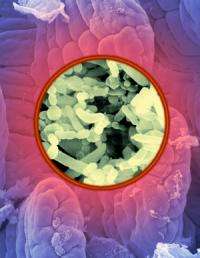
(PhysOrg.com) -- Globally, industrialized countries face an epidemic of obesity while poor nations continue to grapple with pervasive malnutrition, particularly among children. Increasing evidence suggests that both conditions may be linked, in part, to the collection of microbes that live in the intestine and help break down food our bodies otherwise couldn’t digest.
Two new studies by Jeffrey Gordon, MD, and colleagues at Washington University School of Medicine in St. Louis, showcase the dynamic relationship between components of the diet and the intestinal microbiome. The research provides a foundation for improving human health by designing diets and foods that enhance microbes’ ability to capture specific food ingredients or that enrich the presence of beneficial microbes.
In the first study, published online May 19 in Science Express, the researchers demonstrated they could predict how a sampling of human gut microbes fluctuate in response to particular foods, such as carrots, pears, chicken and the like.
In the second paper, published May 20 in the journal Science, the scientists found that gut microbial communities in humans and in a diverse collection of mammals, including giraffes, baboons and lions, carry out core functions that are heavily influenced by whether the animals are carnivores, herbivores or omnivores.
“We are beginning to understand how particular diets and ingredients in those diets shape microbial communities,” explains Gordon, the senior author of both papers and whose research first suggested a link between gut microbes and obesity. He is the Dr. Robert J. Glaser Distinguished University Professor and director of Washington University's Center for Genome Sciences & Systems Biology. “This helps pave the way for understanding the nutritional needs of people who live in different cultures throughout the world and for enhancing the nutritional value of foods.”
In the first paper, lead author Jeremiah Faith, PhD, a postdoctoral research associate in Gordon’s lab, created a simple model of the gut microbiome by introducing 10 species of human intestinal bacteria into germ-free mice that had been raised under sterile conditions. The microbial species added were representatives of the four most prominent bacterial phyla found in healthy human digestive tracts.
The mice were then fed different diets, each composed of four refined ingredients that were added in varying concentrations. Moreover, each added ingredient represented the sole source of a given nutrient. Thus, casein was added as a protein source; corn oil as a fat source; cornstarch as a polysaccharide and sucrose as a simple sugar.
Each mouse was fed a series of three different randomly selected diets for two-week intervals. The researchers then used a mathematical model to predict the abundance of each of the bacterial species after the mice were switched to yet another randomly selected diet for two weeks.
Changes in the abundance of gut microbes in the model community and their patterns of gene expression were determined by sequencing DNA and RNA present in the stool samples from the mice.
To their surprise, the researchers found that if they only knew the concentrations of each of four refined ingredients in the diet, they could explain more than 60 percent of the variations they observed in the abundance of bacterial species in response to a particular diet. They also were able to determine which dietary ingredient was principally responsible for driving the response of a given bacterium.
The researchers then used the same mathematical model to predict how the same community of 10 bacterial species would respond in other mice that were fed more complex diets typically consumed by humans. These animals were fed random combinations and concentrations of four foods selected from eight different human baby foods: apples, peaches, peas, sweet potatoes, beef, chicken, oats and rice.
“We eat different foods all the time, and we know this influences the mix of microbes in the intestine,” Faith says. “But we haven’t had a good way to determine how a particular ingredient or food influences microbes in the gut.”
Each mouse was fed a random sequence of six different baby food diets for one week each. Again, just by knowing the concentrations of the four baby foods that each mouse consumed, the researchers could explain more than half the variation in species abundance.
“This simple model enabled us to predict which bacteria are responsible for processing different ingredients in the diet,” Gordon says. “This sets the stage for potentially creating new types of prebiotics that can influence the structure and functions of communities of human intestinal microbes and for identifying the next generation of probiotics that facilitate the digestion of particular foods.”
Gordon adds that similar models that incorporate more human intestinal microbes could help scientists determine the potential benefits or drawbacks of adding or changing ingredients in foods. Such models could also be used to evaluate claims by food manufacturers that certain foods or ingredients have health benefits.
In the second paper, the researchers sequenced the intestinal microbes in stool samples from 33 mammalian species living in the wild or in zoos in St. Louis and San Diego. In addition to identifying the bacterial species living in the mammalian intestine, the researchers characterized the pool of genes present in the microbial community and their functions.
They found considerable variations from animal to animal in the collections of bacterial species that live in the gut. However, many microbial genes were found in all animal digestive tracts, with differences in their relative abundance depending on whether the animals were carnivores, herbivores or omnivores.
“These mammals were pretty distant from one another on the evolutionary tree, yet their gut microbial communities share a core set of functions essential for living in the intestine and that varied depending on diet,” says lead author Brian Muegge, an MD/PhD student in Gordon’s lab.
Gut microbes in meat-eaters like lions, polar bears and armadillos are specialized to degrade amino acids, the building blocks of proteins. In plant-eaters, including orangutans, kangaroos and bighorn sheep, the microbes are specialized to build amino acids.
The researchers also found that diet influences the microbial communities in the human intestinal tract. They analyzed stool samples from 18 lean people who practice calorie restriction, meaning they purposely cut their daily caloric intake by 25 percent or more. These individuals are part of a long-term study led by Luigi Fontana, research associate professor of medicine at Washington University and senior investigator at the Istituto Superiore di Sanità in Rome, Italy.
His patients keep meticulous dietary records, which allowed the researchers to correlate their diets with their gut microbes. They found that the functions of the gut microbes varied according to how much protein an individual ate and that the bacterial species varied according to how much fiber a person consumed.
“This work illustrates that we need to have a broad view of the genetic landscape of humans and animals – one that includes the myriad genes present in their gut microbial communities as well as the genes present in their own genomes,” Gordon says.
He also urges scientists involved in the 10K Genome Project, an ambitious global effort to sequence the genomes of 10,000 different kinds of vertebrates — mammals, birds, reptiles, amphibians and fishes — to incorporate sequencing of the animals’ gut microbiome.
“This will give us a more comprehensive view of mammalian evolution and of the way diet has shaped and is shaping the biology of animals, including humans,” Gordon says.
More information:
Faith J, McNulty NP, Rey FE, Gordon JI. Predicting a human gut microbiota's response to diet in gnotobiotic mice. Science Express, online May 19, 2011.
Muegge BD, Kuczynski J, Knights D, Clemente JC, Gonzales A, Fontana L, Henrissat B, Knight R, Gordon JI. Diet drives convergence in gut microbiome functions across mammalian phylogeny and within humans. Science, May 20, 2011.


