New NIST reference materials for green tea
May 25, 2011 By Mark Esser in Health
New NIST reference materials for popular diet supplement

Enlarge

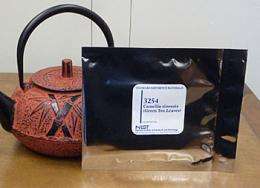
Green tea has been long prized not only for its taste but also for purported health benefits and medicinal value. Use of these green tea reference materials will improve the measurement precision and accuracy of measurements of constituents in green tea products available as dietary supplements. Credit: Baum/NIST

The National Institute of Standards and Technology (NIST) has released a suite of green tea reference materials to help manufacturers evaluate the composition of their products and assure researchers of the accuracy of analytical methods for studying the human health effects of this popular beverage and dietary supplement. The new standard reference materials (SRMs) were prepared as part of an ongoing collaboration with the National Institutes of Health Office of Dietary Supplements.

People have cultivated and consumed tea for at least the past 3,000 years and perhaps much longer than that. The origin of the use of Camellia sinensis (green tea), indigenous to Southeast Asia, is the subject of competing legends. Although there are various versions of the story, Chinese legend records that Emperor Shen Nong discovered the rejuvenating effects of tea when a few leaves fell into his pot of boiling water nearly 5,000 years ago.

Green tea, which is made from the leaves of the plant that are dried without allowing them to oxidize, has been long prized not only for its taste, but also for purported health benefits and medicinal value. Beginning with Shen Nong, proponents have claimed that green tea improves digestion and .

Green tea is rich in antioxidants, notably the phytochemical class "catechins," which some researchers believe account for its potential health benefits. This has spurred interest in studying the chemistry of green tea and its extracts and in evaluating amounts of these antioxidant substances during and after the manufacture of green tea dietary supplements.

The NIST green tea SRMs are natural matrices, meaning they are derived directly from the plant. Unlike purified chemicals, reference materials of this type allow researchers to measure a well-known sample with all the chemical complexity of the natural product. Using as many as five methods of analysis, NIST and collaborating laboratories have determined concentrations of seven catechins and gallic acid, three xanthine alkaloids (including caffeine), theanine, and toxic elements (arsenic, cadmium, lead and mercury) in SRMs 3254 Camellia sinensis (Green Tea) Leaves, 3255 Camellia sinensis (Green Tea) Extract, and SRM 3256 Green Tea-Containing Solid Oral Dosage Form.

These SRMs are the first green tea-containing reference materials with certified values for catechins. It is anticipated that use of the will improve the measurement precision and accuracy of measurements of constituents in products available as dietary supplements.

SRMs are among the most widely distributed and used NIST products. The agency prepares, analyzes and distributes more than 1,200 different carefully characterized materials that are used throughout the world to check the accuracy of instruments and test procedures used in manufacturing, clinical chemistry, environmental monitoring, electronics, criminal forensics and dozens of other fields. For more information, see NIST's SRM website at http://www.nist.gov/srm/ .

SRMs 3254 through 3256 are available from NIST. See the Dietary Supplement Materials (includes nutraceuticals and herbs) Web page at https://www-s.nist … m?tableid=79 for further information and to order.

Provided by National Institute of Standards and Technology search and more info website

3 /5 (1 vote)  

Rank 3 /5 (1 vote)
Relevant PhysicsForums posts

More news stories

A smoke-free country? New Zealand taxes aim for it

(AP) -- There are smoke-free bars, smoke-free parks, even smoke-free college campuses. But a smoke-free country?

Health created 29 minutes ago | popularity not rated yet | comments 0

Docs slower to drop 'black box' drugs, adopt new therapies, when access to drug reps is restricted

After years of reducing their contact with pharmaceutical sales representatives, physicians now risk an unintended consequence: Doctors who rarely meet with pharmaceutical sales representatives — or who do not meet with ...

Health created 12 hours ago | popularity not rated yet | comments 0

Half of Americans with individual health plans could gain better coverage under the ACA: report

More than half of Americans with individual market health insurance coverage in 2010 were enrolled in so-called "tin" plans, which provide less coverage than the lowest "bronze"-level plans in the Affordable Care Act, and ...

Health created 13 hours ago | popularity not rated yet | comments 0

Germs lurk in office kitchens, break rooms

(HealthDay) -- Office kitchens and break rooms are germ "hotspots," and sink and microwave handles in these areas are the dirtiest surfaces touched by office workers on a daily basis, according to a new study.

Health created 15 hours ago | popularity not rated yet | comments 0

Children's body fat linked to Vitamin D insufficiency in mothers

Children are more likely to have more body fat during childhood if their mother has low levels of Vitamin D during pregnancy, according to scientists at the Medical Research Council Lifecourse Epidemiology Unit (MRC LEU), ...

Health created 17 hours ago | popularity not rated yet | comments 0


New estimates up dementia rates in mid-income countries

(HealthDay) -- Use of 10/66 dementia diagnosis criteria (10/66) results in an increase in the estimated incidence of dementia in middle-income countries, according to a study published online May 23 in The La ...

Clot buster seems to help up to 6 hours after stroke

(HealthDay) -- The largest study of its kind finds that stroke patients benefit from a clot-busting drug even six hours after a stroke, suggesting that the current recommended 4.5-hour limit could be expanded.

Calcium supplements linked to significantly increased heart attack risk

Calcium supplements might increase the risk of having a heart attack, and should be "taken with caution," concludes research published in the online issue of the journal Heart.

Study shows how immune cells change wiring of the developing mouse brain

Researchers have shown in mice how immune cells in the brain target and remove unused connections between brain cells during normal development. This research, supported by the National Institutes of Health, sheds light on ...

Childhood obesity increases likelihood of a cranial disorder that may cause blindness

Children who are overweight or obese -- particularly older, non-Hispanic white girls -- are more likely to have a neurological disorder known as idiopathic intracranial hypertension, a rare condition that can result in blindness, ...

The Goldilocks effect: Babies learn from experiences that are 'just right'

Long before babies understand the story of Goldilocks, they have more than mastered the fairy tale heroine's method of decision-making. Infants ignore information that is too simple or too complex, focusing instead on situations ...