Re-educating immune system: New cell therapy prevents organ rejection
May 18, 2011 in Medical research
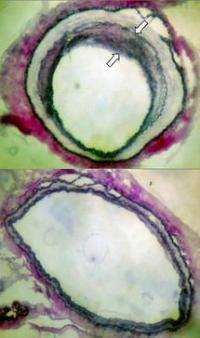
The rejection response (top, arrows) to a transplanted blood vessel in a mouse is prevented by an immune cell therapy (bottom). Image courtesy of Science/AAAS.
Researchers at King's College London have used cells found naturally in the body, to re-educate the immune system to prevent rejection of an organ transplant while remaining capable of fighting infections and cancer.
Currently, patients must take immunosuppressant drugs to prevent a new organ from being rejected after transplantation. However, these drugs suppress the entire immune system, leaving the patient susceptible to infections and tumours.
Scientists say this new approach using immune cells, called regulatory T cells (Tregs), from the body could eliminate the need for immunosuppression, as the Tregs used will only suppress the activity of those cells which will attack the new organ, rather than suppress the whole immune system. The team says these results are encouraging. Ultimately this approach could extend the life of a transplanted organ and in turn, could alleviate the organ shortage problem.
The study, to be published in Science Translational Medicine, was carried out at King's by scientists in its Medical Research Council Centre for Transplantation. King's College London is part of King's Health Partners Academic Health Sciences Centre, a pioneering collaboration with NHS Trusts which aims to ensure that the latest research in health is used to improve patient care at the earliest opportunity.
The study was part-funded by the British Heart Foundation and the Wellcome Trust.
Tregs are known to control the activity of many different immune cells, including T effector cells, which are responsible for mounting immune responses against foreign organisms, such as bacteria during an infection, and an organ following transplantation. The team have developed a method to select Tregs that can regulate only the activity of effector cells that would target a transplanted organ ("specific" Tregs), leaving the remaining effector cells to function normally.
Using a humanised mouse, where a mouse lacking its own immune system was given human effector cells and Tregs, the team were able to test the ability of these "specific" Tregs to prevent rejection of human skin grafted onto the mouse. The team found that the "specific" Tregs were significantly more potent than non-specific Tregs (those able to inhibit all effector cells) in protecting skin grafts from immune damage.
Professor Robert Lechler, Vice-Principal for Health at King's and Executive Director of King's Health Partners, said: 'This study is a promising step forward that could lead to dramatic advances in preventing organ rejection and improving the quality of life of transplant patients.
'Researchers at King's are in a unique position. On average it takes 17 years for research discoveries and medical breakthroughs to become routine clinical practice. But being an Academic Health Sciences Centre means that researchers work directly alongside clinicians at leading NHS Foundation Trusts to speed up the time it takes for research to get from bench to bedside. Because of this, we hope to begin first-in-man trials within five years and could see patients being given this novel cellular therapy in around ten years time.'
If this approach were to be adopted to treat patients, blood would be sampled from a patient who will be receiving a transplant and their Tregs extracted from it. These Tregs would then be mixed with cells from the selected organ donor and the "specific" Tregs isolated using the new method developed by the team. The specific Tregs would then be expanded in numbers in a specialised sterile laboratory and be reintroduced into the patient after the transplant. Scientists believe this therapeutic approach will be applicable to the majority of solid organ transplants such as the kidney, heart and liver.
The King's study is one of three papers in Science Translational Medicine reporting progress towards immune cell therapies to prevent transplant rejection. Together, they make it possible to see how such therapies might work, if successfully developed.
Provided by
King's College London
-
GARP makes the difference
Jun 15, 2009 |
not rated yet |
0
-
Immune cells predict outcome of West Nile virus infection
Oct 12, 2009 |
not rated yet |
0
-
Study reveals promising techniques for extending the life of an organ transplant
Sep 15, 2010 |
not rated yet |
0
-
T-regulatory lymphocytes in gastrointestinal cancer
Jan 31, 2011 |
not rated yet |
0
-
Immune police recognize good and bad guys in the body
Sep 14, 2007 |
not rated yet |
0
-
Limits to growth: Scientists identify key metastasis-enabling enzyme
May 22, 2012 |
5 / 5 (3) |
0
-
Seeing is as seeing does: Spatially-structured retinal input in early development of cortical maps
Apr 26, 2012 |
5 / 5 (4) |
1
-
Dreamless nights: Brain activity during nonrapid eye movement sleep
Apr 09, 2012 |
4.4 / 5 (12) |
0
-
Take your time: Neurobiology sheds light on the superiority of spaced vs. massed learning
Mar 28, 2012 |
4.5 / 5 (21) |
3
-
Your brain on 'shrooms: fMRI elucidates neural correlates of psilocybin psychedelic state
Feb 29, 2012 |
4.9 / 5 (42) |
45
-
A question about drug tolerance
12 hours ago
-
Poor nutrition leading to overeating?
May 23, 2012
-
Math and dyslexia?
May 21, 2012
-
portable metabolism meter?
May 21, 2012
-
Rare medical conditions on 20/20 tonight
May 18, 2012
-
"Good" Cholesterol in Doubt
May 17, 2012
- More from Physics Forums - Medical Sciences
More news stories
A revealing hand
What did you have for lunch yesterday? How many times a month do you eat nuts? How about your kids -- how many servings of vegetables did they consume today?
Medical research
55 minutes ago |
5 / 5 (1) |
0
Stem-cell-growing surface enables bone repair
(Medical Xpress) -- University of Michigan researchers have proven that a special surface, free of biological contaminants, allows adult-derived stem cells to thrive and transform into multiple cell types. ...
Medical research
16 hours ago |
5 / 5 (7) |
1
|
Hormone plays surprise role in fighting skin infections
Antimicrobial peptides (AMPs) are molecules produced in the skin to fend off infection-causing microbes. Vitamin D has been credited with a role in their production and in the body's overall immune response, ...
Medical research
17 hours ago |
not rated yet |
0
|
Aggregating instead of stabilizing: New insights into the mechanisms of heart disease
Malformed desmin proteins aggregate with intact proteins of the same kind, thereby triggering skeletal and cardiac muscle diseases, the desminopathies. This was discovered by researchers from the RUB Heart and Diabetes Center ...
Medical research
21 hours ago |
not rated yet |
0
Array of light for early disease detection?
A special feature in this week's issue of the journal Science highlights protein array technology, touching on research conducted by Joshua LaBaer, director of the Biodesign Institute's Virginia G. Piper ...
Medical research
May 22, 2012 |
not rated yet |
0
|
Spatial configuration can spark deja vu, psychology study reveals
(Medical Xpress) -- Déjà vu - that strange feeling of having experienced something before - is more likely to occur when a scene's spatial layout resembles one in memory, according to groundbreaking new research ...
New genetic method pinpoints geographic origin
(Medical Xpress) -- Understanding the genetic diversity within and between populations has important implications for studies of human disease and evolution. This includes identifying associations between genetic variants ...
World's biggest stroke clot-buster trial reveals patient benefits
(Medical Xpress) -- Patients given a clot-busting drug within six hours of a stroke are more likely to make a better recovery than those who do not receive the treatment, new research has found.
Expert: Medicaid cuts will hurt low-, middle-income Illinois seniors
(Medical Xpress) -- Springfields plan to slash nearly $1.4 billion from the states Medicaid program will ultimately result in bigger medical (and financial) problems for low- and middle-income ...
Professor conducting study to determine whether supplements help muscles grow
Nutritional supplements are often associated with athletes and body builders, but a University of Kansas professor is conducting a research project to determine whether they are in fact, effective and if they might be able ...
No new neurons in the human olfactory bulb
(Medical Xpress) -- Research from Karolinska Institutet shows that the human olfactory bulb - a structure in the brain that processes sensory input from the nose - differs from that of other mammals in that no new neurons ...