Recovery from complicated surgery shows teen has a whole lot of heart
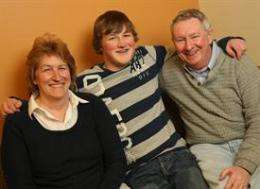
Tracey and Tim Sheehan had run out of options for their son, Ryan, who was born with a complex set of heart defects. His great arteries came from the wrong sides of the heart, his lower chambers were switched, there was a hole between his ventricles and he had a bad mitral valve. He had already undergone three open-heart surgeries to save his life.
But in 2005 Ryan was so weak, he needed a wheelchair to get down the halls at school.
“At that point, I couldn’t stand to see him in a wheelchair anymore,” Tim said. He and Tracey wanted their then-13-year-old to be healthier, and they were determined to get him the care he needed.
“He was so weak and so small,” Tracey said. “He was always at the 5th percentile of height and weight.”
Roger Vermilion, M.D., chief of Pediatric Cardiology at Golisano Children’s Hospital and Ryan’s cardiologist, felt it was time for another heart surgery. Ryan’s previous two surgeries in 1994 and 1999 were performed at The Cleveland Clinic because at the time Rochester didn’t have a surgeon who could do the complicated surgeries Ryan needed. The family wanted to return to Cleveland again for this latest surgery.
“But Cleveland wouldn’t touch him,” Tim said. “They thought he could wait another year or two.”
Ryan’s parents and Dr. Vermilion didn’t think Ryan had that long to wait. So they turned to the new pediatric cardiac surgeon at Golisano Children’s Hospital at the University of Rochester Medical Center, who agreed Ryan needed surgery as soon as possible.
Ryan’s set of defects and extensive surgical history are rare, so it was difficult for George Alfieris, M.D., chief of pediatric cardiac surgery, to give the family an exact idea of how the surgery would go. He told the family it was risky and there was a 30 percent chance Ryan wouldn’t make it off the operating table.
“I operate on hundreds of kids every year, and Ryan’s heart was the most complicated one I’d ever seen. And he was very sick,” Alfieris said. “It was hard to know how he would do.”
Alfieris had to cut through and clear a lot of scar tissue from the three previous surgeries to get to Ryan’s heart. Once inside, Alfieris repaired Ryan’s leaking and hardened tricuspid valve that had been making him so sick. He also relieved the heart of some of its burden by performing a bidirectional Glenn shunt procedure, which routes the blood from the upper body past the heart, directly to the lungs for oxygenation. Now his already weak heart had a little less work.
Knowing how difficult it would be to place a pacemaker’s leads into Ryan’s heart later because of his complicated arteries, Alfieris and his team did it while they had access. Children like Ryan are at increased risk for developing arrhythmias later in life, but most are able to have them placed years later without open-heart surgery.
Ryan’s recovery was not quick. He weighed just 60 pounds when he went home two months later. He was so sick going in and the surgery was so complicated, it took months for Ryan to even catch up to where he was before the surgery. It was very disappointing for Ryan.
Alfieris knew Ryan needed some inspiration to get over the hump in his recovery. He told Ryan that if he could gain another 20 pounds, he would take him for a flight in his airplane. It took a few months, but he did it, and Ryan said the goal of taking that flight with his surgeon helped him focus on getting better.
Alfieris was true to his word and took Ryan up in his Grumman Yankee airplane, nicknamed Herbie. They flew out over Sodus Bay and over Lake Ontario. Ryan said the plane’s cockpit was surrounded in windows and gave him a view he’d never seen before.
“It was surreal. It was awesome,” Ryan said.
Vermilion said it’s been amazing to see the change in Ryan. He has grown to 5-foot-10-inches and weighs 100 pounds more than he did the day he was discharged. He got the surgery exactly when he needed it, Vermilion said. He’s a model for other children with heart defects.
“He’s one of the new generation of kids who would’ve died 15 years ago without these surgeries,” Tracey said. “We don’t know what’s in store for him. He could have an arrhythmia or his right ventricle could get enlarged and at that point, it’d be a heart transplant.”
But after several points when the family prepared to lose Ryan – rushing Ryan’s baptism when he was first diagnosed and once involving a counselor to help his older brother, Tim, deal with Ryan’s impending death – his parents, Vermilion and Alfieris were delighted to see him graduate last June and go off to college last fall.
“We never thought he’d be able to go away to school,” Tracey said. In fact, Ryan said he didn’t think he’d be able to either, but in his first semester, he earned a 3.92 grade point average.
“Dr. Alfieris changed everything. He was able to help me,” Ryan said. “And it wasn’t like he did the surgery and went on to another patient. He stuck with me and helped me get better after the surgery. He even showed up to my graduation party.”
Alfieris doesn’t hesitate when he talks about Ryan: “He is a miracle. The biggest miracle of my career.”


