Specific modules for robot-assisted surgery debuts
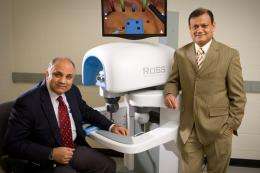
Two life-sciences entrepreneurs are launching the first procedure-specific software modules for robot-assisted surgery.
Through a combination of simulation and haptic technologies, these first-of-their kind training modules guide novice surgeons' hands through every step of four key robot-assisted surgical procedures, helping users to become proficient in these highly complex operations, toward the goal of ensuring patient safety and improving surgical outcomes.
Khurshid A. Guru, MD, director of robotic surgery at Roswell Park Cancer Institute (RPCI), and Thenkurussi "Kesh" Kesavadas, PhD, director of the Virtual Reality Lab and a professor of mechanical and aerospace engineering at the University at Buffalo (UB), created Hands-on Surgical Training (HoST) to harness the didactic potential of their proprietary Robotic Surgical Simulator, or RoSS.
The new modules, the first procedure-specific software applications for robot-assisted surgery, are available for four commonly performed minimally invasive, robot-assisted procedures: prostatectomy, removal of the prostate gland; hysterectomy, removal of the uterus; cystectomy, removal of the bladder; and complex extended lymph-node dissection.
The four HoST modules will be publicly demonstrated for the first time at the annual conference of the American Urological Association in Washington, D.C., May 14-17.
The key to the HoST platform, which is unlike any other available training tools in robot-assisted surgical technique, is interactive software that diligently records and replays the precise hand movements of world-renowned surgeons during minimally invasive surgeries.
"HoST virtualizes every single motion that a surgeon makes during an operation, down to the suturing," explains Kesavadas. "Then we convert all these actions with surgical principles based on HoST software, which brings a sense of touch to virtual reality. The trainee can then sit on the RoSS platform and can feel exactly how the expert robotic surgeon performed the procedure."
"The concept of learning and performing a real procedure on the simulator with the master surgeon and not on the patient, isn't that the holy grail of simulation for surgery?" said Guru, who is also an associate professor in RPCI's Department of Urology. "It's this element that makes HoST such an important tool for both new surgeons just learning the techniques for the first time and experienced surgeons looking to hone their skills or 'warm up' before live procedures."
Under Kesavadas' direction, the UB Virtual Reality Lab has been focused on ways to virtually transmit some of the most unique and difficult-to-imitate skills that humans have.
"Both the RoSS- and the HoST-based modules demonstrate how a surgeon who is training can learn the same skills that good robotic surgeons have," notes David Parish, chief executive officer of Simulated Surgical Systems, LLC, (SSS) the Williamsville, NY, company that builds and markets the RoSS. "These products merge UB's virtual-reality research with Dr. Guru's expertise in robotic surgery to come up with an innovative approach for training."
The modules employ detailed anatomical illustrations matching the magnification of the RoSS interface.
"I believe the illustrations will be constructive by allowing the surgeon to more clearly envision these complex anatomical surgical fields," notes John Nyquist, lead medical illustrator and clinical assistant professor of pathology and anatomical sciences at UB's School of Medicine and Biomedical Sciences, who contributed the illustrations.
The patent-pending HoST system was jointly developed by RPCI and UB and licensed to Simulated Surgical Systems, which Drs. Guru and Kesavadas co-founded in 2009.
"Ingenuity has been the hallmark of everything Drs. Guru and Kesavadas have created through their SSS partnership, so it's no surprise to see how they've once again adapted technology to advantage in the surgical environment with these HoST procedure modules," said James Mohler, MD, associate director, senior vice president for translational research and chair of urology at RPCI. "These are outstanding training tools that will, no doubt, help to reduce the risks associated with robot-assisted surgery, and they were made possible through a marvelous example of inter-institutional collaboration."
More information: For more information about Simulated Surgical Systems and the HoST modules, go to www.simulatedsurgicals.com/host


