Students mimic blood flow in the lab
May 25, 2011 By Marcia Goodrich in Medical research
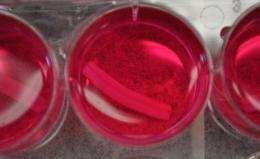
A fibrin-coated wire in a well plate, covered with pink cell culture medium.
If by chance you should have a stent inserted in a clogged coronary artery, you can probably count on it staying around for a very long time. So its important to know what will happen to it.
But theres not a lot of information on exactly how stents degrade in the body, said Patrick Bowen, who just completed his BS in Materials Science and Engineering at Michigan Technological University. What information there is, on stents and other devices that surgeons place inside us for our own good, has been derived from studies on large animals, which are expensive and time-consuming.
That information may now be more forthcoming. Bowen is part of an interdisciplinary Senior Design team that found a couple of new ways to replicate what happens to stents and other manmade things tucked inside our blood vessels.
First, the group implanted tiny wires in the aortas of rats and tracked what happened to the material. Over time, the wires became coated with a layer of calcium and phosphorus and then were gradually covered by a layer of cell tissue.
The students then concocted a mixture of fibrin (a protein involved in blood clotting) and a cell culture medium chemically similar to blood. Next they put iron and magnesium wires in the mix. Then they subjected it to circulatory flow, said Jeremy Goldman, an associate professor of biomedical engineering and the teams co-advisor. Essentially, we tried to place the candidate stent material into a simulated artery.
The wires in the fibrin mixture corroded in exactly the same way as the wires in the rats. In the past, in vivo and in vitro corrosion rates have always been different, said Jaroslaw Drelich, an associate professor of materials science and engineering and the groups other co-advisor. These appear to be identical.
If their slurry is as good a mimic as these initial tests suggest, the teams work has major implications for scientists.
The rat model could help reduce reliance on large animals. And the students in vitro model might make it possible to reduce the use of animals overall, Goldman said.
In other words, said Bowen, We could save a lot of pigs and rabbits, and companies could save a lot of money.
The Senior Design team has been funded by Boston Scientific, a designer and manufacturer of implantable medical devices, including stents. In particular, they are investigating bioabsorbable stents, which would be gradually absorbed into the body over time. So far, the company has been impressed with the students efforts, said Goldman. Theyve done cutting-edge work. For undergraduates to accomplish this shows a high level of effort and dedication.
Their success has been due in great part to its interdisciplinary nature, Goldman added. The project brought together our two departments in a very nice way, he said.
Senior Design team members, in addition to Bowen, are Rebecca Franke, Judy Bryne, Ellen Pokorney, Jessica Rhadigan and Aaron Tauscher (Biomedical Engineering); and Jesse Gelbaugh (Materials Science and Engineering). The researchers expect to publish a number of papers on the project; two recent graduates, Daniel Pierson and Jacob Edick, are first and second author, respectively on a paper that has been submitted for publication in the Journal of Biomedical Materials Research B: Applied Biomaterials.
Provided by
Michigan Technological University
-
Nanotech filter separates oil and water
Apr 13, 2011 |
not rated yet |
0
-
King of the (lunar) road
Mar 30, 2011 |
not rated yet |
0
-
A new way to date old ceramics
Jan 10, 2011 |
not rated yet |
0
-
Making lifesaving devices less life-threatening
Feb 16, 2011 |
not rated yet |
0
-
Humans more diverse than we allow
Mar 29, 2011 |
not rated yet |
0
-
Motion perception revisited: High Phi effect challenges established motion perception assumptions
Apr 23, 2013 |
3 / 5 (2) |
2
-
Anything you can do I can do better: Neuromolecular foundations of the superiority illusion (Update)
Apr 02, 2013 |
4.5 / 5 (11) |
5
-
The visual system as economist: Neural resource allocation in visual adaptation
Mar 30, 2013 |
5 / 5 (2) |
9
-
Separate lives: Neuronal and organismal lifespans decoupled
Mar 27, 2013 |
4.9 / 5 (8) |
0
-
Sizing things up: The evolutionary neurobiology of scale invariance
Feb 28, 2013 |
4.8 / 5 (10) |
14
-
How can there be a term called "intestinal metaplasia" of stomach
20 hours ago
-
Pressure-volume curve: Elastic Recoil Pressure don't make sense
May 18, 2013
-
If you became brain-dead, would you want them to pull the plug?
May 17, 2013
-
MRI bill question
May 15, 2013
-
Ratio of Hydrogen of Oxygen in Dessicated Animal Protein
May 13, 2013
-
Alcohol and acetaminophen
May 13, 2013
- More from Physics Forums - Medical Sciences
More news stories
H. pylori, smoking trends, and gastric cancer in US men
Trends in Helicobacter pylori (H. pylori) and smoking explain a significant proportion of the decline of intestinal-type noncardia gastric adenocarcinoma (NCGA) incidence in US men between 1978 and 2008, and are estimated ...
Medical research
10 hours ago |
not rated yet |
0
Common food supplement fights degenerative brain disorders
Widely available in pharmacies and health stores, phosphatidylserine is a natural food supplement produced from beef, oysters, and soy. Proven to improve cognition and slow memory loss, it's a popular treatment for older ...
Medical research
15 hours ago |
5 / 5 (3) |
0
|
Finding a family for a pair of orphan receptors in the brain
Researchers at Emory University have identified a protein that stimulates a pair of "orphan receptors" found in the brain, solving a long-standing biological puzzle and possibly leading to future treatments for neurological ...
Medical research
15 hours ago |
5 / 5 (1) |
0
|
Insight into the dazzling impact of insulin in cells
Australian scientists have charted the path of insulin action in cells in precise detail like never before. This provides a comprehensive blueprint for understanding what goes wrong in diabetes.
Medical research
16 hours ago |
4.6 / 5 (7) |
0
|
Do men's and women's hearts burn fuel differently?
Researchers at the University of Illinois at Chicago College of Medicine will study gender differences in how the heart uses and stores fat—its main energy source—and how changes in fat metabolism play ...
Medical research
19 hours ago |
not rated yet |
0
If you can remember it, you can remember it wrong
(Medical Xpress)—Native peoples in regions where cameras are uncommon sometimes react with caution when their picture is taken. The fear that something must have been stolen from them to create the photo ...
B vitamins could delay dementia
(Medical Xpress)—Despite spending billions of dollars on research and development, drug companies have been unable to come up with effective treatments for dementia and Alzheimer's Disease (AD). Now, A. ...
New sleeping pill poised to hit US markets
An experimental sleeping pill from US drug company Merck is effective at helping people fall and stay asleep, according to reviewers at the US Food and Drug Administration, which could soon approve the new drug.
Reducing caloric intake delays nerve cell loss
Activating an enzyme known to play a role in the anti-aging benefits of calorie restriction delays the loss of brain cells and preserves cognitive function in mice, according to a study published in the May ...
Antidepressant reduces stress-induced heart condition
A drug commonly used to treat depression and anxiety may improve a stress-related heart condition in people with stable coronary heart disease, according to researchers at Duke Medicine.
Drugs found to both prevent and treat Alzheimer's disease in mice
Researchers at USC have found that a class of pharmaceuticals can both prevent and treat Alzheimer's Disease in mice.