Talking about the taboo: Women's menstrual practices and sanitation in Africa
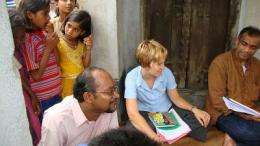
University of Maryland researcher Vivian Hoffmann has studied poverty, migration, and economic development in Africa and elsewhere, and she has first-hand experience with issues facing women in the developing world. Now, through a $1.3 million grant from the Bill & Melinda Gates Foundation, she will lead a team of researchers in a project that will shed light on women's menstrual practices, needs, and product demands and help to inform sanitation planning in developing countries.
Although expanding and improving access to sanitation services is recognized as a critical challenge to improving global public health, little attention has been paid thus far to women's menstrual management practices. "There is anecdotal evidence
that menstrual management issues have a real impact on the lives and opportunities of girls and women in low-income countries," said Hoffmann who is a professor in the University of Maryland's Department of Agricultural and Resource Economics. "This study will give us reliable insight into those impacts and may spur innovation in the design and marketing of menstrual management products for low-income markets," she added.
Beliefs and behaviors related to menstrual management are an important factor: "They will make up an important part of our comprehensive literature review, and we expect to see an emphasis on the existing stigma, taboos, and secrecy that continue to exist around this topic, all of which pose challenges for adolescent girls and women's management of menstruation in public spaces – such as the marketplace, or the school," Hoffmann noted.
The project represents a mammoth undertaking. No fewer than five other organizations will mobilize resources to bring off the study, which is scheduled to be completed within two years. It will involve detailed case studies, focus groups, household surveys, interviews with experts, and clinical studies in one of the selected communities.
There will also be a randomized product dissemination and demand trial through
which women will be offered the opportunity to test and then purchase alternative menstrual management products. Data collected through this exercise will be used to develop predictions about the evolution of market demand for these products by
enhancing understanding of women's preferences concerning menstrual management options and their willingness to pay for alternative products.
Results from the case studies and product demand trial will be synthesized to characterize the current and possible future impacts of menstrual management product waste disposal on sanitation systems, and to develop recommendations for
how sanitation system design and operations could be adapted and improved to better serve the needs of menstruating women and girls.
The project is part of the foundation's broader efforts to explore next-generation systems that will benefit both the 2.5 billion people without current access to safe
sanitation and the 2.1 billion that have access to systems that are not sustainable as currently designed or used. PATH, the Stockholm Environmental Institute, the African Health and Population Research Center, Mount Holyoke College, and
Columbia University are among the collaborators making up the research team.
Vivian Hoffmann, Ph.D, is Assistant Professor in the Department of Agricultural and Resource Economics and a Faculty Associate of the Maryland Population Research Center at the University of Maryland. She has published articles in American Economic Review and World Development on how goods flow through households in developing countries.


