Tiny variation in one gene may have led to crucial changes in human brain
May 15, 2011 in Genetics
Tiny variation in 1 gene may have led to crucial changes in human brain

Enlarge

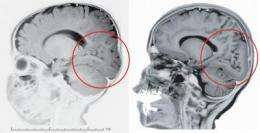
On the left, the occipital region of a normal human brain is circled. On the right, the same area of the brain of a subject with mutation of LAMC3 gene is smooth, and lacks normal folds and convolutions. Credit: courtesy of Yale University

The human brain has yet to explain the origin of one its defining features – the deep fissures and convolutions that increase its surface area and allow for rational and abstract thoughts.

An international collaboration of scientists from the Yale School of Medicine and Turkey may have discovered humanity's beneficiary – a tiny variation within a single gene that determines the formation of brain convolutions – they report online May 15 in the journal .

A genetic analysis of a Turkish patient whose brain lacks the characteristic convolutions in part of his cerebral cortex revealed that the deformity was caused by the deletion of two genetic letters from 3 billion in the human genetic alphabet. Similar variations of the same gene, called laminin gamma3 (LAMC3), were discovered in two other patients with similar abnormalities.

"The demonstration of the fundamental role of this gene in human brain development affords us a step closer to solve the mystery of the crown jewel of creation, the cerebral cortex," said Murat Gunel, senior author of the paper and the Nixdorff-German Professor of Neurosurgery, co-director of the Neurogenetics Program and professor of genetics and neurobiology at Yale.

The folding of the brain is seen only in mammals with larger brains, such as dolphins and apes, and is most pronounced in humans. These fissures expand the surface area of the cerebral cortex and allow for complex thought and reasoning without taking up more space in the skull. Such foldings aren't seen in mammals such as rodents or other animals. Despite the importance of these foldings, no one has been able to explain how the brain manages to create them. The LAMC3 gene – involved in cell adhesion that plays a key role in embryonic development – may be crucial to the process.

An analysis of the gene shows that it is expressed during the embryonic period that is vital to the formation of dendrites, which form synapses or connections between brain cells. "Although the same gene is present in lower organisms with smooth brains such as mice, somehow over time, it has evolved to gain novel functions that are fundamental for human occipital cortex formation and its mutation leads to the loss of surface convolutions, a hallmark of the human ," Gunel said.

Provided by Yale University search and more info website

4.5 /5 (13 votes)  

Filter


Move the slider to adjust rank threshold, so that you can hide some of the comments.


Display comments: newest first

Egleton
May 16, 2011

Rank: 5 / 5 (1)
So umm. What are the practical consequences of not having the crenulations to the patient?
Is the patient disadvantaged, and if so what form does the disadvantage take?
TAz00
May 16, 2011

Rank: not rated yet
Will they try to give the genes to other animals?
gmurphy
May 16, 2011

Rank: not rated yet
Interesting article but it suggests that the cortical folds allow for complex thought and reasoning. This is patently untrue. Corivd brains exhibit no such topological characteristics but are well known to be capable of highly complex behaviour.
Rank 4.5 /5 (13 votes)
Relevant PhysicsForums posts

More news stories

Key gene found responsible for chronic inflammation, accelerated aging and cancer

Researchers at NYU School of Medicine have, for the first time, identified a single gene that simultaneously controls inflammation, accelerated aging and cancer.

Genetics created 1 hour ago | popularity not rated yet | comments 0

Knowing genetic makeup may not significantly improve disease risk prediction

Harvard School of Public Health (HSPH) researchers have found that detailed knowledge about your genetic makeup—the interplay between genetic variants and other genetic variants, or between genetic variants and environmental ...

Genetics created 1 hour ago | popularity 2 / 5 (1) | comments 0 | with audio podcast

Male fertility genes discovered

A new study has revealed previously undiscovered genetic variants that influence fertility in men. The findings, published by Cell Press on May 24th in the American Journal of Human Genetics, shed much-needed light on hum ...

Genetics created 1 hour ago | popularity not rated yet | comments 0 | with audio podcast

New genetic method pinpoints geographic origin

(Medical Xpress) -- Understanding the genetic diversity within and between populations has important implications for studies of human disease and evolution. This includes identifying associations between genetic variants ...

Genetics created 6 hours ago | popularity not rated yet | comments 0 | with audio podcast

Whole genome sequencing of rare olfactory neuroblastoma

The Translational Genomics Research Institute (TGen) and the Virginia G. Piper Cancer Center at Scottsdale Healthcare have conducted whole genome sequencing (WGS) of a rare nasal tract cancer called olfactory neuroblastoma ...

Genetics created 20 hours ago | popularity not rated yet | comments 0 | with audio podcast


New test shows potential for detecting active cases of Lyme disease

George Mason University researchers can find out if a tick bite means Lyme disease well before the bite victim begins to show symptoms.

Researchers identify protein necessary for behavioral flexibility

Researchers have identified a protein necessary to maintain behavioral flexibility, which allows us to modify our behaviors to adjust to circumstances that are similar, but not identical, to previous experiences. Their findings, ...

Boundary stops molecule right where it needs to be

A molecule responsible for the proper formation of a key portion of the nervous system finds its way to the proper place not because it is actively recruited, but instead because it can't go anywhere else.

Thioridazine kills cancer stem cells in human while avoiding toxic side-effects of conventional cancer treatments

A team of scientists at McMaster University has discovered a drug, thioridazine, successfully kills cancer stem cells in the human while avoiding the toxic side-effects of conventional cancer treatments.

Researcher calls for new approach to regulating probiotics

In today's Nature scientific journal Dr. Gregor Reid, Director of the Canadian R&D Centre for Probiotics at Lawson Health Research Institute and a scientist at Western University, calls for a Category Tree system to be imp ...

A boost in microRNA may protect against sepsis and other inflammatory diseases

Acute inflammatory diseases, such as sepsis, as well as chronic inflammatory diseases like diabetes and arthritis, develop as a result of sustained inflammation of the blood vessel wall. Researchers at Brigham and Women's ...