Vaccine protects from deadly Hendra virus
May 17, 2011 in Medications

Vaccine protects from deadly Hendra virus

Enlarge

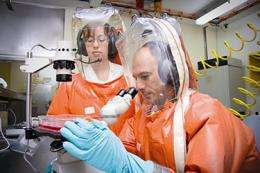
CSIRO's high bio-containment facility at the Australian Animal Health Laboratory was necessary to safely asses the vaccine’s effectiveness. Image credit - CSIRO

(Medical Xpress) -- CSIRO scientists have shown that a new experimental vaccine helps to protect horses against the deadly Hendra virus.

Dr Deborah Middleton from CSIRO’s Australian Animal Health Laboratory (AAHL) will announce the successful progress to develop the at the Australian Veterinary Association conference in Adelaide today.

“Our trials so far have shown that the vaccine prevents the infection of horses with Hendra virus,” Dr Middleton said.

Stopping the disease in horses could also help protect people from the disease.

“A horse vaccine is crucial to breaking the cycle of Hendra virus transmission from flying foxes to horses and then to people, as it prevents both the horse developing the disease and passing it on,” Dr Middleton said.

first appeared in 1994 and five of the 14 known outbreaks have spread to people. The virus has killed four of the seven people infected.

Depending on further development, field trials and registration the vaccine may be available as early as 2012.

Dr Barry Smyth, President of the Australian Veterinary Association, said that the news on the vaccine will be welcomed by both vets and horse owners.

“It’s important that veterinarians and horse owners continue with precautions that reduce the risk of spreading the virus and that they report suspected cases immediately,” Dr Smyth said.

Recent work on evaluating the vaccine was jointly funded by the CSIRO, the Australian Government Department of Agriculture, Fisheries and Forestry and the Queensland Government Department of Employment, Economic Development and Innovation.

The development of the vaccine goes back more than ten years to shortly after CSIRO scientists first isolated the following the first outbreak of the disease in Hendra, Queensland.

Development and source of the vaccine is the result of a close collaboration with Dr Christopher Broder of the Uniformed Services University of the Health Sciences (the US federal health sciences university) supported by the US National Institutes of Health, but the high bio-containment facility at AAHL was essential for evaluating its beneficial effects.

“Our bio-security facility at AAHL is the only laboratory in the world where this work could have been done. It has been slow, painstaking and high-risk work and the credit is due to many people who’ve worked on this since 1994,” Dr Middleton said.

Provided by CSIRO search and more info website

5 /5 (1 vote)  

Rank 5 /5 (1 vote)
Related Stories
Relevant PhysicsForums posts

More news stories

Acne pill benefits outweigh blood clot risk: EU agency

Europe's medicines watchdog said Friday the benefits of acne drug Diane-35, also widely used as a contraceptive, outweigh the risk of developing blood clots in the veins—when correctly prescribed.

Medications created May 17, 2013 | popularity not rated yet | comments 0

First influenza vaccine brought to clinical testing

Singapore's Agency for Science, Technology and Research (A*STAR) and Switzerland's Cytos Biotechnology AG today announced that the first healthy volunteer has been dosed in a Phase 1 clinical trial with their ...

Medications created May 17, 2013 | popularity 5 / 5 (1) | comments 0

Aspirin not always best treatment for many individuals

(Medical Xpress)—An aspirin a day may not always keep heart disease away, say two University of Florida cardiologists. But a new algorithm they have developed outlines factors physicians should weigh as ...

Medications created May 16, 2013 | popularity 3.5 / 5 (2) | comments 0 | with audio podcast

FDA: lower ambien's dose to prevent drowsy driving

(HealthDay)—The U.S. Food and Drug Administration has approved new, lower-dose labeling for the popular sleep drug Ambien (zolpidem) in an effort to cut down on daytime drowsiness that could be a hazard ...

Medications created May 15, 2013 | popularity not rated yet | comments 0

Simponi approved for ulcerative colitis

(HealthDay)—Simponi (golimumab) injection has been approved by the U.S. Food and Drug Administration to treat adults with moderate-to-severe ulcerative colitis.

Medications created May 15, 2013 | popularity not rated yet | comments 0


Computational tool translates complex data into simplified 2-dimensional images

In their quest to learn more about the variability of cells between and within tissues, biomedical scientists have devised tools capable of simultaneously measuring dozens of characteristics of individual ...

New theory on genesis of osteoarthritis comes with successful therapy in mice

Scientists at Johns Hopkins have turned their view of osteoarthritis (OA) inside out. Literally. Instead of seeing the painful degenerative disease as a problem primarily of the cartilage that cushions joints, ...

'Gap' for HIV vaccine efforts after latest setback

The hunt for an HIV vaccine has gobbled up $8 billion in the past decade, and the failure of the most recent efficacy trial has delivered yet another setback to 26 years of efforts.

Alzheimer's leaves bilingual victims stranded in Canada

The devastating effect of Alzheimer's disease on bilingual people has been thrown into focus in Canada, where the sudden loss of a second language can leave sufferers feeling like strangers in their own country.

Consuming coffee linked to lower risk of detrimental liver disease, study finds

Regular consumption of coffee is associated with a reduced risk of primary sclerosing cholangitis (PSC), an autoimmune liver disease, Mayo Clinic research shows. The findings were being presented at the Digestive Disease ...

Ketamine shows significant therapeutic benefit in people with treatment-resistant depression

Patients with treatment-resistant major depression saw dramatic improvement in their illness after treatment with ketamine, an anesthetic, according to the largest ketamine clinical trial to-date led by researchers from the ...