Adulterated cocaine causing serious skin reactions
June 20, 2011 in Medical research

Adulterated cocaine causing serious skin reactions

Enlarge

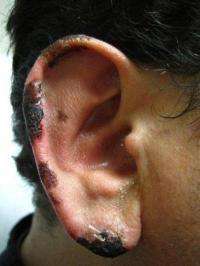
Doctors warn of a potential public health epidemic after treating patients with serious skin reactions after the patients had smoked or snorted cocaine believed to be contaminated with a veterinary medication. Credit: Dr. Noah Craft

Doctors warned of a potential public health epidemic in a recent report on patients in Los Angeles and New York who developed serious skin reactions after smoking or snorting cocaine believed to be contaminated with a veterinary medication drug dealers are using to dilute, or "cut," up to 70% of the cocaine in the U.S.

The report, published online in the Journal of the American Academy of Dermatology, said six patients developed purple-colored patches of necrotic skin on their ears, nose, cheeks and other parts of their body and, in some instances, suffered permanent scarring after they had used .

Doctors in San Francisco had previously reported two similar cases there. Others have also reported on users of contaminated cocaine who developed a related life-threatening immune-system disorder called agranulocytosis, which kills 7% to 10% of patients.

The U.S. Department of Justice has reported that up to 70% of cocaine in the U.S. is contaminated with the drug, levamisole, which is cheap, widely available and commonly used for deworming livestock. Levamisole had been prescribed for humans in the past but was discontinued after developing side effects similar to those found in the .

"We believe these cases of skin reactions and illnesses linked to contaminated cocaine are just the tip of the iceberg in a looming public health problem posed by levamisole," said Noah Craft, MD, PhD, a Los Biomedical Research Institute at Harbor-UCLA Medical Center (LA BioMed) principal researcher and author of the report in the Journal. "We published this report to educate the public to the additional risks associated with and to increase awareness among physicians who may see patients with these skin reactions that are a clue to the underlying cause of the disease. Because this reaction can commonly be mistaken as an autoimmune disease called vasculitis, it is important for physicians to know about this new disease entity."

Dr. Craft said he and other physicians were initially baffled by the severity of the skin damage. He is a member of a team of doctors who advise Logical Images, a company that developed a software program, called VisualDx, for diagnosing skin diseases and other conditions.

During one of their conference calls in May 2010, Dr. Craft said they began discussing the skin damage seen in emergency rooms in New York and Los Angeles and realized they were all seeing similar patterns and that the one common thread was the use of cocaine prior to the development of the . The cases were pooled and added into the professional database immediately so that other physicians across the US were then able to see this new diagnosis.

"We have had several more cases since we wrote this report," he said. "In one of the more interesting ones, the patient used cocaine again and developed the same skin reaction again. He then switched drug dealers and the problem cleared up."

Provided by Los Angeles Biomedical Research Institute at Harbor

not rated yet  

Rank not rated yet
Relevant PhysicsForums posts

More news stories

Computational tool translates complex data into simplified 2-dimensional images

In their quest to learn more about the variability of cells between and within tissues, biomedical scientists have devised tools capable of simultaneously measuring dozens of characteristics of individual ...

Medical research created 3 hours ago | popularity 5 / 5 (1) | comments 0 | with audio podcast

Now we know why old scizophrenia medicine works on antibiotics-resistant bacteria

In 2008 researchers from the University of Southern Denmark showed that the drug thioridazine, which has previously been used to treat schizophrenia, is also a powerful weapon against antibiotic-resistant bacteria such as ...

Medical research created May 17, 2013 | popularity 3.7 / 5 (3) | comments 0 | with audio podcast

SUMO wrestling cells reveal new protective mechanism target for stroke

Scientists investigating the interaction of a group of proteins in the brain responsible for protecting nerve cells from damage have identified a new target that could increase cell survival.

Medical research created May 17, 2013 | popularity 5 / 5 (1) | comments 0

How serotonin receptors can shape drug effects, from LSD to migraine medication

New findings by researchers carrying out experiments at the U.S. Department of Energy Office of Science's Advanced Photon Source (APS) help explain why some drugs that interact with two kinds of human serotonin ...

Medical research created May 17, 2013 | popularity 4 / 5 (1) | comments 0 | with audio podcast

Preventing blood poisoning

Peptide molecules derived from the body's natural immune system can help boost the body's defence against life-threatening blood poisoning, joint University research has uncovered.

Medical research created May 17, 2013 | popularity 4 / 5 (1) | comments 0 | with audio podcast


Researchers identify a potential new risk for sleep apnea: Asthma

Researchers at the University of Wisconsin have identified a potential new risk factor for obstructive sleep apnea: asthma. Using data from the National Institutes of Health (Heart, Lung, and Blood Institute)-funded Wisconsin ...

Study finds that sleep apnea and Alzheimer's are linked

A new study looking at sleep-disordered breathing (SDB) and markers for Alzheimer's disease (AD) risk in cerebrospinal fluid (CSF) and neuroimaging adds to the growing body of research linking the two.

New theory on genesis of osteoarthritis comes with successful therapy in mice

Scientists at Johns Hopkins have turned their view of osteoarthritis (OA) inside out. Literally. Instead of seeing the painful degenerative disease as a problem primarily of the cartilage that cushions joints, ...

'Gap' for HIV vaccine efforts after latest setback

The hunt for an HIV vaccine has gobbled up $8 billion in the past decade, and the failure of the most recent efficacy trial has delivered yet another setback to 26 years of efforts.

Ginger compounds may be effective in treating asthma symptoms

Gourmands and foodies everywhere have long recognized ginger as a great way to add a little peppery zing to both sweet and savory dishes; now, a study from researchers at Columbia University shows purified components of the ...

Alzheimer's leaves bilingual victims stranded in Canada

The devastating effect of Alzheimer's disease on bilingual people has been thrown into focus in Canada, where the sudden loss of a second language can leave sufferers feeling like strangers in their own country.