Antivenom against lethal snake gives hope to developing countries
June 30, 2011 in Diseases, Conditions, Syndromes
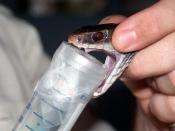
Venom extraction from Papuan taipan. Credit: David Williams
(Medical Xpress) -- Researchers from the Australian Venom Research Unit (AVRU) at the University of Melbourne have collaborated with scientists from the University of Papua New Guinea and the University of Costa Rica, to develop new antivenom against the lethal Papuan taipan.
The preclinical studies of this antivenom have been published in the international journal PLoS Neglected Tropical Diseases.
Around 750 people are bitten in PNG each year. PhD candidate David Williams from AVRU, who coordinated the project in PNG, said snakebite is a neglected public health problem compounded by antivenom shortages, poor infrastructure and inadequate health worker training in many of the worlds least developed countries, including PNG.
Most victims of snakebite are among the poorest, least empowered people in the world, he said.
Access to safe, affordable medicines is a basic human right and our focus is to give that right back to victims of snakebite in PNG and other developing nations.
This antivenom helps give Papua New Guineans that chance.
Researchers said the high cost of imported Australian antivenom has made it difficult for the PNG Government to meet demand. Chronic shortages have become common, creating a black market in stolen antivenoms that have been sold for up to three times their price.
Australian Venom Research Unit Director, Dr. Ken Winkel said AVRU and its partners in PNG and Costa Rica have shown that affordable, potent antivenom to one of the worlds most lethal snakes, the Papuan taipan can be produced for less than US$100 per dose by adopting a humanitarian approach to drug development.
The partnership between the three Universities involved in the project is a landmark example of how international cooperation can help to solve the challenge of delivering, high quality, effective antivenoms to developing world nations, he said.
Mr. Williams said with extra funding they could pursue a rigorous randomized controlled trial to test the safety and effectiveness of the new antivenom.
Provided by
University of Melbourne
-
Adrenaline given before snakebite anti-venom treatment reduces allergic reactions
May 10, 2011 |
not rated yet |
0
-
Biting back: Costa Rica experts harvest deadly snake venom
Apr 22, 2010 |
not rated yet |
0
-
Life s-s-s-saver? WHO launches snake venom website
May 04, 2010 |
not rated yet |
0
-
Snakebite is a neglected threat to global public health
Nov 04, 2008 |
not rated yet |
0
-
Research identifies importance of diet in snake venom evolution
Apr 08, 2009 |
not rated yet |
0
-
Limits to growth: Scientists identify key metastasis-enabling enzyme
May 22, 2012 |
5 / 5 (3) |
0
-
Seeing is as seeing does: Spatially-structured retinal input in early development of cortical maps
Apr 26, 2012 |
5 / 5 (4) |
1
-
Dreamless nights: Brain activity during nonrapid eye movement sleep
Apr 09, 2012 |
4.4 / 5 (12) |
0
-
Take your time: Neurobiology sheds light on the superiority of spaced vs. massed learning
Mar 28, 2012 |
4.5 / 5 (21) |
3
-
Your brain on 'shrooms: fMRI elucidates neural correlates of psilocybin psychedelic state
Feb 29, 2012 |
4.9 / 5 (42) |
45
-
Classical and Quantum Mechanics via Lie algebras
Apr 15, 2011
- More from Physics Forums - Independent Research
More news stories
New test shows potential for detecting active cases of Lyme disease
George Mason University researchers can find out if a tick bite means Lyme disease well before the bite victim begins to show symptoms.
Diseases, Conditions, Syndromes
2 hours ago |
not rated yet |
0
|
Dramatic increase in fragility fractures expected in Latin America
The International Osteoporosis Foundation (IOF), in cooperation with medical and patient societies from throughout Latin America, has today published a landmark report which compiles osteoporosis-related data on 14 countries ...
Diseases, Conditions, Syndromes
3 hours ago |
not rated yet |
0
Exercise does not improve lipoprotein levels in obese patients with fatty liver disease
New research found that moderate exercise does not improve lipoprotein concentrations in obese patients with non alcoholic fatty liver disease (NAFLD). Results published in the June issue of Hepatology, a journal of the Am ...
Diseases, Conditions, Syndromes
3 hours ago |
not rated yet |
0
A new strategy for developing meningitis vaccines
Bacterial meningitis is an infection of the meninges, the protective membrane that covers the spinal cord and brain. Children, elderly patients and immunocompromised patients are at a higher risk for the development of severe ...
Diseases, Conditions, Syndromes
3 hours ago |
not rated yet |
0
In Brazil number of hip fractures expected to increase 32 percent by 2050
A new Audit report on fragility fractures, issued today by the International Osteoporosis Foundation (IOF), predicts that Brazil will experience an explosion in the number of fragility fractures due to osteoporosis in the ...
Diseases, Conditions, Syndromes
3 hours ago |
not rated yet |
0
Researchers identify protein necessary for behavioral flexibility
Researchers have identified a protein necessary to maintain behavioral flexibility, which allows us to modify our behaviors to adjust to circumstances that are similar, but not identical, to previous experiences. Their findings, ...
Boundary stops molecule right where it needs to be
A molecule responsible for the proper formation of a key portion of the nervous system finds its way to the proper place not because it is actively recruited, but instead because it can't go anywhere else.
Thioridazine kills cancer stem cells in human while avoiding toxic side-effects of conventional cancer treatments
A team of scientists at McMaster University has discovered a drug, thioridazine, successfully kills cancer stem cells in the human while avoiding the toxic side-effects of conventional cancer treatments.
Researcher calls for new approach to regulating probiotics
In today's Nature scientific journal Dr. Gregor Reid, Director of the Canadian R&D Centre for Probiotics at Lawson Health Research Institute and a scientist at Western University, calls for a Category Tree system to be imp ...
Male fertility genes discovered
A new study has revealed previously undiscovered genetic variants that influence fertility in men. The findings, published by Cell Press on May 24th in the American Journal of Human Genetics, shed much-needed light on hum ...
Knowing genetic makeup may not significantly improve disease risk prediction
Harvard School of Public Health (HSPH) researchers have found that detailed knowledge about your genetic makeupthe interplay between genetic variants and other genetic variants, or between genetic variants and environmental ...