Study suggests 'hard to read' fonts may increase reading retention
June 1, 2011 by Bob Yirka in Psychology & Psychiatry report

Study suggests 'hard to read' fonts may increase reading retention

(Medical Xpress) -- Researchers from Indiana University and Princeton, in a paper published in Cognition, describe two experiments they conducted that appear to show reading retention improves when fonts that are considered harder to read are used.

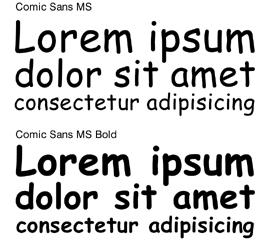
In the study, as described by lead author, Connor Diemand-Yauman in an interview with ABC Radio National, a first group of volunteers, comprised of 28 adults, were asked to read some fictional text and then were asked questions about the characters involved afterwards. The volunteers were divided into three groups, with each being given the same text but printed in a different font; the first got 16-point Arial, the second 12-point Comic Sans MS and the third 12-point Bodoni MT. The group that had the so-called hard to read Comic Sans outperformed the other two on the questions given afterwards.

In the second study, the volunteers were high school students (over 220 of them, from six separate groups) reading normal course material in different fonts; some of which were considered hard to read, such as Comic Sans or Monotype Corsiva. Once again, those that were reading the material printed in the more difficult to read fonts outperformed those reading easier type on tests given afterwards.

Diemand-Yauman says these experiments show that people tend to remember what they’ve read better if the material given is in a hard to read font.

What’s not discussed in the paper, however, is if it was possible that the results achieved were due simply to the newness of the fonts to the readers, thus heightening their awareness, or what criteria was chosen in deciding which fonts should be considered as “hard to read.” Many fans of Comic Sans, for example might argue that it’s actually easier to read than say Arial, or Callibri, both of which are considered easy to read by most in the mainstream.

Also, if what the study suggests is true, might it be possible to integrate such fonts as Comic Sans into textbooks, or journals (or on the web) to help improve retention, and hopefully overall learning, or would such hard to fonts cause excessive eyestrain and headaches?

In either case, it’s clear that this research has opened the door to a new area of learning science that will no-doubt lead to more studies which will hopefully clear up such questions and in the end provide us all with the best font for whatever we might be reading.

More information: Fortune favors the bold (and the Italicized): Effects of disfluency on educational outcomes, Cognition, doi:10.1016/j.cognition.2010.09.012

Abstract
Previous research has shown that disfluency – the subjective experience of difficulty associated with cognitive operations – leads to deeper processing. Two studies explore the extent to which this deeper processing engendered by disfluency interventions can lead to improved memory performance. Study 1 found that information in hard-to-read fonts was better remembered than easier to read information in a controlled laboratory setting. Study 2 extended this finding to high school classrooms. The results suggest that superficial changes to learning materials could yield significant improvements in educational outcomes.

© 2010 PhysOrg.com

5 /5 (6 votes)  

Filter


Move the slider to adjust rank threshold, so that you can hide some of the comments.


Display comments: newest first

xstos
Jun 01, 2011

Rank: 5 / 5 (1)
I hate hard to read fonts. I set firefox to override every font with tahoma (both serif and sans serif) and my enjoyment increases immensely.
trantor
Jun 01, 2011

Rank: 5 / 5 (1)
there is one problem with this study. People were ASKED to read the text. So people tried hard to read the texts with difficult to read fonts, and obviously, since they had to pay more attention, they could remember the text better.

But what the study forgot to verify, is if people, in their normal lifes, would try so hard to read texts with difficult to read fonts!

When confronted with some texts in REALLY hard fonts, like Gothic fonts and some others, where its hard to even identify caracthers, I usually give up on reading them.

I suppose however that a medieval monk would have an easier time reading a text in gothic font than in Comic Sans or Arial.
RobertKarlStonjek
Jun 02, 2011

Rank: not rated yet
The 'hard to read' status quickly evaporates as one habituates to it, so novelty is the key. Compare Medieval fonts (eg Gothic), for instance, which is only just legible to the uninitiated but can be read fluently by those familiar with it.

Trantor is on the money in my opinion.
Rank 5 /5 (6 votes)
Relevant PhysicsForums posts

More news stories

Motion quotient: IQ predicted by ability to filter motion (w/ video)

A brief visual task can predict IQ, according to a new study. This surprisingly simple exercise measures the brain's unconscious ability to filter out visual movement. The study shows that individuals whose ...

Psychology & Psychiatry created 19 minutes ago | popularity 5 / 5 (1) | comments 0 | with audio podcast

Anxious men fare worse during job interviews, study finds

Nervous about that upcoming job interview? You might want to take steps to reduce your jitters, especially if you are a man.

Psychology & Psychiatry created 1 hour ago | popularity not rated yet | comments 0

Are kids who take music lessons different from other kids?

(Medical Xpress)—Research by U of T Mississauga psychology professor Glenn Schellenberg reveals that two key personality traits – openness-to-experience and conscientiousness—predict better than IQ ...

Psychology & Psychiatry created 3 hours ago | popularity 5 / 5 (1) | comments 0 | with audio podcast

Parents can help preteens with abduction concerns

Parents naturally are concerned for their children's safety, particularly when there is news of a child abduction that happens close to home. Finding the balance between emotions and the "teachable moment" as parents talk ...

Psychology & Psychiatry created 3 hours ago | popularity not rated yet | comments 0

Ireland needs real-time database for teen and young adult suicides

A new report on suicide in Ireland shows that suicide cases experienced a significant number (and intensity) of life events in the 6 months prior to their death.

Psychology & Psychiatry created 3 hours ago | popularity not rated yet | comments 0


Regenerating spinal cord fibers may be treatment for stroke-related disabilities

A study by researchers at Henry Ford Hospital found "substantial evidence" that a regenerative process involving damaged nerve fibers in the spinal cord could hold the key to better functional recovery by most stroke victims.

The secret lives, and deaths, of neurons

As the human body fine-tunes its neurological wiring, nerve cells often must fix a faulty connection by amputating an axon—the "business end" of the neuron that sends electrical impulses to tissues or other ...

Protein preps cells to survive stress of cancer growth and chemotherapy

Scientists have uncovered a survival mechanism that occurs in breast cells that have just turned premalignant-cells on the cusp between normalcy and cancers-which may lead to new methods of stopping tumors.

Defective cellular waste removal explains why Gaucher patients often develop Parkinson's disease

Gaucher disease causes debilitating and sometimes fatal neurodegeneration in early childhood. Recent studies have uncovered a link between the mutations responsible for Gaucher disease and an increased risk ...

Breakthrough on Huntington's disease

Researchers at Lund University have succeeded in preventing very early symptoms of Huntington's disease, depression and anxiety, by deactivating the mutated huntingtin protein in the brains of mice.

Frequent heartburn may predict cancers of the throat and vocal cord

Frequent heartburn was positively associated with cancers of the throat and vocal cord among nonsmokers and nondrinkers, and the use of antacids, but not prescription medications, had a protective effect, according to data ...