HIV disrupts blood-brain barrier
June 28, 2011 in HIV & AIDS
HIV disrupts blood-brain barrier

Enlarge

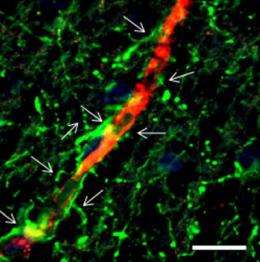
Astrocytes (pictured in green) help to support blood vessels (red) that act as the blood‑brain barrier ‑ a network that keeps potentially harmful chemicals and toxins out of the brain. This image shows the close interaction between the cells in the human brain. Credit: Reprinted with permission: Eugenin, et al. The Journal of Neuroscience 2011.

HIV weakens the blood-brain barrier — a network of blood vessels that keeps potentially harmful chemicals and toxins out of the brain — by overtaking a small group of supporting brain cells, according to a new study in the June 29 issue of The Journal of Neuroscience. The findings may help explain why some people living with HIV experience neurological complications, despite the benefits of modern drug regimens that keep them living longer.

Standard antiretroviral treatments successfully suppress the replication of and slow the progression of the disease. Yet recent studies show 40 to 60 percent of patients on such therapy continue to experience mild to moderate neurological deficits — including memory loss and learning challenges.

In the new study, Eliseo Eugenin, PhD, of Albert Einstein College of Medicine, found that HIV infection in a small number of supporting brain cells called astrocytes breaks down the blood-brain barrier, despite low to undetectable viral production. Under normal conditions astrocytes help bolster the blood vessels comprising the barrier.

To test if HIV interfered with this support system, Eugenin and his colleagues built a model of the blood-brain barrier using human cells in the laboratory. In a previous study, the researchers found HIV infects around 5 percent of astrocytes. In the current study, the researchers found the presence of HIV in a similar percentage of astrocytes led to the death of nearby uninfected cells and made the barrier more permeable.

As the neighboring cells died, however, HIV-infected astrocytes survived. Astrocytes exchange chemical signals through specialized molecules called gap junctions. When they were blocked in the model, it prevented the changes to the blood-brain barrier and nearby cells, suggesting the infected astrocytes relay toxic signals to neighboring cells through the gap junctions.

"Our results suggest HIV infection of astrocytes may be important in the onset of cognitive impairment in people living with the disease," Eugenin said. "New therapies are needed that not only target the virus, but also to stop the virus from spreading damage to other uninfected brain cells."

Eugenin's group also analyzed the brain tissue of macaque monkeys infected with the simian form of HIV. Similar to what they saw in the human model, the researchers found uninfected in contact with HIV-infected astrocytes died, while infected astrocytes remained alive as the disease progressed.

"Researchers have been stymied to explain why HIV-associated neurological complications persist, despite potent combination antiviral therapies that have dramatically improved health and survival," said Igor Grant, an expert who studies HIV-associated neurocognitive impairment at the University of California, San Diego. "This study provides a possible explanation indicating that minute numbers of infected astrocytes can trigger a cascade of signals that could open the brain to various toxic influences."

The findings open up the possibility of developing new therapeutic approaches that block or modify the transmission of signals from the HIV-infected astrocytes, added Grant, who was not affiliated with the study.

Provided by Society for Neuroscience search and more info website

4.3 /5 (3 votes)  

Filter


Move the slider to adjust rank threshold, so that you can hide some of the comments.


Display comments: newest first

dutchman
Jun 29, 2011

Rank: not rated yet

Not sure I understand this. Is it the virus or is it the retroviral cocktail?
Rank 4.3 /5 (3 votes)
Relevant PhysicsForums posts

More news stories

Mortality rates decrease, chronic disease rates increase among HIV+ ICU patients

The expanded use of antiretrovirals, potent drugs used to treat retroviral infections such as human immunodeficiency virus (HIV), has been linked to significant decreases in hospital mortality rates among severely ill HIV-positive(HIV+) ...

HIV & AIDS created May 23, 2012 | popularity not rated yet | comments 0

Newly discovered breast milk antibodies help neutralize HIV

Antibodies that help to stop the HIV virus have been found in breast milk. Researchers at Duke University Medical Center isolated the antibodies from immune cells called B cells in the breast milk of infected mothers in Malawi, ...

HIV & AIDS created May 22, 2012 | popularity 5 / 5 (3) | comments 1 | with audio podcast

Reactions to HIV drug have autoimmune cause, reports AIDS journal

Potentially severe hypersensitivity reactions to the anti-HIV drug abacavir occur through an autoimmune mechanism, resulting from the creation of drug-induced immunogens that are attacked by the body's immune system, according ...

HIV & AIDS created May 22, 2012 | popularity 5 / 5 (1) | comments 0

Is the U.S. ready for home HIV tests?

At the pharmacy, you can buy anything from tea kettles to Tylenol. But what if you could buy a rapid HIV test over the counter and test yourself in the privacy of your own home?

HIV & AIDS created May 21, 2012 | popularity not rated yet | comments 0 | with audio podcast

Reduced glycerin formulation of tenofovir vaginal gel safe for rectal use

A change in the formulation of tenofovir gel, an anti-HIV gel developed for vaginal use, may make it safer to use in the rectum, suggests a study published online this week in the Journal of Antimicrobial Chemotherapy. In lab ...

HIV & AIDS created May 17, 2012 | popularity 5 / 5 (1) | comments 0


'Personality genes' may help account for longevity

"It's in their genes" is a common refrain from scientists when asked about factors that allow centenarians to reach age 100 and beyond. Up until now, research has focused on genetic variations that offer a physiological advantage ...

Amino acid consumption associated with how fast cancer cells divide

For almost a century, researchers have known that cancer cells have peculiar appetites, devouring glucose in ways that normal cells do not. But glucose uptake may tell only part of cancer's metabolic story. Researchers from ...

Gene discovery points towards non-hormonal male contraceptive

A new type of male contraceptive could be created thanks to the discovery of a key gene essential for sperm development.

Brentuximab vedotin effective in large-cell lymphoma

(HealthDay) -- More than half of patients with relapsed or refractory systemic anaplastic large-cell lymphoma (ALCL) treated with the CD30-directed antibody-drug conjugate brentuximab vedotin achieve a complete ...

Study provides compelling evidence for an effective new treatment for tinnitus

According to new research, a multidisciplinary approach to treating tinnitus that combines cognitive behaviour therapy with sound-based tinnitus retraining therapy is significantly more effective than currently available ...

Cyber exercise partners help you go the distance: Motivation gains can double

A new study testing the benefits of a virtual exercise partner shows the presence of a moderately more capable cycling partner can significantly boost the motivation – by as much as 100 percent – ...