Placing landmarks on the genome map
June 2, 2011 By Aaron Dubrow in Genetics
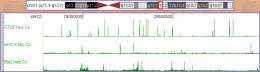
The schematic diagram shows human chromosome 21 with a small region outlined in red. The main rectangle below is a close-up of the outlined region, showing the binding locations of three transcription factors along the chromosome. Credit: Courtesy of Vishy Iyer
Supercomputers and next-generation gene sequencers allow researchers to explore DNA and heredity.
We typically think of heredity--eye color, body type or susceptibility to a disease--as rooted in our genes. And it is. But as biologists sequence more genomes and analyze the results, they're finding that the non-coding regions of the genome outside the genes, formerly considered "junk," play an important role in our genetic make-up as well.
Since 2001, the cost of DNA sequencing a human genome has dropped from billions to tens of thousands of dollars, enabling more focused investigations of gene expression. This has greatly improved scientists' ability to understand biological systems and their relation to illness.
Many common diseases have a genetic component that predisposes one to become sick, but the connection is rarely simple. The combination of next-generation gene sequencers and high-performance computers are enabling biologists to ask novel questions about our DNA and to glean new insights about disease and heredity.
An important example involves the role of transcription factor proteins in gene regulation, which scientists are just beginning to explore. These proteins bind to landing pads on the genome and act as control dials for gene regulation--turning genes on or off, and determining the level of gene activity in a cell.
"If you're comparing normal cells to cancer cells, you want to know what happened in the cancer cell that makes it different," said Vishy Iyer, at the University of Texas at Austin. "The gene expression patterns change, and we want to know which genes are regulated up or down, and how that came about."
About 2,000 transcription factor proteins have been identified, and some have been linked to breast and other cancers, Rett syndrome, and autoimmune diseases. However, little is known about how they work.
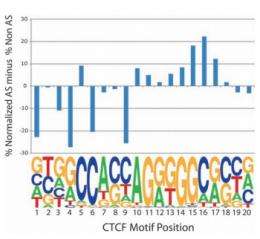
Representation of allele-specific and non-allele-specific single nucleotide polymorphisms (SNPs) across the CTCF binding motif (17). The y-axis indicates the difference between the two as a percentage of normalized total SNPs. Higher bars indicate an increased representation of allele-specific SNPs relative to other positions, which tend to occur at conserved positions. Credit: McDaniell, R., et al. 2010. Heritable Individual-Specific and Allele-Specific Chromatin Signatures in Humans. Science 328 (5975): 235-239.
Iyer, along with colleagues at Duke University, University of North Carolina at Chapel Hill, National Human Genome Research Institute and Wellcome Trust Genome Campus, are trying to change that. Published in the journal Science in 2010, their research was one of the first studies to use next-generation sequencing and supercomputers to explore the expression of genes related to a specific regulatory transcription factor (called CTCF). They determined that transcription factor binding is a heritable trait."We showed for the first time that some of the differences in DNA between individuals can affect the binding of transcription factors," said Iyer. "More importantly, that those differences could be inherited."
The group used a relatively new sequencing technology, called ChIP-Seq, to study only the regions of DNA to which the proteins of interest were bound. These base pairs were then sequenced to determine the order of nucleotides and to count how many molecules were bound to the protein.
Sounds simple enough, until you try to sequence millions of these regions to locate their exact position among the approximately three billion base pairs in the human genome.
"The genome is a vast area with many features," said Iyer. "You can think of the proteins as landmarks that we're trying to place on the genome map."
The National Science Foundation-funded Ranger supercomputer at the Texas Advanced Computing Center took the short sequence reads generated by ChIP-Seq and aligned them to the reference genome.
"It's like a text search. Though if you tried to run it in Microsoft Word, it would never finish," Iyer joked.
Using several thousand processors simultaneously on Ranger, the alignment took several hours for each of the data sets, and, in total, used the equivalent of 20 years on a single processor.
The single base resolution offered by next-generation sequencing enabled the researchers to look at individual, known differences in the DNA and to use those dissimilarities to examine how genes on each chromosome bind transcription factors.
"We could tell the difference in binding from the gene that you inherited from your father and mother--that was the big advance," said Iyer. "Now, we're applying this technology to cases where you know that the gene from one of your parents has a mutation that pre-disposes you to some disease."
These findings bring science one step closer to personalized medicine based on a detailed reading of an individual's genome, including the non-coding regions. Despite the tremendous complexity of the genome, Iyer is optimistic that the research will have an impact on human health.
"There are lots of diseases and for a subset, they're affecting gene expression by impacting transcription factors," he said. "If we pick the diseases and the factors smartly, I think we'll find them."
Provided by
National Science Foundation
-
Gene regulation in humans is closer than expected to simple organisms
Aug 29, 2007 |
not rated yet |
0
-
What makes us unique? Not genes so much as surrounding sequences
Mar 18, 2010 |
not rated yet |
0
-
Rewiring of gene regulation across 300 million years of evolution
Apr 09, 2010 |
not rated yet |
0
-
Rewrite the textbooks: Transcription is bidirectional
Jan 25, 2009 |
not rated yet |
0
-
'Moonlighting' molecules discovered
Oct 29, 2009 |
not rated yet |
0
-
Limits to growth: Scientists identify key metastasis-enabling enzyme
May 22, 2012 |
5 / 5 (3) |
0
-
Seeing is as seeing does: Spatially-structured retinal input in early development of cortical maps
Apr 26, 2012 |
5 / 5 (4) |
1
-
Dreamless nights: Brain activity during nonrapid eye movement sleep
Apr 09, 2012 |
4.4 / 5 (12) |
0
-
Take your time: Neurobiology sheds light on the superiority of spaced vs. massed learning
Mar 28, 2012 |
4.5 / 5 (21) |
3
-
Your brain on 'shrooms: fMRI elucidates neural correlates of psilocybin psychedelic state
Feb 29, 2012 |
4.9 / 5 (42) |
45
-
Classical and Quantum Mechanics via Lie algebras
Apr 15, 2011
- More from Physics Forums - Independent Research
More news stories
'Personality genes' may help account for longevity
"It's in their genes" is a common refrain from scientists when asked about factors that allow centenarians to reach age 100 and beyond. Up until now, research has focused on genetic variations that offer a physiological advantage ...
Genetics
3 hours ago |
not rated yet |
0
|
Gene discovery points towards non-hormonal male contraceptive
A new type of male contraceptive could be created thanks to the discovery of a key gene essential for sperm development.
Genetics
3 hours ago |
5 / 5 (3) |
0
|
Key gene found responsible for chronic inflammation, accelerated aging and cancer
Researchers at NYU School of Medicine have, for the first time, identified a single gene that simultaneously controls inflammation, accelerated aging and cancer.
Genetics
8 hours ago |
not rated yet |
0
Knowing genetic makeup may not significantly improve disease risk prediction
Harvard School of Public Health (HSPH) researchers have found that detailed knowledge about your genetic makeupthe interplay between genetic variants and other genetic variants, or between genetic variants and environmental ...
Genetics
8 hours ago |
2 / 5 (1) |
0
|
Male fertility genes discovered
A new study has revealed previously undiscovered genetic variants that influence fertility in men. The findings, published by Cell Press on May 24th in the American Journal of Human Genetics, shed much-needed light on hum ...
Genetics
8 hours ago |
not rated yet |
0
|
Amino acid consumption associated with how fast cancer cells divide
For almost a century, researchers have known that cancer cells have peculiar appetites, devouring glucose in ways that normal cells do not. But glucose uptake may tell only part of cancer's metabolic story. Researchers from ...
Thioridazine kills cancer stem cells in human while avoiding toxic side-effects of conventional cancer treatments
A team of scientists at McMaster University has discovered a drug, thioridazine, successfully kills cancer stem cells in the human while avoiding the toxic side-effects of conventional cancer treatments.
Cyber exercise partners help you go the distance: Motivation gains can double
A new study testing the benefits of a virtual exercise partner shows the presence of a moderately more capable cycling partner can significantly boost the motivation by as much as 100 percent ...
Brentuximab vedotin effective in large-cell lymphoma
(HealthDay) -- More than half of patients with relapsed or refractory systemic anaplastic large-cell lymphoma (ALCL) treated with the CD30-directed antibody-drug conjugate brentuximab vedotin achieve a complete ...
Study provides compelling evidence for an effective new treatment for tinnitus
According to new research, a multidisciplinary approach to treating tinnitus that combines cognitive behaviour therapy with sound-based tinnitus retraining therapy is significantly more effective than currently available ...
Researchers identify protein necessary for behavioral flexibility
Researchers have identified a protein necessary to maintain behavioral flexibility, which allows us to modify our behaviors to adjust to circumstances that are similar, but not identical, to previous experiences. Their findings, ...
