Understanding the link between HIV and dementia
June 29, 2011 in HIV & AIDS
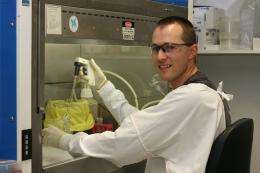
(Medical Xpress) -- HIV can hide out in the brain, protected from the immune system and antiviral drugs, Dr. Lachlan Gray and his colleagues at Monash University and the Burnet Institute have found.
Their discovery is an important step in understanding the link between HIV infection and HIV dementia, and is important for the eradication of HIV in general.
The persistence of the virus in the brain compromises the brains normal function, and leads to the death of neurons and to clinical dementia, Lachlan says.
In fact, about one in five of those infected by HIV ends up with dementia.
We believe our findings will aid the development of novel drugs that will prevent HIV using the brain as a sanctuary, and help to shape future eradication strategies.
Lachlans work is being presented for the first time in public through Fresh Science, a communication boot camp for early career scientists held at the Melbourne Museum. He was one of 16 winners from across Australia.
Lachlan has been examining the life cycle of the virus to understand better how it survives within the brain.
Weve identified changes in the way the virus reproduces, which allows it to keep a low profile and persist undetected in the brain.
At present, people living with HIV must rely on the continued use of antiviral drugs to control their infection.
Viral persistence is a major barrier to the cure of AIDS. Modern drugs are very good at controlling the virus, but they are unable to eradicate it from sanctuary sites like the brain, Lachlans supervisor, Associate Professor Melissa Churchill says.
Unfortunately, brain infection often leads to dementia which can be very debilitating. Somewhat more concerning, HIV is now the commonest cause of dementia in people under the age of 40, and is placing an extra burden on our mental health services.
Lachlans research is part of a larger project aiming to trial new drugs that could potentially eradicate or even cure HIV.
Lachlan Gray is one of 16 early-career scientists unveiling their research to the public for the first time thanks to Fresh Science, a national program sponsored by the Australian Government.
Provided by Fresh Science
-
Kids born with HIV growing up well
Apr 21, 2011 |
not rated yet |
0
-
Neural progenitor cells as reservoirs for HIV in the brain
Mar 04, 2008 |
not rated yet |
0
-
Insight into HIV immunity may lead to vaccine
May 06, 2011 |
not rated yet |
0
-
HIV is a 'double hit' to the brain
Aug 15, 2007 |
not rated yet |
0
-
Ridding the human body of HIV
Dec 02, 2010 |
not rated yet |
0
-
Limits to growth: Scientists identify key metastasis-enabling enzyme
May 22, 2012 |
5 / 5 (3) |
0
-
Seeing is as seeing does: Spatially-structured retinal input in early development of cortical maps
Apr 26, 2012 |
5 / 5 (4) |
1
-
Dreamless nights: Brain activity during nonrapid eye movement sleep
Apr 09, 2012 |
4.4 / 5 (12) |
0
-
Take your time: Neurobiology sheds light on the superiority of spaced vs. massed learning
Mar 28, 2012 |
4.5 / 5 (21) |
3
-
Your brain on 'shrooms: fMRI elucidates neural correlates of psilocybin psychedelic state
Feb 29, 2012 |
4.9 / 5 (42) |
45
-
Classical and Quantum Mechanics via Lie algebras
Apr 15, 2011
- More from Physics Forums - Independent Research
More news stories
Mortality rates decrease, chronic disease rates increase among HIV+ ICU patients
The expanded use of antiretrovirals, potent drugs used to treat retroviral infections such as human immunodeficiency virus (HIV), has been linked to significant decreases in hospital mortality rates among severely ill HIV-positive(HIV+) ...
HIV & AIDS
May 23, 2012 |
not rated yet |
0
Newly discovered breast milk antibodies help neutralize HIV
Antibodies that help to stop the HIV virus have been found in breast milk. Researchers at Duke University Medical Center isolated the antibodies from immune cells called B cells in the breast milk of infected mothers in Malawi, ...
HIV & AIDS
May 22, 2012 |
5 / 5 (3) |
1
|
Reactions to HIV drug have autoimmune cause, reports AIDS journal
Potentially severe hypersensitivity reactions to the anti-HIV drug abacavir occur through an autoimmune mechanism, resulting from the creation of drug-induced immunogens that are attacked by the body's immune system, according ...
HIV & AIDS
May 22, 2012 |
5 / 5 (1) |
0
Is the U.S. ready for home HIV tests?
At the pharmacy, you can buy anything from tea kettles to Tylenol. But what if you could buy a rapid HIV test over the counter and test yourself in the privacy of your own home?
HIV & AIDS
May 21, 2012 |
not rated yet |
0
|
Reduced glycerin formulation of tenofovir vaginal gel safe for rectal use
A change in the formulation of tenofovir gel, an anti-HIV gel developed for vaginal use, may make it safer to use in the rectum, suggests a study published online this week in the Journal of Antimicrobial Chemotherapy. In lab ...
HIV & AIDS
May 17, 2012 |
5 / 5 (1) |
0
Amino acid consumption associated with how fast cancer cells divide
For almost a century, researchers have known that cancer cells have peculiar appetites, devouring glucose in ways that normal cells do not. But glucose uptake may tell only part of cancer's metabolic story. Researchers from ...
'Personality genes' may help account for longevity
"It's in their genes" is a common refrain from scientists when asked about factors that allow centenarians to reach age 100 and beyond. Up until now, research has focused on genetic variations that offer a physiological advantage ...
Gene discovery points towards non-hormonal male contraceptive
A new type of male contraceptive could be created thanks to the discovery of a key gene essential for sperm development.
Thioridazine kills cancer stem cells in human while avoiding toxic side-effects of conventional cancer treatments
A team of scientists at McMaster University has discovered a drug, thioridazine, successfully kills cancer stem cells in the human while avoiding the toxic side-effects of conventional cancer treatments.
Cyber exercise partners help you go the distance: Motivation gains can double
A new study testing the benefits of a virtual exercise partner shows the presence of a moderately more capable cycling partner can significantly boost the motivation by as much as 100 percent ...
Brentuximab vedotin effective in large-cell lymphoma
(HealthDay) -- More than half of patients with relapsed or refractory systemic anaplastic large-cell lymphoma (ALCL) treated with the CD30-directed antibody-drug conjugate brentuximab vedotin achieve a complete ...