Lyme disease bacteria take cover in lymph nodes, study finds
June 9, 2011 in Diseases, Conditions, Syndromes
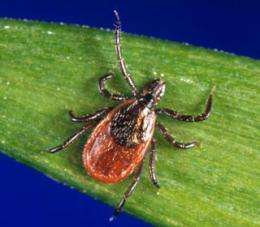
The black-legged tick transmits Lyme disease. (Michael L. Levin/Centers for Disease Control photo)
(Medical Xpress) -- The bacteria that cause Lyme disease, one of the most important emerging diseases in the United States, appear to hide out in the lymph nodes, triggering a significant immune response, but one that is not strong enough to rout the infection, report researchers at the University of California, Davis.
Results from this groundbreaking study involving mice may explain why some people experience repeated infections of Lyme disease. The study appears online in the journal Public Library of Science Biology at: http://tinyurl.com/3vs8pm9 .
Our findings suggest for the first time that Borrelia burgdorferi, the bacteria that cause Lyme disease in people, dogs and wildlife, have developed a novel strategy for subverting the immune response of the animals they infect, said Professor Nicole Baumgarth, an authority on immune responses at the UC Davis Center for Comparative Medicine.
At first it seems counter intuitive that an infectious organism would choose to migrate to the lymph nodes where it would automatically trigger an immune response in the host animal, Baumgarth said. But B. burgdorferi have apparently struck an intricate balance that allows the bacteria to both provoke and elude the animals immune response.
Lyme disease, the most important tick-borne disease in the United States is caused by Borrelia burgdorferi, corkscrew-shaped bacteria also known as spirochetes. The disease is transmitted to humans and animals through bites from infected deer ticks. The disease occurs mainly in the Northeastern and Great Lakes states, and is present to a lesser extent in Northern California.
Symptoms of Lyme disease are quite variable and may include fever, headache, fatigue and a skin rash. If the infection is not treated, it can spread to the joints, heart and nervous system.
Usually, Lyme disease can be successfully treated with about four weeks of antibiotics; treatment is most successful during the early stages of infection.
Swollen lymph nodes, or lymphadenopathy, is one of the hallmarks of Lyme disease, although it has been unclear why this occurs or how it affects the course of the disease. The UC Davis research team set out to explore in mice the mechanisms that cause the enlarged lymph nodes and to determine the nature of the resulting immune response.
They found that when mice were infected with B. burgdorferi, these live spirochetes accumulated in the animals lymph nodes. The lymph nodes responded with a strong, rapid accumulation of B cells, white blood cells that produce antibodies to fight infections. Also, the presence of B. burgdorferi caused the destruction of the distinct architecture of the lymph node that usually helps it to function normally.
While B cells accumulated in large numbers and made some specific antibodies against B. burgdorferi, they did not form germinal centers, structures that are needed for the generation of highly functional and long-lived antibody responses.
Overall, these findings suggest that B. burgdorferi hinder the immune system from generating a response that is fully functional and that can persist and protect after repeat infections, Baumgarth said. Thus, the study might explain why people living in endemic areas can be repeatedly infected with these disease-causing spirochetes.
Provided by
UC Davis
-
Lingering bacteria don't indicate chronic Lyme disease
Apr 01, 2008 |
not rated yet |
0
-
Lingering Bacteria Don't Indicate Chronic Lyme Disease
Mar 31, 2008 |
not rated yet |
0
-
Genetic blueprint of bacteria causing Lyme disease unraveled
Oct 14, 2010 |
not rated yet |
0
-
Researchers track Lyme disease spirochetes
Jun 20, 2008 |
not rated yet |
0
-
Birds Play an Important Role in the Spread of Lyme Disease
Dec 23, 2009 |
not rated yet |
0
-
Motion perception revisited: High Phi effect challenges established motion perception assumptions
Apr 23, 2013 |
3 / 5 (2) |
2
-
Anything you can do I can do better: Neuromolecular foundations of the superiority illusion (Update)
Apr 02, 2013 |
4.5 / 5 (11) |
5
-
The visual system as economist: Neural resource allocation in visual adaptation
Mar 30, 2013 |
5 / 5 (2) |
9
-
Separate lives: Neuronal and organismal lifespans decoupled
Mar 27, 2013 |
4.9 / 5 (8) |
0
-
Sizing things up: The evolutionary neurobiology of scale invariance
Feb 28, 2013 |
4.8 / 5 (10) |
14
-
Classical and Quantum Mechanics via Lie algebras
Apr 15, 2011
- More from Physics Forums - Independent Research
More news stories
Telerehabilitation allows accurate assessment of patients with low back pain
A new "telerehabilitation" approach lets physical therapists assess patients with low back pain (LBP) over the Internet, with good accuracy compared with face-to-face examinations, reports a study in the May 15 issue of Sp ...
Diseases, Conditions, Syndromes
1 minute ago |
not rated yet |
0
Bronchodilators appear associated with increased risk of cardiovascular events
A study of older patients with chronic obstructive pulmonary disease (COPD) suggests that new use of the long-acting bronchodilators β-agonists and anticholinergics was associated with similar increased risks of cardiovascular ...
Diseases, Conditions, Syndromes
11 minutes ago |
not rated yet |
0
Leading explanations for whooping cough's resurgence don't stand up to scrutiny
Whooping cough has exploded in the United States and some other developed countries in recent decades, and many experts suspect ineffective childhood vaccines for the alarming resurgence.
Diseases, Conditions, Syndromes
1 hour ago |
not rated yet |
0
|
Early childhood respiratory infections may explain link between analgesics and asthma
A new study conducted by Boston researchers reports that the link between asthma and early childhood use of acetaminophen or ibuprofen may be driven by underlying respiratory infections that prompt the use of these analgesics, ...
Diseases, Conditions, Syndromes
2 hours ago |
not rated yet |
0
Tiny, implantable coil promises hope for emphysema patients
A small, easily implantable device called the Lung Volume Reduction Coil (LVRC) may play a key role in the treatment of two types of emphysema, according to a study conducted in Europe. Results of the study indicate the beneficial ...
Diseases, Conditions, Syndromes
2 hours ago |
not rated yet |
0
The compound in the Mediterranean diet that makes cancer cells 'mortal'
New research suggests that a compound abundant in the Mediterranean diet takes away cancer cells' "superpower" to escape death. By altering a very specific step in gene regulation, this compound essentially re-educates cancer ...
Study shows how bilinguals switch between languages
(Medical Xpress)—Individuals who learn two languages at an early age seem to switch back and forth between separate "sound systems" for each language, according to new research conducted at the University of Arizona.
Discovery of circadian clock in mice hair reveals period of time when damage from radiotherapy can be quickly repaired
Discovering that mouse hair has a circadian clock - a 24-hour cycle of growth followed by restorative repair - researchers suspect that hair loss in humans from toxic cancer radiotherapy and chemotherapy ...
Gym class reduces probability of obesity, study finds for first time
Little is known about the effect of physical education (PE) on child weight, but a new study from Cornell University finds that increasing the amount of time that elementary schoolchildren spent in gym class reduces the probability ...
Human-like opponents lead to more aggression in video game players, study finds
Video games that pit players against human-looking characters may be more likely to provoke violent thoughts and words than games where monstrous creatures are the enemy, according to a new study by researchers ...
Effect of fluid and sodium restrictions on weight loss among patients with heart failure
A clinical trial of 75 patients hospitalized with acute decompensated heart failure (ADHF) suggests that aggressive fluid and sodium restriction has no effect on weight loss or clinical stability at three days but was associated ...