Lyme disease -- why do some fare better than others?
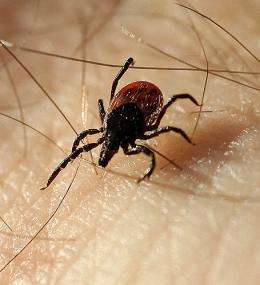
(Medical Xpress) -- Borrelia burgdorferi (Bb) is a spirochete, a coiled bacterium that looks like a kinetic spring. Just a few microns long, smaller than the width of a human hair, it is invisible to the naked eye. But it packs a big punch. Bb is the bug that causes Lyme disease.
A skin rash, swollen joints, and flu-like symptoms can develop for many of those bitten by the deer tick that carries Bb. Diagnosis and treatment of Lyme disease cost about half a billion dollars annually.
Promising research being conducted by Dr. Juan Salazar, associate professor of pediatrics at the Health Center and director of the Pediatric Infectious Disease Division and Youth HIV Program at Connecticut Children’s Medical Center, could eventually have a beneficial impact on both the disease and its cost by helping healthcare professionals better understand how the disease develops.
“Left untreated, Bb can cause a wide range of health problems, mostly involving the central nervous system, the joints, and the heart,” says Salazar, “but for most patients, the clinical syndrome associated with the disease begins to subside within a few days after initiating antibiotic treatment.”
A small percentage of individuals may require several weeks or months to make a full recovery. And there are the rare cases in which “the patient may develop a poorly defined fibromyalgia-like illness that fails to respond to even prolonged courses of antimicrobial therapy,” Salazar says.
He began exploring the disease nearly a decade ago after receiving a Mentored Patient-Oriented Research Career Development Award (K23) from the National Institutes of Health. K23 grants support the career development of investigators who commit to focusing on patient-oriented research. While Salazar has conducted most of his laboratory and translational research at the UConn Health Center, his work has also had the financial and institutional support of the Connecticut Children’s Medical Center, a longtime Health Center partner that serves as the School of Medicine’s Department of Pediatrics.
Last December, Connecticut Children’s established a formal research agreement with the Health Center affirming that the two institutions have mutual interests that benefit the state. Since Connecticut Children’s does not have research facilities, it submits grants that require the use of those facilities by researchers like Salazar through the Health Center.
Salazar had been mentored by Dr. Justin Radolf, a renowned spirochetologist who is a professor of medicine, pediatrics, and genetics and developmental biology. “I was already working on pediatric congenital and venereal syphilis, which is also caused by a spirochete, so it was natural for me to investigate Lyme disease, as well.”
What interested Salazar was the early development of the bacterium after it enters the body. “Many people get Lyme disease and don’t even remember it,” he notes. “Years later, blood tests reveal they have developed antibodies, but they suffered no ill effects. So I wondered why there are other people who don’t do as well.” Reasoning that something unique was going on with the immune responses of those who fared poorly, he wondered if congenital abnormalities made them more susceptible.
“Until recently,” he says, “most efforts to understand how Bb initiates immune cell activation in tissues were focused chiefly on the pro-inflammatory attributes of isolated spirochetal lipoproteins.”
Spirochetes exude a lot of those fatty proteins, especially on their outer membrane. Theorizing that humans’ innate immune responses were triggered by the lipoproteins, researchers focused on a protein called Toll-like receptor 2 (TLR2). It recognizes dangerous foreign substances, zeroing in on pathogen-associated molecular patterns (PAMPs) and alerting the immune system by propelling production of cytokines, small proteins key to the immune response.
Salazar’s team has worked with actual human cells cultured in the laboratory. “The mouse research model has been useful, but it has limitations,” he says. “Lyme infection in rodents is not precisely the same as in humans.”
With the human cells, Salazar’s team has shown the infection process is more complex than previously thought. The immune response involves creation of a phagosome, a pocket in the membrane of a human cell that corrals the Bb so it can be destroyed. Formation of the phagosome, in turn, facilitates cooperation between TLR2 and another receptor, TLR8, about which very little is known.
Some people, Salazar says, may be at increased risk of Lyme infection because of a genetic deficiency in these receptors. “Our research model is significant because it provides a new paradigm for the immune system’s recognition of Bb,” he says. “It helps researchers better understand how the innate immune recognition of the bacterium may impact the clinical outcome of Lyme disease in humans. And it can also be applied to other similar bacterial pathogens.”


