Music therapy helps patients cope with illness, regain health
June 16, 2011 By Sara Peach in Health

Music therapy helps patients cope with illness, regain health

Enlarge

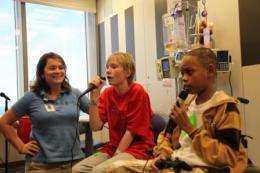
Music therapist Elizabeth Fawcett works with two patients at North Carolina Children's Hospital.

In the months since the shooting that left Arizona Rep. Gabrielle Giffords with a critical brain injury, music therapy has been a key to her recovery.

Although at first Giffords could not talk, she could sing. So she and her music therapist sang “Twinkle Twinkle Little Star” and other classics together. Because music and speech are closely linked, singing helped her injured brain relearn how to form words for conversation.

In addition to aiding recovery in with brain injuries, music therapy can help chronically ill children cope with their diseases, said Elizabeth Fawcett, MT-BC, a music therapist at North Carolina Children’s Hospital.

At the children’s hospital, Fawcett spends 20 hours each week with pediatric patients. She plays the guitar and the piano, and she also helps children write their own songs. Music therapy provides a time for her patients to express their feelings in a safe way, she said.

“I’m not coming in there to poke them again, to draw blood, to give them good or bad news,” she said. “I’m just there to have fun with them.”

But music therapy provides more than just a good time for patients. Fawcett works with each child’s treatment team to assess the patient’s abilities, to set goals and to help him or her return home faster. In July, Fawcett will begin working 12 hours each week with geriatric patients.

In studies, music therapy has been shown to have a number of benefits. It can reduce anxiety and pain and ease the symptoms of depression. Several studies suggest that it can help autistic children learn to be more creative and tolerant of change. The therapy can also help older patients maintain motor functioning through movement to the music. In fact, more than 60 percent of hospice centers offer music therapy services, according to a 2007 national survey.

When they work with geriatric patients, music therapists can use music as a tool for reminiscing and discussion, Fawcett said. 

“If you hear a song, you think, ‘Oh my gosh, I was in junior high when that song came out,’” she said. That can trigger old memories and work a patient’s mental muscles.

At the children’s hospital, Fawcett’s music room contains a Wii, a Playstation 2, a drum machine, keyboards, a child-size electric guitar, plus a digital recording studio. There, patients can sing karaoke and learn to play the instruments.

Fawcett said that in some cases, involves well-intentioned trickery. For example, she encourages children with cystic fibrosis, a genetic disease that can cause lung infections, to sing.

“They think they’re just singing karaoke, but really they’re working their lungs,” she said.

One patient learned to play the guitar while he was in the hospital. He wrote a song and recorded it using Fawcett’s studio. 

“Not only was he fighting cancer, he was becoming a rock star,” she said.

Music therapy at home

Even healthy people can benefit from using music for stress relief, and you don’t need musical talent to take part. Try taking a break by listening to calming music and breathing deeply. You may need to experiment with several styles of music to find the kind that helps you relax, Fawcett said. Slow music with 60 or fewer beats per minute may help you reduce anxiety, she added.

If you can’t take a break – because you’re stuck in a stressful meeting, for example – it can help just to sing a song in your head.

More information: To find a music therapist in your area, contact the American Music Therapy Association at 301-589-3300 or at the organization’s website, www.musictherapy.org/find.html .

Provided by University of North Carolina at Chapel Hill School of Medicine search and more info website

4 /5 (1 vote)  

Rank 4 /5 (1 vote)
Relevant PhysicsForums posts

More news stories

Calorie information in fast food restaurants used by 40 percent of 9-18 year olds when making food choices

A new study published online today (Thursday) in the Journal of Public Health has found that of young people who visited fast food or chain restaurants in the U.S. in 2010, girls and youth who were obese were more likely ...

Health created 6 hours ago | popularity not rated yet | comments 0

Systematic screening of med adherence will ID barriers

(HealthDay)—Implementation of systematic monitoring for medication adherence will allow for identification of barriers to adherence and tailoring of interventions, according to a viewpoint piece published ...

Health created 8 hours ago | popularity not rated yet | comments 0

More doctors, hospitals using electronic records

(AP)—The Obama administration says more doctors and hospitals are embracing technology as adoption of computerized medical records reaches a "tipping point" in America.

Health created 9 hours ago | popularity not rated yet | comments 0

Hospitals profit when patients develop bloodstream infections

Johns Hopkins researchers report that hospitals may be reaping enormous income for patients whose hospital stays are complicated by preventable bloodstream infections contracted in their intensive care units.

Health created 10 hours ago | popularity not rated yet | comments 0

Alleviating hunger in the US, it's a SNAP, researcher says

A University of Illinois researcher says that the cornerstone of our efforts to alleviate food insecurity should be to encourage more people to participate in the Supplemental Nutrition Assistance Program (SNAP) "because ...

Health created 10 hours ago | popularity not rated yet | comments 0


Rate of bicycle-related fatalities significantly lower in states with helmet laws

Existing research shows that bicyclists who wear helmets have an 88 percent lower risk of brain injury, but researchers at Boston Children's Hospital found that simply having bicycle helmet laws in place showed a 20 percent ...

Slowing the aging process—only with antibiotics

Swiss scientists reveal the mechanism responsible for aging hidden deep within mitochondria—and dramatically slow it down in worms by administering antibiotics to the young.

Researchers complete largest genetic sequencing study of human disease

Researchers from Queen Mary, University of London have led the largest sequencing study of human disease to date, investigating the genetic basis of six autoimmune diseases.

Brain can be trained in compassion, study shows

Until now, little was scientifically known about the human potential to cultivate compassion—the emotional state of caring for people who are suffering in a way that motivates altruistic behavior.

Having both migraines, depression may mean smaller brain

(HealthDay)—Migraines and depression can each cause a great deal of suffering, but new research indicates the combination of the two may be linked to something else entirely—a smaller brain.

Novel approach for influenza vaccination shows promise in early animal testing

A new approach for immunizing against influenza elicited a more potent immune response and broader protection than the currently licensed seasonal influenza vaccines when tested in mice and ferrets. The vaccine ...