Nervous system stem cells can replace themselves, give rise to variety of cell types, even amplify
June 30, 2011 in Medical research
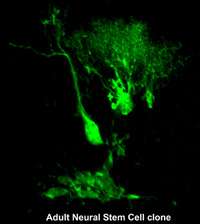
A green fluorescent protein-labeled neural stem cell clone contains the mother stem cell with neuronal and astroglial progeny within the mouse brain. Image by Michael A. Bonaguidi, Johns Hopkins Medicine.
(Medical Xpress) -- A Johns Hopkins team has discovered in young adult mice that a lone brain stem cell is capable not only of replacing itself and giving rise to specialized neurons and glia important types of brain cells but also of taking a wholly unexpected path: generating two new brain stem cells.
A report on their study appears June 24 in Cell.
Although it was known that the brain has the capacity to generate both neurons, which send and receive signals, and the glial cells that surround them, it was unclear whether these various cell types came from a single source. In addition to demonstrating that a single radial glia-like (RGL) brain cell is able to generate two very different functional cell types, the Hopkins researchers, by following the fates of single cells over time, found that a single brain stem cell can even produce two stem cells like itself.
Now we know they dont just maintain their numbers, or go down in number, but that stem cells can amplify, says Hongjun Song, Ph.D., professor of neurology and neuroscience and director of the Stem Cell Program in the Institute for Cell Engineering, the Johns Hopkins University School of Medicine. If we can somehow cash in on this newly discovered property of stem cells in the brain, and find ways to intervene so they divide more, then we might actually increase their numbers instead of losing them over time, which is what normally happens, perhaps due to aging or diseases.
The researchers findings hinged on a decision to single out and follow lone, radial glia-like cells, instead of labeling and monitoring entire stem cell populations in the mouse brain. They took this approach because they suspected radial glia-like cells were essentially stem cells, having been shown in previous studies to give rise to neurons.
Using mice genetically modified with special genes that color-code cells for easy labeling and tracking, the Hopkins team injected a very small amount of a chemical into about 50 mouse brains to induce extremely limited cell labeling.
Its a simple idea that forced us to confront a lot of complex technical issues, Song says. With so many millions of cells in the relatively large mouse brain, labeling a single stem cell and then chasing its family history was like finding a needle in a haystack.
The scientists developed computer programs and devised a new imaging technique that allowed them to examine stained slices of the mouse brain and, ultimately, follow single, randomly chosen radial glia-like stem cells over time. The method allowed them to track down all the new cells derived from a single original stem cell.
We reconstituted single stem cells family trees to look at the progeny they gave rise to, says Guo-li Ming, associate professor of neurology and neuroscience and a member of the Neuroregeneration Program in the Institute for Cell Engineering. We discovered that single cells in an intact animal nervous system absolutely do exhibit stem-cell properties; they are capable of both replicating themselves and producing different types of differentiated neural progeny.
The team followed the fates of all the marked radial glia-like stem cells for at least a month or two, and examined some a full year later to discover that even over the long term, the mother cell was still generating itself as well as different kinds of progeny.
In addition, the researchers investigated how these RGLs were activated on a molecular level, focusing, in particular, on the regulatory role of an autism-associated gene called PTEN. Conventional wisdom was that deleting this gene led to an increase in stem-cell activation. However, the scientists demonstrated that was a transient effect in the mouse brains, and that, ultimately, PTEN deletion leads to stem-cell depletion.
More information: http://www.cell.com/current
Provided by
Johns Hopkins University
-
When is a stem cell not really a stem cell?
Aug 26, 2007 |
not rated yet |
0
-
Researchers find stem cells from monkey teeth can stimulate growth and generation of brain cells
Nov 11, 2008 |
not rated yet |
0
-
Researchers Stimulate Growth of Neural Stem Cells in Adult Brain for Treatment of Neurological Disorders
Nov 15, 2006 |
not rated yet |
0
-
An Inexhaustible Source of Neural Cells
Feb 17, 2009 |
not rated yet |
0
-
Stem-cell therapies for brain more complicated than thought
Nov 27, 2007 |
not rated yet |
0
-
Limits to growth: Scientists identify key metastasis-enabling enzyme
May 22, 2012 |
5 / 5 (3) |
0
-
Seeing is as seeing does: Spatially-structured retinal input in early development of cortical maps
Apr 26, 2012 |
5 / 5 (4) |
1
-
Dreamless nights: Brain activity during nonrapid eye movement sleep
Apr 09, 2012 |
4.4 / 5 (12) |
0
-
Take your time: Neurobiology sheds light on the superiority of spaced vs. massed learning
Mar 28, 2012 |
4.5 / 5 (21) |
3
-
Your brain on 'shrooms: fMRI elucidates neural correlates of psilocybin psychedelic state
Feb 29, 2012 |
4.9 / 5 (42) |
45
-
A question about drug tolerance
May 23, 2012
-
Poor nutrition leading to overeating?
May 23, 2012
-
Math and dyslexia?
May 21, 2012
-
portable metabolism meter?
May 21, 2012
-
Rare medical conditions on 20/20 tonight
May 18, 2012
-
"Good" Cholesterol in Doubt
May 17, 2012
- More from Physics Forums - Medical Sciences
More news stories
The cells' petrol pump is finally identified
The oxygen and food we consume are converted into energy by tiny organelles present in each cell, the mitochondria. These 'power plants' must be continuously supplied with fuel, to maintain all vital functions. A team led ...
Medical research
7 hours ago |
5 / 5 (1) |
0
Researchers identify protein necessary for behavioral flexibility
Researchers have identified a protein necessary to maintain behavioral flexibility, which allows us to modify our behaviors to adjust to circumstances that are similar, but not identical, to previous experiences. Their findings, ...
Medical research
9 hours ago |
5 / 5 (1) |
1
|
From stem cell to brain cell - new technique mimics the brain
A new technique that converts stem cells into brain cells has been developed by researchers at Lund University. The method is simpler, quicker and safer than previous research has shown and opens the doors to a shorter route ...
Medical research
11 hours ago |
5 / 5 (1) |
0
A revealing hand
What did you have for lunch yesterday? How many times a month do you eat nuts? How about your kids -- how many servings of vegetables did they consume today?
Medical research
15 hours ago |
5 / 5 (2) |
0
Stem-cell-growing surface enables bone repair
(Medical Xpress) -- University of Michigan researchers have proven that a special surface, free of biological contaminants, allows adult-derived stem cells to thrive and transform into multiple cell types. ...
Medical research
May 23, 2012 |
5 / 5 (9) |
1
|
Amino acid consumption associated with how fast cancer cells divide
For almost a century, researchers have known that cancer cells have peculiar appetites, devouring glucose in ways that normal cells do not. But glucose uptake may tell only part of cancer's metabolic story. Researchers from ...
'Personality genes' may help account for longevity
"It's in their genes" is a common refrain from scientists when asked about factors that allow centenarians to reach age 100 and beyond. Up until now, research has focused on genetic variations that offer a physiological advantage ...
Gene discovery points towards non-hormonal male contraceptive
A new type of male contraceptive could be created thanks to the discovery of a key gene essential for sperm development.
Thioridazine kills cancer stem cells in human while avoiding toxic side-effects of conventional cancer treatments
A team of scientists at McMaster University has discovered a drug, thioridazine, successfully kills cancer stem cells in the human while avoiding the toxic side-effects of conventional cancer treatments.
Cyber exercise partners help you go the distance: Motivation gains can double
A new study testing the benefits of a virtual exercise partner shows the presence of a moderately more capable cycling partner can significantly boost the motivation by as much as 100 percent ...
Brentuximab vedotin effective in large-cell lymphoma
(HealthDay) -- More than half of patients with relapsed or refractory systemic anaplastic large-cell lymphoma (ALCL) treated with the CD30-directed antibody-drug conjugate brentuximab vedotin achieve a complete ...