'Optogenetics' used to control reward-seeking behavior
June 29, 2011 in Medical research
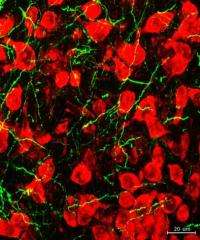
Nerve cells in the nucleus accumbens (red) receive input from amygdala fibers (green). Optogenetic stimulation of these nerve fibers produces a rewarding effect in mice. Credit: Stuber lab/UNC-Chapel Hill
Using a combination of genetic engineering and laser technology, researchers at the University of North Carolina at Chapel Hill have manipulated brain wiring responsible for reward-seeking behaviors, such as drug addiction. The work, conducted in rodent models, is the first to directly demonstrate the role of these specific connections in controlling behavior.
The UNC study, published online on June 29, 2011, by the journal Nature, uses a cutting-edge technique called "optogenetics" to tweak the microcircuitry of the brain and then assess how those changes impact behavior. The findings suggest that therapeutics targeting the path between two critical brain regions, namely the amygdala and the nucleus accumbens, represent potential treatments for addiction and other neuropsychiatric diseases.
"For most clinical disorders we knew that one region or another in the brain was important, however until now we didn't have the tools to directly study the connections between those regions," said senior study author Garret D. Stuber, PhD, assistant professor in the departments of cell and molecular physiology, psychiatry and the Neuroscience Center in UNC School of Medicine. "Our ability to perform this level of sophistication in neural circuit manipulation will likely to lead to the discovery of molecular players perturbed during neuropsychiatric illnesses."
Because the brain is comprised of diverse regions, cell types and connections in a compact space, pinpointing which entity is responsible for what function can be quite tricky. In the past, researchers have tried to get a glimpse into the inner workings of the brain using electrical stimulation or drugs, but those techniques couldn't quickly and specifically change only one type of cell or one type of connection. But optogenetics, a technique that emerged six years ago, can.
In the technique, scientists transfer light-sensitive proteins called "opsins" derived from algae or bacteria that need light to grow into the mammalian brain cells they wish to study. Then they shine laser beams onto the genetically manipulated brain cells, either exciting or blocking their activity with millisecond precision.
In Stuber's initial experiments, the target was the nerve cells connecting two separate brain regions associated with reward, the amygdala and the nucleus accumbens. The researchers used light to activate the connections between these regions, essentially "rewarding" the mice with laser stimulations for performing the mundane task of poking their nose into a hole in their cage. They found that the opsin treated mice quickly learned to "nosepoke" in order to receive stimulation of the neural pathway. In comparison, the genetically untouched control mice never caught onto the task.
Then Stuber and his colleagues wanted to see whether this brain wiring had a role in more natural behavioral processes. So they trained mice to associate a cue a light bulb in the cage turning on to a reward of sugar water. This time the opsin that the researchers transferred into the brains of their rodent subjects was one that would shut down the activity of neural connections in response to light. As they delivered the simple cue to the control mice, they also blocked the neuronal activity in the genetically altered mice. The control mice quickly began responding to the cue by licking the sugar-producing vessel in anticipation, whereas the treated mice did not give the same response.
The researchers are now exploring how changes to this segment of brain wiring can either make an animal sensitized to or oblivious to rewards. Stuber says their approach presents an incredibly useful tool for studying basic brain function, and could one day provide a powerful alternative to electrical stimulation or pharmacotherapy for neuropsychiatric illnesses like Parkinson's disease.
"For late-stage Parkinson's disease it has become more routine to use deep brain stimulation, where electrodes are chronically implanted into brain tissue, constantly stimulating the tissue to alleviate some of the disease symptoms," said Stuber. "From the technical perspective, implanting our optical fibers is not going to be more difficult than that. But there is quite a bit of work to be done before we get to that point."
Provided by
University of North Carolina School of Medicine
-
New research identifies gene important for nicotine's effects on the brain
Dec 05, 2006 |
not rated yet |
0
-
Scientists' findings may lead to new drug-abuse treatments
Aug 27, 2008 |
not rated yet |
0
-
Scientists establish link between brain activity and Parkinson's disease symptoms
Jul 07, 2010 |
not rated yet |
0
-
Enzyme regulates brain pathology induced by cocaine, stress
Nov 08, 2007 |
not rated yet |
0
-
Shedding some light on Parkinson's treatment
Apr 16, 2009 |
not rated yet |
0
-
Limits to growth: Scientists identify key metastasis-enabling enzyme
May 22, 2012 |
5 / 5 (3) |
0
-
Seeing is as seeing does: Spatially-structured retinal input in early development of cortical maps
Apr 26, 2012 |
5 / 5 (4) |
1
-
Dreamless nights: Brain activity during nonrapid eye movement sleep
Apr 09, 2012 |
4.4 / 5 (12) |
0
-
Take your time: Neurobiology sheds light on the superiority of spaced vs. massed learning
Mar 28, 2012 |
4.5 / 5 (21) |
3
-
Your brain on 'shrooms: fMRI elucidates neural correlates of psilocybin psychedelic state
Feb 29, 2012 |
4.9 / 5 (42) |
45
-
A question about drug tolerance
May 23, 2012
-
Poor nutrition leading to overeating?
May 23, 2012
-
Math and dyslexia?
May 21, 2012
-
portable metabolism meter?
May 21, 2012
-
Rare medical conditions on 20/20 tonight
May 18, 2012
-
"Good" Cholesterol in Doubt
May 17, 2012
- More from Physics Forums - Medical Sciences
More news stories
The cells' petrol pump is finally identified
The oxygen and food we consume are converted into energy by tiny organelles present in each cell, the mitochondria. These 'power plants' must be continuously supplied with fuel, to maintain all vital functions. A team led ...
Medical research
7 hours ago |
5 / 5 (1) |
0
Researchers identify protein necessary for behavioral flexibility
Researchers have identified a protein necessary to maintain behavioral flexibility, which allows us to modify our behaviors to adjust to circumstances that are similar, but not identical, to previous experiences. Their findings, ...
Medical research
9 hours ago |
5 / 5 (1) |
1
|
From stem cell to brain cell - new technique mimics the brain
A new technique that converts stem cells into brain cells has been developed by researchers at Lund University. The method is simpler, quicker and safer than previous research has shown and opens the doors to a shorter route ...
Medical research
11 hours ago |
5 / 5 (1) |
0
A revealing hand
What did you have for lunch yesterday? How many times a month do you eat nuts? How about your kids -- how many servings of vegetables did they consume today?
Medical research
15 hours ago |
5 / 5 (2) |
0
Stem-cell-growing surface enables bone repair
(Medical Xpress) -- University of Michigan researchers have proven that a special surface, free of biological contaminants, allows adult-derived stem cells to thrive and transform into multiple cell types. ...
Medical research
May 23, 2012 |
5 / 5 (9) |
1
|
Amino acid consumption associated with how fast cancer cells divide
For almost a century, researchers have known that cancer cells have peculiar appetites, devouring glucose in ways that normal cells do not. But glucose uptake may tell only part of cancer's metabolic story. Researchers from ...
'Personality genes' may help account for longevity
"It's in their genes" is a common refrain from scientists when asked about factors that allow centenarians to reach age 100 and beyond. Up until now, research has focused on genetic variations that offer a physiological advantage ...
Gene discovery points towards non-hormonal male contraceptive
A new type of male contraceptive could be created thanks to the discovery of a key gene essential for sperm development.
Thioridazine kills cancer stem cells in human while avoiding toxic side-effects of conventional cancer treatments
A team of scientists at McMaster University has discovered a drug, thioridazine, successfully kills cancer stem cells in the human while avoiding the toxic side-effects of conventional cancer treatments.
Cyber exercise partners help you go the distance: Motivation gains can double
A new study testing the benefits of a virtual exercise partner shows the presence of a moderately more capable cycling partner can significantly boost the motivation by as much as 100 percent ...
Brentuximab vedotin effective in large-cell lymphoma
(HealthDay) -- More than half of patients with relapsed or refractory systemic anaplastic large-cell lymphoma (ALCL) treated with the CD30-directed antibody-drug conjugate brentuximab vedotin achieve a complete ...