June 28, 2011 report
Optogenetics researcher develops wireless brain stimulator
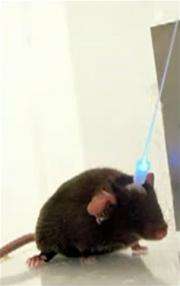
(Medical Xpress) -- In a major step forward in optogenetics, MIT researcher Christian Wentz has developed a sort of wireless hat that can be used to transmit light to photo sensitized cells in the brain, thus stimulating them to fire when struck by light, or to cease firing, whichever has been programmed for. Previously such optical therapies were done by connecting a light source to a cable or tether to deliver the power for the light sources (lasers or LEDs); now as described in a paper he and his colleagues have published in the Journal of Neural Engineering, a transmitter can be used to create a magnetic field, which in turn is converted to electricity in a tiny hat placed atop a mouse’s head, that is then used to power the implanted light sources.
Over the past several years, the field of optogenetics has arisen, mostly due to the efforts of Ed Boyd, a former physicist and electrical engineer. Optogenetics is where brain cells (neurons) are coaxed into growing their own photo receptors by inserting the genes of other cells, such as green algae, that naturally respond to light, into the neurons being studied. When light is applied, the newly grown photo receptors open and allow the flow of positively charged ions to interact with the normal firing mechanism of the neurons, which means they can be controlled with an external source, in this case light.
The whole purpose of such research is to find out if such devices might help people who suffer from brain disorders such as epilepsy, which is in essence, a disorder of the brain where neurons begin firing all willy nilly causing an electrical storm of sorts, resulting in convulsions. If certain neurons that exist within the brain that are normally supposed to control such outbursts could be stimulated via light, then the storm could perhaps be headed off before it ever really gets going, thus eliminating the convulsions altogether.
The newly developed hat developed by Wentz, controlled by a computer via USB port, will allow researchers to study the way neurons in the brain work in much more natural situations. Without a tether, subjects (mice) under study should be able to move around the way they normally would in their normal environment, which of course allows the brain to function as it would were it not in a lab; the optimal situation, of course, for studying how the brain works.
More information: A wirelessly powered and controlled device for optical neural control of freely-behaving animals, Christian T Wentz et al 2011 J. Neural Eng. 8 046021 doi:10.1088/1741-2560/8/4/046021
Abstract
Optogenetics, the ability to use light to activate and silence specific neuron types within neural networks in vivo and in vitro, is revolutionizing neuroscientists' capacity to understand how defined neural circuit elements contribute to normal and pathological brain functions. Typically, awake behaving experiments are conducted by inserting an optical fiber into the brain, tethered to a remote laser, or by utilizing an implanted light-emitting diode (LED), tethered to a remote power source. A fully wireless system would enable chronic or longitudinal experiments where long duration tethering is impractical, and would also support high-throughput experimentation. However, the high power requirements of light sources (LEDs, lasers), especially in the context of the extended illumination periods often desired in experiments, precludes battery-powered approaches from being widely applicable. We have developed a headborne device weighing 2 g capable of wirelessly receiving power using a resonant RF power link and storing the energy in an adaptive supercapacitor circuit, which can algorithmically control one or more headborne LEDs via a microcontroller. The device can deliver approximately 2 W of power to the LEDs in steady state, and 4.3 W in bursts. We also present an optional radio transceiver module (1 g) which, when added to the base headborne device, enables real-time updating of light delivery protocols; dozens of devices can be controlled simultaneously from one computer. We demonstrate use of the technology to wirelessly drive cortical control of movement in mice. These devices may serve as prototypes for clinical ultra-precise neural prosthetics that use light as the modality of biological control.
© 2010 PhysOrg.com


