Cause and potential treatment found for cancer drug's kidney toxicity
June 2, 2011 in Cancer
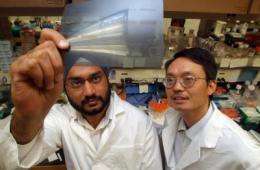
Drs. Navjotsingh Pabla and Zheng Dong at Georgia Health Sciences University have found a way to make the popular cancer drug cisplatin less toxic to the kidneys and more effective against some cancers. Credit: Phil Jones/GHSU photographer
Scientists may have a way to make the powerful cancer drug cisplatin less toxic to the kidneys and more effective against some cancers.
The chemotherapeutic agent used in combination with other drugs for a variety of cancers, results in kidney damage or failure in about 30 percent of users, although the mechanism has been unclear. The most physicians can do today to protect the kidneys is advise patients to drink more water.
The relatively simple, highly reactive compound tends to accumulate in the kidneys, said Dr. Navjotsingh Pabla, postdoctoral fellow at Georgia Health Sciences University and first author on the study in The Journal of Clinical Investigation. "The kidneys can take it up, but they have trouble removing it, so it just accumulates," he said.
The kidneys' endless workload of filtering some substances while resorbing others leaves them vulnerable to injury, one of the reasons the kidneys are the first organ to shut down when a patient is critically ill, said Dr. Zheng Dong, GHSU cell biologist, Career Research Scientist at the Charlie Norwood Veterans Affairs Medical Center in Augusta and the study's senior author. "Any stress to the cell can injure it," Dong said.
The scientists have shown in mice with tumors as well as human cancer cells in culture that cisplatin highly activates protein kinase C delta; protein kinases regulate other proteins by adding phosphates to them that can change their function. They've further shown that protein kinase C delta is a key mediator of cell death in kidneys and important to cancer cell survival.
The dichotomy appears useful because they've also shown that a drug, already in clinical trials for its potential in protecting brain cells following stroke, blocks the kidney destruction. In fact, protein kinase inhibitors in mice with tumors, enhanced breast and ovarian cancer treatment.
"Normal cells may not depend on this protein for survival and growth so if you remove it, there don't appear to be major negative consequences," Pabla said. The findings point toward using protein kinase C inhibitors as an adjunct therapy for patients experiencing kidney problems and potentially for all cancer patients treated with cisplatin if the enhanced efficacy finding continues to hold up, Dong said.
The scientists note that reducing the cisplatin dose decreases kidney toxicity but also decreases its efficacy and may leave the patient resistant to even higher doses of the drug. In the more than 30-year history with cisplatin, related drugs, such as carboplatin, have been developed to circumvent kidney damage, but those drugs tend to have more limited use, be less effective and/or have additional side effects. In more recent years, the focus has been on trying to protect the kidneys.
Next steps include working with chemists to see if an even more effective inhibitor can be developed.
Provided by Georgia Health Sciences University
-
Research points to a new way to protect kidneys threatened by insufficient blood or toxins (w/Video)
May 18, 2009 |
not rated yet |
0
-
Super-sizing a cancer drug minimizes side effects
Jul 28, 2010 |
not rated yet |
0
-
Using nanotechnology to improve a cancer treatment
Jun 28, 2010 |
not rated yet |
0
-
Curcumin compound improves effectiveness of head and neck cancer treatment
May 19, 2011 |
not rated yet |
0
-
Why cancer drugs lose their power: Platinum-based cancer drugs destroy tumor cells by binding to DNA strands
Apr 14, 2010 |
not rated yet |
0
-
Limits to growth: Scientists identify key metastasis-enabling enzyme
May 22, 2012 |
5 / 5 (3) |
0
-
Seeing is as seeing does: Spatially-structured retinal input in early development of cortical maps
Apr 26, 2012 |
5 / 5 (4) |
1
-
Dreamless nights: Brain activity during nonrapid eye movement sleep
Apr 09, 2012 |
4.4 / 5 (12) |
0
-
Take your time: Neurobiology sheds light on the superiority of spaced vs. massed learning
Mar 28, 2012 |
4.5 / 5 (21) |
3
-
Your brain on 'shrooms: fMRI elucidates neural correlates of psilocybin psychedelic state
Feb 29, 2012 |
4.9 / 5 (42) |
45
-
A question about drug tolerance
May 23, 2012
-
Poor nutrition leading to overeating?
May 23, 2012
-
Math and dyslexia?
May 21, 2012
-
portable metabolism meter?
May 21, 2012
-
Rare medical conditions on 20/20 tonight
May 18, 2012
-
"Good" Cholesterol in Doubt
May 17, 2012
- More from Physics Forums - Medical Sciences
More news stories
Brentuximab vedotin effective in large-cell lymphoma
(HealthDay) -- More than half of patients with relapsed or refractory systemic anaplastic large-cell lymphoma (ALCL) treated with the CD30-directed antibody-drug conjugate brentuximab vedotin achieve a complete ...
Cancer
9 hours ago |
not rated yet |
0
Childhood cancer scars survivors later in life
Scars left behind by childhood cancer treatments are more than skin-deep. The increased risk of disfigurement and persistent hair loss caused by childhood cancer and treatment are associated with emotional distress and reduced ...
Cancer
11 hours ago |
not rated yet |
0
Amino acid consumption associated with how fast cancer cells divide
For almost a century, researchers have known that cancer cells have peculiar appetites, devouring glucose in ways that normal cells do not. But glucose uptake may tell only part of cancer's metabolic story. Researchers from ...
Cancer
11 hours ago |
5 / 5 (3) |
1
|
Marked for destruction: Newly developed compound triggers cancer cell death
The BCL-2 protein family plays a large role in determining whether cancer cells survive in response to therapy or undergo a form of cell death known as apoptosis. Cells are pressured toward apoptosis by expression of pro-apoptotic ...
Cancer
15 hours ago |
5 / 5 (1) |
0
Thioridazine kills cancer stem cells in human while avoiding toxic side-effects of conventional cancer treatments
A team of scientists at McMaster University has discovered a drug, thioridazine, successfully kills cancer stem cells in the human while avoiding the toxic side-effects of conventional cancer treatments.
Cancer
15 hours ago |
4.7 / 5 (26) |
2
|
Like curry? New biological role identified for compound used in ancient medicine
Scientists have just identified a new reason why some curry dishes, made with spices humans have used for thousands of years, might be good for you.
'Personality genes' may help account for longevity
"It's in their genes" is a common refrain from scientists when asked about factors that allow centenarians to reach age 100 and beyond. Up until now, research has focused on genetic variations that offer a physiological advantage ...
Gene discovery points towards non-hormonal male contraceptive
A new type of male contraceptive could be created thanks to the discovery of a key gene essential for sperm development.
Cyber exercise partners help you go the distance: Motivation gains can double
A new study testing the benefits of a virtual exercise partner shows the presence of a moderately more capable cycling partner can significantly boost the motivation by as much as 100 percent ...
Researchers identify protein necessary for behavioral flexibility
Researchers have identified a protein necessary to maintain behavioral flexibility, which allows us to modify our behaviors to adjust to circumstances that are similar, but not identical, to previous experiences. Their findings, ...
New test shows potential for detecting active cases of Lyme disease
George Mason University researchers can find out if a tick bite means Lyme disease well before the bite victim begins to show symptoms.