A pulse no longer necessary for life

June 15, 2011 by Deborah Braconnier in Cardiology report

A pulse no longer necessary for life
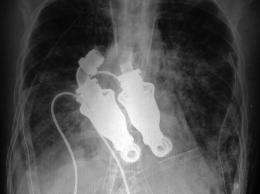
Enlarge

This X-ray image shows the dual turbinelike blood pumps that replaced patient's heart. Image: Texas Heart Institute

(PhysOrg.com) -- While most people connect a pulse and a heartbeat to life, Dr. Billy Cohn and Dr. Bud Frazier from the Texas Heart Institute have found a way to keep the blood circulating and extend the life of patients while taking away their pulse.

Researchers have spent years trying to perfect an artificial heart that does not break down, wear out, or cause and infections. However, Cohn and Frazier have developed an artificial heart, of sorts, that seems to do the trick. The only catch is it isn’t a heart. There is no . There is no pulse. If a patient had one of their new hearts, the patient would appear dead. Attaching an EKG would return a flat-line.

The new device uses technology that has been used to aid failing hearts since the 1980s. A ventricular assist device, or VAD, is a circulatory device designed to assist either the right or left ventricle of the heart. The VADs have a rotor of blades that circulate and push the blood forward in a continuous flow.

While VADs are typically used to help one section of the heart, Cohn and Frazier hooked two of these VADs together so they would essentially work as both sides of the heart. They began working on calves and currently have an 8-month-old calf named Abigail who has no heart. Her heart was removed and in its place the doctors inserted their new pump device. Abigail is a healthy and active young calf, however, according to any medical cardiac tests, she would appear dead.

Cohn and Frazier, after testing on 38 calves, wanted to take this new pump one step further and test it on a human patient. This is where Craig Lewis, a 55-year-old man who was dying from amyloidosis comes in. His heart had become so damaged from the disease that doctors had only given him about 12 hours to live. Lewis and his wife agreed to let the doctors try the new pump to try and extend his life, if even for a short time. The doctors inserted the new pumps and Lewis did recover and had another month of life before the disease took other organs. His new heart however worked flawlessly.

Cohn and Frazier still have much work to do before the new will be available. A final design must be determined, a manufacturer must be found and they must apply for FDA approval. Results show amazing promise and may be the new future in artificial hearts.

© 2010 PhysOrg.com

4.9 /5 (25 votes)  

Filter


Move the slider to adjust rank threshold, so that you can hide some of the comments.


Display comments: newest first

Jaeherys
Jun 15, 2011

Rank: 5 / 5 (2)
Wow that's just crazy! All this time and no one thought to do this. People have spent so much time trying to replicate the heart and completely ignored a replacement that imitates its functionality. In retrospec it seems so obvious, but isn't that always the case!
FrankHerbert
Jun 15, 2011

Rank: 2.3 / 5 (9)
Well that's just the thing, it doesn't imitate the heart's functionality. IIRC earlier implantable artificial hearts produced a pulse in an attempt to more closely imitate a natural heart.

Nature rarely uses the best design. Intelligent my ass ;-)
DarwiN100
Jun 15, 2011

Rank: not rated yet
Nice. But what about the flow rate. Our blood does not circulate with a constant speed, so I dont see how one could go running a marathon with this device and with a constant flow..
Other modern artificial hearths have already developed ways to address this, but there is no mention of this problem in this article..
Vendicar_Decarian
Jun 15, 2011

Rank: 1 / 5 (1)
I doubt if Craig Lewis was too concerned about the subtle changes in the flow rate associated with exercise.
DarwiN100
Jun 15, 2011

Rank: not rated yet
Vendicar: No, no, I am obviously not talking about mr. Lewis... I am just wondering, because I also just googled around for more info and these two doctors seem to suggest that this technology will prevail and all other designs will go obsolete..
Than this flow rate becomes a real issue, so I am just curious and interested to know.
Ramael
Jun 15, 2011

Rank: 5 / 5 (2)
Well that's just the thing, it doesn't imitate the heart's functionality. IIRC earlier implantable artificial hearts produced a pulse in an attempt to more closely imitate a natural heart.

Nature rarely uses the best design. Intelligent my ass ;-)


Haha, its true. We are a product of evolution, we are a product of mistakes. :P
Bob_Kob
Jun 15, 2011

Rank: not rated yet
Well I suppose even without variable bloodflow this is better than death! Eventually it should be possible to intercept the nerve that controls heart rate to control the pump.
gwrede
Jun 15, 2011

Rank: not rated yet
The blood flow is constant compared to a pounding heart. Therefore, no pulse.

But, it has to be adjusted for different activities. Sleeping, washing the dishes, walking, climbing stairs, and running, all need a different blood flow speed. A real heart replacement needs a micro processor to keep the flow speed right for the occasion.

That was implicit in the article. Unfortunately the writer focused too much on the "Look Ma, no pulse" aspect.
chthonic
Jun 15, 2011

Rank: 5 / 5 (1)
FrankHerbert:
Nature rarely uses the best design. Intelligent my ass ;-)
Right, for really intelligent design go to Ix or Tleilax, or, if you're looking to save money, Richese. :-)
Neurons_At_Work
Jun 15, 2011

Rank: not rated yet
Does anyone remember the movie 'Threshold' which stars Donald Sutherland and Jeff Goldblum as doctors/inventors of an internally powered turbine artificial heart? It was released in the US in 1983 and the plot line parallels this discovery in many uncanny ways, from the near identical device design, to testing on calves, and also the ethical dilemma of having no pulse. Amazing sometimes how life imitates art.
aroc91
Jun 15, 2011

Rank: not rated yet
Does anyone remember the movie 'Threshold'...?


Never seen it. Based on this line alone-

ethical dilemma of having no pulse


I don't want to see it, because frankly, that's just stupid. How is not having a pulse an ethical dilemma?
jscroft
Jun 15, 2011

Rank: not rated yet
The reciprocating engine always was kind of a dumb idea.
mrwolfe
Jun 16, 2011

Rank: not rated yet
Wow that's just crazy! All this time and no one thought to do this. People have spent so much time trying to replicate the heart and completely ignored a replacement that imitates its functionality. In retrospec it seems so obvious, but isn't that always the case!


Actually, the idea isn't that new. A team in Australia had a prototype that uses a similar idea working a decade ago.
Eric_B
Jun 16, 2011

Rank: not rated yet
this would make the recipient a better sniper.

heartbeat is one factor that causes involuntary movements.
orgon
Jun 16, 2011

Rank: not rated yet
All this time and no one thought to do this.
Of course he though, but not all turbine design are worth to consider. The blood isn't water and the pump action shouldn't destroy the blood cells.
dsl5000
Jun 17, 2011

Rank: not rated yet
if this becomes main stream i hope they have a tag to identify people with turbines as hearts. A defibrillator and CPR would do nothing (design looks rigid, chest compressions would be rendered in-effective?).

Also i wonder what the effects would be on the aorta, considering it will have a constant pressure instead of the standard "lub-dub" which fluctuates between high and low pressure. What's the consequence of eliminating diastole?
jscroft
Jun 17, 2011

Rank: not rated yet
What's the consequence of eliminating diastole?


I'm no doctor, but it seems to me that a steady pressure would eliminate a lot of wear and tear associated with repetitive beating.
orgon
Jun 18, 2011

Rank: not rated yet
I'm no doctor, but it seems to me that a steady pressure would eliminate a lot of wear and tear associated with repetitive beating.

But it could make the blood flow more prone to clogging.
FroShow
Jun 18, 2011

Rank: not rated yet
I was thinking the same as orgon.
I imagine that some biological processes might rely on the pulsating blood flow.
Nonetheless, any blood flow's better than none.
hush1
Jun 18, 2011

Rank: not rated yet
Doctors? Without stethoscopes?
Of course, there will always be purpose for stethoscopes. Just not the original purpose. One less subject in medical school.
Rank 4.9 /5 (25 votes)
Related Stories
Relevant PhysicsForums posts

More news stories

Dual-source cardiac CT IDs CAD in hard-to-image patients

(HealthDay)—In patients who have previously been considered difficult to image, dual-source cardiac (DSC) computed tomography (CT) can identify clinically significant coronary artery disease, according ...

Cardiology created 10 hours ago | popularity not rated yet | comments 0

Death rates decline for advanced heart failure patients, but outcomes are still not ideal

UCLA researchers examining outcomes for advanced heart-failure patients over the past two decades have found that, coinciding with the increased availability and use of new therapies, overall mortality has decreased and sudden ...

Cardiology created 13 hours ago | popularity not rated yet | comments 0

Second-generation TAVI device—Lotus Valve—shows good performance in REPRISE II

22 May 2013, Paris, France: The Lotus Valve, a second-generation transcatheter aortic valve implantation (TAVI) device, was successfully implanted in all of the first 60 patients in results from REPRISE II reported at EuroPCR ...

Cardiology created 17 hours ago | popularity not rated yet | comments 0

Costs to treat stroke in America may double by 2030

Costs to treat stroke are projected to more than double and the number of people having strokes may increase 20 percent by 2030, according to the American Heart Association/American Stroke Association.

Cardiology created May 22, 2013 | popularity not rated yet | comments 0

New blood-thinner measures may cut medication errors

Blood thinners are the preferred treatment option to prevent heart attacks, blood clots and stroke, but they are not without risk, and not just because of their side effects. These high-risk drugs, known as anticoagulants, ...

Cardiology created May 22, 2013 | popularity not rated yet | comments 0


Hormone replacement therapy—clarity at last

The British Menopause Society and Women's Health Concern have today released updated guidelines on Hormone Replacement Therapy (HRT) to provide clarity around the role of HRT, the benefits and the risks. The new guidelines ...

Controlling mood through the motions of mitochondria

(Medical Xpress)—Regulating the distribution of power in neurons is done by a system that makes the national electric grid look simple by comparison. Each neuron has several thousand mitochondria confined ...

Motion quotient: IQ predicted by ability to filter motion (w/ video)

A brief visual task can predict IQ, according to a new study. This surprisingly simple exercise measures the brain's unconscious ability to filter out visual movement. The study shows that individuals whose ...

Multiple research teams unable to confirm high-profile Alzheimer's study

Teams of highly respected Alzheimer's researchers failed to replicate what appeared to be breakthrough results for the treatment of this brain disease when they were published last year in the journal Science.

Scientists discover molecule triggers sensation of itch

Scientists at the National Institutes of Health report they have discovered in mouse studies that a small molecule released in the spinal cord triggers a process that is later experienced in the brain as ...

Researchers find common childhood asthma unconnected to allergens or inflammation

Little is known about why asthma develops, how it constricts the airway or why response to treatments varies between patients. Now, a team of researchers at Weill Cornell Medical College, Columbia University Medical Center ...