New salmonella-based 'clean vaccines' aid the fight against infectious disease
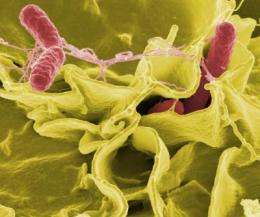
A powerful new class of therapeutics, known as recombinant attenuated Salmonella vaccines (RASV), holds great potential in the fight against fatal diseases including hepatitis B, tuberculosis, cholera, typhoid fever, AIDS and pneumonia.
Now, Qingke Kong and his colleagues at the Biodesign Institute at Arizona State University, have developed a technique to make such vaccines safer and more effective. The group, under the direction of Dr. Roy Curtiss, chief scientist at Biodesign's Center for Infectious Diseases and Vaccinology, demonstrated that a modified strain of Salmonella showed a five-fold reduction in virulence in mice, while preserving strong immunogenic properties.
Their findings appear in the cover story of the current issue of the Journal of Immunology.
Streptococcus pneumoniae, an aerobic bacterium, is the causative agent of diseases including community-acquired pneumonia, otitis media, meningitis, and bacteremia. It remains a leading killer—childhood pneumonia alone causing some 3 million fatalities annually, mostly in poorer countries.
Existing vaccines are inadequate for protecting vulnerable populations for several reasons. Heat stabilization and needle injection are required, which are often impractical for mass inoculation efforts in the developing world. Repeated doses are also needed to induce full immunity. Finally, the prohibitively high costs of existing vaccines often deprive those who need them most. The problem is exacerbated by the recent emergence of antibiotic-resistant strains of pneumococcus causing the disease, highlighting the urgency of developing safe, effective, and lower-cost antipneumococcal vaccines.
One of the most promising strategies for new vaccine development is to use a given pathogen as a cargo ship to deliver key antigens from the pathogen researchers wish to vaccinate against. Salmonella, the bacterium responsible for food poisoning, has proven particularly attractive for this purpose, as Curtiss explains: "Orally-administered RASVs stimulate all three branches of the immune system stimulating mucosal, humoral, and cellular immunity that will be protective, in this case, against a majority of pneumococcal strains causing disease."
Recombinant Salmonella is a highly versatile vector—capable of delivering disease-causing antigens originating from viruses, bacteria and parasites. An attenuated Salmonella vaccine against pneumonia, developed in the Curtiss lab, is currently in FDA phase 1 clinical trials.
In the current research, the team describe a method aimed at retaining the immunogenicity of an anti-pneumonia RASV while reducing or eliminating unwanted side effects sometimes associated with such vaccines, including fever and intestinal distress. "Many of the symptoms associated with reactogenic Salmonella vaccines are consistent with known reactions to lipid A, the endotoxin component of the Salmonella lipopolysaccharide (LPS)," the the major surface membrane component , Kong explained. "In this paper, we describe a method for detoxifying the lipid A component of LPS in living cells without compromising the ability of the vaccine to stimulate a desirable immune response."
To achieve detoxification, Salmonella was induced to produce dephosphoylated lipid A, rendering the vaccine safer, while leaving its ability to generate a profound, system-wide immune response, intact.
To accomplish this, a recombinant strain of Salmonella was constructed using genes from another pathogen, Francisella tularensis, a bacterium associated with tularemia or rabbit fever. Salmonella expressing lipid A 1-phosphatase from tularensis (lpxE) showed less virulence in mice, yet acted to inoculate the mice against subsequent infection by wild-type Salmonella.
In further experiments, the group showed that Salmonella strains could also be constructed to additionally synthesize pneumococcal surface protein A (PspA)—a key antigen responsible for generating antibodies to pneumonia. Again, the candidate RASV displayed nearly complete dephosphorylation of lipid A, thereby reducing toxicity.
Following inoculation with the new Salmonella strain, mice produced a strong antibody response to PspA and showed greatly improved immunity to wild-type Streptococcus pneumoniae, compared with those inoculated with Salmonella lacking the PspA antigen. Tissue culture studies showing reduction of inflammatory cytokines following application of modified lipid A further buttressed the results.
Francisella LpxE was shown to effectively strip the 1-phosphate group from Salmonella's lipid A, without loss of the bacterium's capacity for colonization. The research holds promise for constructing modified live attenuated Salmonella vaccine strains for humans, with dephosphoylated lipid A providing additional safety benefits.


