Not senseless -- watching the brain relearning the sense of smell
June 29, 2011 in Neuroscience
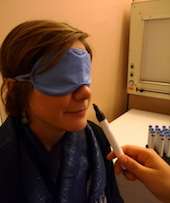
Sniffing for Science: Neural processes affected by a loss of olfactory sensory perception are now being explored.
Neural and biochemical processes that are affected by the loss of olfactory sensory perception are now being explored. These studies provide insight into the effects of the loss of smell on corresponding relevant brain areas. One such project, conducted with support from the Austrian Science Fund FWF, is studying the reasons behind this illness that, surprisingly, affects many people. In particular, the processes in individuals who learn to smell again after having lost this ability are being examined.
Even though we sometimes wish it were less, we collect 20% of our information on our environment with our sense of smell. Our olfactory functions are not only very highly developed, they also have important social functions something which individuals who no longer have a sense of smell strongly experience. This neural disease, known as anosmia, often leads to poor nutrition, depression and seclusion. Although up to 5% of the population suffers from total loss of olfactory functions and 15% suffer from reduced olfactory function little is known about the impact of this loss on higher neural processes. This is now being studied at the Medical University of Vienna in a newly launched project from the Austrian Science Fund FWF. The study makes use of a phenomenon that has only recently been discovered: through special training, some anosmics recover their sense of smell.
Olfactory Fitness Program
With regard to this specialized research approach, project manager Dr. Veronika Schoepf, Department of Neuroradiology and Musculoskeletal Radiology at the University Clinic of Radiology comments that, "in recent years it has become known that patients can regain a certain amount of odour perception through special training methods. Just as little is known as yet on how the training works, the same holds true for the neural processing of chemosensory information in those affected. Regaining the sense of smell offers us the opportunity to learn more about the impact of anosmia on neural processes."
One method that Dr. Schoepf uses for her work is fMRI (functional magnetic resonance imaging). This type of magnetic resonance imaging enables visualize physiological processes in the human body. Due to its non-invasive operating principle, fMRI can be used for studies in particularly sensitive areas, such as the brain.
One part of the project is now focussed on investigating whether the special olfactory training also affects the activity of individual brain regions, such as the olfactory cortex. A comparison of the activities before and after such training provides additional information and clarifies whether other brain structures are activated to compensate for the loss of smell.
A further compensatory mechanism may occur in the trigeminal nerve an important nerve for olfactory perception. To clarify this hypothesis, the team led by Dr. Schoepf will compare chemosensory stimuli along the nerves of healthy subjects and those affected by using fMRI. At the same time, energy consumption and the relative concentrations of neurotransmitters are also measured.
Sniffing for Science
Dr. Schoepf is also studying a very specific process of smelling in more detail, namely sniffing. According to Dr. Schoepf: "Today we know that sniffing is more than just an intense form of suction of air into the nasal cavity. Sniffing actually increases neural activity in the olfactory cortex. This even occurs when no odorant is absorbed. What we now want to know is whether this type of neural activation is also possible in the brains of individuals with anosmia."
The results of this interdisciplinary project by medical doctors, physicists and odour researchers will provide an important basis for understanding anosmia and can simultaneously contribute to the development of possible new treatments. In addition, this project, supported by the FWF, offers basic insight into the neural processes of one of our most important senses.
Provided by Australian Science Fund
-
Olfactory bulb size may change as sense of smell changes
Jun 16, 2008 |
not rated yet |
0
-
Patients appear to adjust and learn to cope with loss or reduced sense of smell
Apr 18, 2011 |
not rated yet |
0
-
Women's brains recognize, encode smell of male sexual sweat
Jan 08, 2009 |
not rated yet |
0
-
Study on olfactory nerve cells shows why we smell better when we sniff
Mar 13, 2007 |
not rated yet |
0
-
Got smell? Research shows that accurate taste perception relies on a functioning olfactory system
Dec 22, 2009 |
not rated yet |
0
-
Limits to growth: Scientists identify key metastasis-enabling enzyme
May 22, 2012 |
5 / 5 (3) |
0
-
Seeing is as seeing does: Spatially-structured retinal input in early development of cortical maps
Apr 26, 2012 |
5 / 5 (4) |
1
-
Dreamless nights: Brain activity during nonrapid eye movement sleep
Apr 09, 2012 |
4.4 / 5 (12) |
0
-
Take your time: Neurobiology sheds light on the superiority of spaced vs. massed learning
Mar 28, 2012 |
4.5 / 5 (21) |
3
-
Your brain on 'shrooms: fMRI elucidates neural correlates of psilocybin psychedelic state
Feb 29, 2012 |
4.9 / 5 (42) |
45
-
For Sale virormone testosterone:$6
56 minutes ago
-
A question about drug tolerance
May 23, 2012
-
Poor nutrition leading to overeating?
May 23, 2012
-
Math and dyslexia?
May 21, 2012
-
portable metabolism meter?
May 21, 2012
-
Rare medical conditions on 20/20 tonight
May 18, 2012
- More from Physics Forums - Medical Sciences
More news stories
Persistent sensory experience is good for aging brain
Despite a long-held scientific belief that much of the wiring of the brain is fixed by the time of adolescence, a new study shows that changes in sensory experience can cause massive rewiring of the brain, even as one ages. ...
Neuroscience
16 hours ago |
not rated yet |
0
Boundary stops molecule right where it needs to be
A molecule responsible for the proper formation of a key portion of the nervous system finds its way to the proper place not because it is actively recruited, but instead because it can't go anywhere else.
Neuroscience
16 hours ago |
not rated yet |
0
|
Locating ground zero: How the brain's emergency workers find the disaster area
Like emergency workers rushing to a disaster scene, cells called microglia speed to places where the brain has been injured, to contain the damage by 'eating up' any cellular debris and dead or dying neurons. ...
Neuroscience
16 hours ago |
5 / 5 (2) |
0
|
Genetic 'reset switch' enables signaling pathway to induce multiple developmental outcomes for olfactory neurons
Within the nervous system, a handful of signaling pathways modulate development of a cornucopia of different neuronal subtypes. Even small alterations in neuron differentiation pathways can disrupt subsequent ...
Neuroscience
19 hours ago |
not rated yet |
0
The auditory cortex adapts agilely with concentration
The birth of sensory perception on the human cerebral cortex is yet to be fully explained. The different areas on the cortex function in cooperation, and no perception is the outcome of only one area working alone. In his ...
Neuroscience
20 hours ago |
not rated yet |
0
Amino acid consumption associated with how fast cancer cells divide
For almost a century, researchers have known that cancer cells have peculiar appetites, devouring glucose in ways that normal cells do not. But glucose uptake may tell only part of cancer's metabolic story. Researchers from ...
Thioridazine kills cancer stem cells in human while avoiding toxic side-effects of conventional cancer treatments
A team of scientists at McMaster University has discovered a drug, thioridazine, successfully kills cancer stem cells in the human while avoiding the toxic side-effects of conventional cancer treatments.
Like curry? New biological role identified for compound used in ancient medicine
Scientists have just identified a new reason why some curry dishes, made with spices humans have used for thousands of years, might be good for you.
'Personality genes' may help account for longevity
"It's in their genes" is a common refrain from scientists when asked about factors that allow centenarians to reach age 100 and beyond. Up until now, research has focused on genetic variations that offer a physiological advantage ...
Gene discovery points towards non-hormonal male contraceptive
A new type of male contraceptive could be created thanks to the discovery of a key gene essential for sperm development.
Cyber exercise partners help you go the distance: Motivation gains can double
A new study testing the benefits of a virtual exercise partner shows the presence of a moderately more capable cycling partner can significantly boost the motivation by as much as 100 percent ...