Team identifies new breast cancer tumor suppressor and how it works
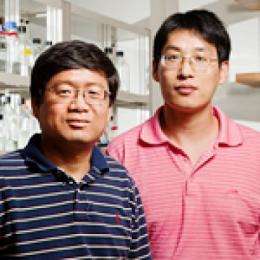
University of Illinois medical biochemistry professor Lin-Feng Chen (left), research scientist Bo Huang and their colleagues identified a new breast cancer tumor suppressor protein, Runx3, and determined how it functioned. Credit: L. Brian Stauffer
Researchers have identified a protein long known to regulate gene expression as a potent suppressor of breast cancer growth. Their study, in the journal Oncogene, is the first to demonstrate how this protein, known as Runx3, accomplishes this feat.
"People suggested that Runx3 might be a tumor suppressor in breast cancer because they found that it is down-regulated in a lot of breast cancer cell lines and breast cancer tissues," said University of Illinois medical biochemistry professor Lin-Feng Chen, who led the study. But no previous studies uncovered direct evidence to support that idea, he said.
In the new study, Chen and his colleagues at Nagasaki University discovered that a significant proportion of mice lacking one of two Runx3 genes spontaneously developed mammary gland tumors at 14 or 15 months of life an age corresponding to age 40 to 50 in humans.
"We found mammary tumors growing in about 20 percent of the female mice lacking a copy of the Runx3 gene," Chen said. None of the mice with two normal copies of the gene developed tumors.
The researchers also found that estrogen receptor alpha (ER-alpha), a well-known culprit in the development of many breast tumors, was up-regulated in the mouse tumors. ER-alpha is overexpressed in about 75 percent of human cases of breast cancer, and enhanced ER-alpha expression in normal breast tissue is associated with an increased risk of breast cancer, Chen said.
Circulating estrogen binds to ER-alpha and initiates a chain of events that alter gene expression in the targeted cell. This is a normal part of cellular signaling, but in ER-positive breast cancers, the overexpression of ER-alpha leads to enhanced tumor cell survival, growth and proliferation.
The researchers found that when Runx3 was re-introduced into ER-alpha positive breast cancer cell lines, it suppressed the growth of the cancer cells and inhibited the potential of the cancer cells to form tumors in the mouse. Further experiments revealed that Runx3 actually targeted ER-alpha signaling by inducing the degradation of ER-alpha.
"By regulating the cellular levels of ER-alpha, Runx3 appears to control the cell's response to circulating estrogen, thus playing an important role in the onset of breast cancer," Chen said.
Chen sees three potential benefits that spring from this study. First, the researchers have discovered a mouse model of spontaneously occurring mammary tumors that corresponds to an age of increased risk of breast cancer in humans.
Second, Chen hopes to develop a simple test to measure Runx3 levels in mammary tissue.
"We know from other people's studies that Runx3 is inactivated in the early stages of breast cancer," he said. "So we might be able to use Runx3 as a biomarker of early stage breast cancer."
And third, since the Runx3 gene appears to be intact but inactivated in breast cancer, future studies will focus on reversing its inactivation, Chen said.
"If you can reactivate Runx3, then you can suppress tumor growth," he said.
The study team also included researchers from the University of Pittsburgh Medical Center and the National University of Singapore.
More information: "RUNX3 Acts as a Tumor Suppressor in Breast Cancer by Targeting Estrogen Receptor Alpha," Oncogene (2011)
Provided by
University of Illinois at Urbana-Champaign
-
Estrogen receptor-alpha, breast cancer patients and tamoxifen response
Nov 25, 2009 |
not rated yet |
0
-
Cancer-causing bacterium targets tumor-suppressor protein
Aug 02, 2010 |
not rated yet |
0
-
Findings point to molecular 'Achilles heel' for half of breast cancer tumors
Jan 15, 2008 |
not rated yet |
0
-
Team discovers new inhibitors of estrogen-dependent breast cancer cells
Jun 16, 2008 |
not rated yet |
0
-
New subtype of breast cancer responds to targeted drug
Mar 01, 2010 |
not rated yet |
0
-
Motion perception revisited: High Phi effect challenges established motion perception assumptions
Apr 23, 2013 |
3 / 5 (2) |
2
-
Anything you can do I can do better: Neuromolecular foundations of the superiority illusion (Update)
Apr 02, 2013 |
4.5 / 5 (11) |
5
-
The visual system as economist: Neural resource allocation in visual adaptation
Mar 30, 2013 |
5 / 5 (2) |
9
-
Separate lives: Neuronal and organismal lifespans decoupled
Mar 27, 2013 |
4.9 / 5 (8) |
0
-
Sizing things up: The evolutionary neurobiology of scale invariance
Feb 28, 2013 |
4.8 / 5 (10) |
14
-
Pressure-volume curve: Elastic Recoil Pressure don't make sense
16 hours ago
-
If you became brain-dead, would you want them to pull the plug?
May 17, 2013
-
MRI bill question
May 15, 2013
-
Ratio of Hydrogen of Oxygen in Dessicated Animal Protein
May 13, 2013
-
Alcohol and acetaminophen
May 13, 2013
-
Marie Curie's leukemia
May 13, 2013
- More from Physics Forums - Medical Sciences
More news stories
New colonoscope provides ground-breaking view of colon
A ground-breaking advance in colonoscopy technology signals the future of colorectal care, according to research presented today at Digestive Disease Week(DDW). Additional research focuses on optimizing the minimal withdrawal ...
Cancer
8 hours ago |
5 / 5 (1) |
0
ASCO: combo antibody therapy effective for melanoma
(HealthDay)—Concurrent use of two immune checkpoint antibodies—ipilimumab and nivolumab—may be effective for the treatment of advanced melanoma, according to a proof-of-principal study presented in ...
Cancer
May 17, 2013 |
not rated yet |
0
Risk factors ID'd for poor cutaneous cell CA outcomes
(HealthDay)—The risks of metastasis and death associated with cutaneous squamous cell carcinoma (CSCC) are low, but significant, and risk factors for poor outcome include tumor diameter, invasion beyond ...
Cancer
May 17, 2013 |
not rated yet |
0
|
Physical & emotional impairments common, often untreated in people with cancer
A new review finds cancer survivors suffer a diverse and complex set of impairments, affecting virtually every organ system. Writing in CA: A Cancer Journal for Clinicians, Julie Silver, M.D., associate professor at Harvar ...
Cancer
May 17, 2013 |
not rated yet |
0
Calif. doc with 'cancer cure' gets 14 years prison (Update)
(AP)—A California doctor has been sentenced to 14 years in federal prison for bilking her patients out of more than $1 million by promising that an herbal supplement could cure late-stage cancer and other diseases.
Cancer
May 17, 2013 |
not rated yet |
0
New research identifies risks, interventions for children's GI health
An increasing number of U.S. children are experiencing gastrointestinal issues that require interventions to resolve, according to research presented at Digestive Disease Week (DDW).
US psychiatry gets makeover in new manual
The latest makeover to a massive psychiatric tome honored by some, reviled by others and even called the "Bible" of mental disorders is being released Saturday with a host of new changes.
New case of SARS-like virus in Saudi: ministry
A new case of the deadly coronavirus has been detected in Saudi Arabia where 15 people have already died after contracting it, the health ministry announced on Saturday on its Internet website.
AIDS science at 30: 'Cure' now part of lexicon
Big names in medicine are set to give an upbeat assessment of the war on AIDS on Tuesday, 30 years after French researchers identified the virus that causes the disease.
For combat veterans suffering from post-traumatic stress disorder, 'fear circuitry' in the brain never rests
Chronic trauma can inflict lasting damage to brain regions associated with fear and anxiety. Previous imaging studies of people with post-traumatic stress disorder, or PTSD, have shown that these brain regions can over-or ...
Flesh-eating disease victim gets prosthetic hands
(AP)—A woman who lost both hands, her left leg and right foot after contracting a flesh-eating disease has been fitted with prosthetic hands.