Tiny worms head into the breach as team searches for Parkinson's treatment
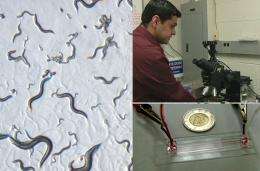
McMaster researchers from three disciplines are deploying thousands of tiny worms and a homegrown invention to test drugs in a collaborative bid to defeat Parkinson's Disease.
A team of researchers from the faculties of Science, Engineering and Health Sciences, armed with a $450,000 grant from the Collaborative Health Research Projects program, are to spend the next three years using microtechnology to search for effective new drugs to treat the degenerative neurological disease.
The method they are using could speed the process of drug discovery in other areas.
"We all have different areas of expertise," says Bhagwati Gupta, a professor in the Department of Biology whose lab uses genetics to understand the nervous system. "We hope we can make progress that wouldn't be possible if one single lab were working on it. Collaboration brings new perspectives, new ideas and new tools."
The CHRP program is funded by the National Science and Engineering Research Council and the Canadian Institutes of Health Research.
The McMaster team will use a device that was created by its engineers, compounds from its medical researchers and modified worms prepared by its biologists for the Parkinson's project – one they hope will create new knowledge about the disease and become a model for future research in other areas.
"This could have direct application to human health and welfare," said Ram Mishra, a professor in the Department of Psychiatry and Neuroscience who studies nervous system degeneration. "It's a simple model, but it can answer very complex questions."
The McMaster team will use a new device created at the university to assess the effects of more than 500 compounds on nematodes – tiny worms that are almost invisible to the naked eye, but which share more than 50 per cent of their DNA in common with humans.
The simple, transparent creatures lend themselves well to lab use, Gupta says. The worms are cheap, plentiful and hardy, and their simple structure and nervous system allow them to be studied at high resolution.
Parkinson's affects the brain's dopamine neurons. Humans have billions of such neurons, but nematodes have only eight. But of the eight genes linked to Parkinson's in humans, nematodes have all eight, making them model test subjects.
The new tool us es a harmless electrical impulse to drive the worms wriggling through fluid and along a narrow channel, where they can readily be measured in numerous contexts, at high volume and at extremely low cost compared to lab mice, for example.
Until McMaster mechanical engineer Ravi Selvaganapathy and his team developed the microchannel device – technically known as a microfluidic electrotaxis assay system – manipulating the movement of such tiny worms for scientific experiments was challenging: the nematodes moved freely in every direction, making it difficult for scientists to obtain meaningful information.
"Now for the very first time, you have a way of telling the worm something to do and it does something in response," says Selvaganapathy, an associate professor and expert in the design, fabrication and development of microdevices. "It's like a police officer telling you to get out of your car and walk 10 steps to see whether you're drunk or not. The movement of that person tells the police officer something about the neurological state the person is in, as well as whether they are co-ordinating that with muscular action."
This process allows early-stage drug testing on living beings in an automated and sensitive manner, producing rich data at low cost, Selvaganapathy says. The process promises to accelerate the process of drug discovery.
The nematodes in the Parkinson's project will be mutated to simulate the symptoms of the illness, and treated with compounds to measure their beneficial effect on the worms.


