Researchers aim for 'direct brain control' of prosthetic arms (w/ Video)
July 27, 2011 in Medical research
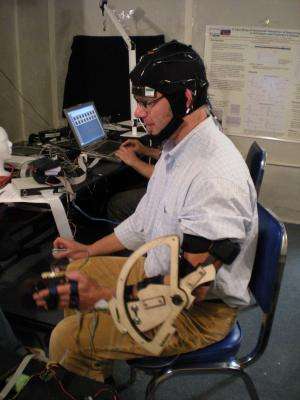
In tests at the University of Maryland, University of Michigan engineering researcher Brent Gillespie uses a prototype of a device that provides feedback to the wearer's arm while objects are moved with a prosthetic 'hand,' a gripper. The prototype, which incorporates noninvasive monitoring of electrical activity and blood-oxygen levels in the brain, may be incorporated into next-generation prosthetic arms. Credit: J. Contreras-Vidal/University of Maryland
Engineering researchers at four U.S. universities are embarking on a four-year project to design a prosthetic arm that amputees can control directly with their brains and that will allow them to feel what they touch. While it may sound like science fiction, the researchers say much of the technology has already been proven in small-scale demonstrations.
The research at Rice University, the University of Michigan, Drexel University and the University of Maryland is made possible by a $1.2 million grant from the National Science Foundation's Human-Centered Computing program.
"There's nothing fictional about this," said Rice University co-principal investigator Marcia O'Malley. "The investigators on this grant have already demonstrated that much of this is possible. What remains is to bring all of it -- noninvasive neural decoding, direct brain control and tactile sensory feedback -- together into one device."
This video is not supported by your browser at this time.
O'Malley and her co-investigators on the project -- Michigan's Brent Gillespie, Drexel's Patricia Shewokis and Maryland's José Contreras-Vidal -- have previously demonstrated technology that allowed amputees to correctly perceive and manipulate objects with a prosthetic gripper based upon sensory feedback that was provided in a natural way to the remaining portion of their limbs."Neuroprosthetic control is an important part of our project, but an equally important challenge is providing sensory feedback for contact tasks that are performed with the prosthesis," Gillespie said.
The team plans to incorporate technology that feeds both tactile information from the prosthetic fingertips and grasping-force information from the prosthetic hand via a robotic exoskeleton and touchpads that vibrate, stretch and squeeze the skin where the prosthesis attaches to the body.
"The idea is to provide a range of sensory feedback that can be integrated by the user, much like able-bodied individuals integrate a variety of tactile, kinesthetic and force information from nerves in their skin and muscles," Contreras-Vidal said.
Contreras-Vidal has previously demonstrated technology that allowed test subjects to move a cursor on a computer screen simply by thinking about it. That technology noninvasively taps into the user's neural network using a cap of electrodes that read electrical activity on the scalp via electroencephalography (EEG). The team plans to combine this EEG information with real-time data about blood-oxygen levels in the user's frontal lobe using functional near-infrared (fNIR) technology developed by Drexel's Optical Brain Imaging Laboratory.
Shewokis said, "We want to provide intuitive control over contact tasks, and we're also interested in strengthening the motor imagery the patients are using as they think about what they want their arm to do. Ideally, this tactile or haptic feedback will improve the signal from the EEG and fNIR decoder and make it easier for patients to get their prosthetic arms to do exactly what they want them to do. We are moving toward incorporating the 'brain in the loop' for prosthetic use and control."
O'Malley said the new technology is a big leap over what's used in existing prosthetic devices, which don't allow amputees to feel what they touch. Some state-of-the-art prostheses today use force-feedback systems that vibrate -- much like the vibrate mode on a mobile phone -- to provide limited information about objects a prosthetic hand is gripping.
"Often, these vibrotactile cues aren't very helpful," O'Malley said. "Many times individuals simply rely on visual feedback -- watching their prosthesis grasp an object -- to infer whether the object is soft or hard, how tightly they are grasping it and the like. There's a lot of room for improvement."
"This truly unique team has been given the opportunity to help solve the challenging problem of brain-to-machine interface," Gillespie said. "I'm excited about our breakthroughs and the promise for future results. We are approaching the dilemma with big respect for the brain/body connection and hope to discover methods to harness the body in new ways.
"Sensory feedback, especially haptic feedback, is often overlooked, but we think it's the key to closing the loop between the brain and motorized prosthetic devices," he said. "These results indicate that we stand a very good chance to help amputees and also help others who may be suffering from motor impairments."
Provided by
Rice University
-
New device may enable limbs to be controlled by thought alone
Mar 04, 2010 |
not rated yet |
0
-
Brain cap technology turns thought into motion
Jul 27, 2011 |
not rated yet |
0
-
Robot arm improves performance of brain-controlled device
Dec 14, 2010 |
not rated yet |
0
-
Amputees can experience prosthetic hand as their own
Dec 11, 2008 |
not rated yet |
0
-
New generation of prosthetic gets closer to the real limb
Feb 10, 2011 |
not rated yet |
0
-
Motion perception revisited: High Phi effect challenges established motion perception assumptions
Apr 23, 2013 |
3 / 5 (2) |
2
-
Anything you can do I can do better: Neuromolecular foundations of the superiority illusion (Update)
Apr 02, 2013 |
4.5 / 5 (11) |
5
-
The visual system as economist: Neural resource allocation in visual adaptation
Mar 30, 2013 |
5 / 5 (2) |
9
-
Separate lives: Neuronal and organismal lifespans decoupled
Mar 27, 2013 |
4.9 / 5 (8) |
0
-
Sizing things up: The evolutionary neurobiology of scale invariance
Feb 28, 2013 |
4.8 / 5 (10) |
14
-
Why is zone 1 in liver more prone to ischemic injury?
May 23, 2013
-
How can there be villous adenoma in colon, if there are no villi there
May 22, 2013
-
How can there be a term called "intestinal metaplasia" of stomach
May 21, 2013
-
Pressure-volume curve: Elastic Recoil Pressure don't make sense
May 18, 2013
-
If you became brain-dead, would you want them to pull the plug?
May 17, 2013
-
MRI bill question
May 15, 2013
- More from Physics Forums - Medical Sciences
More news stories
Study reveals new mechanism for estrogen suppression of liver lipid synthesis
By discovering the new mechanism by which estrogen suppresses lipid synthesis in the liver, UC Irvine endocrinologists have revealed a potential new approach toward treating certain liver diseases.
Medical research
May 23, 2013 |
5 / 5 (1) |
0
|
MRI-based measurement helps predict vascular disease in the brain
Aortic arch pulse wave velocity, a measure of arterial stiffness, is a strong independent predictor of disease of the vessels that supply blood to the brain, according to a new study published in the June issue the journal ...
Medical research
May 23, 2013 |
not rated yet |
0
Antibiotics: A new understanding of sulfonamide nervous system side effects
Since the discovery of Prontosil in 1932, sulfonamide antibiotics have been used to combat a wide spectrum of bacterial infections, from acne to chlamydia and pneumonia. However, their side effects can include serious neurological ...
Medical research
May 23, 2013 |
3 / 5 (1) |
0
|
Scientists discover molecule triggers sensation of itch
Scientists at the National Institutes of Health report they have discovered in mouse studies that a small molecule released in the spinal cord triggers a process that is later experienced in the brain as ...
Medical research
May 23, 2013 |
5 / 5 (3) |
0
|
Discarded immune cells induce the relocation of stem cells
Spanish researchers have discovered that the daily clearance of neutrophils from the body stimulates the release of hematopoietic stem cells from the bone marrow into the bloodstream, according to a report published today ...
Medical research
May 23, 2013 |
5 / 5 (2) |
0
First drug to improve heart failure mortality in over a decade
Coenzyme Q10 decreases all cause mortality by half, according to the results of a multicentre randomised double blind trial presented today at Heart Failure 2013 congress. It is the first drug to improve heart failure mortality ...
Heart failure accelerates male 'menopause'
Heart failure accelerates the aging process and brings on early andropausal syndrome (AS), according to research presented today at the Heart Failure Congress 2013. AS, also referred to as male 'menopause', was four times ...
Seniors more likely to crash when driving with pet, study finds
(HealthDay)—Animals make great companions for senior citizens, but elderly people who always drive with a pet in the car are far more likely to crash than those who never drive with a pet, researchers have ...
New immune system discovered
(Medical Xpress)—A research team, led by Jeremy Barr, a biology post-doctoral fellow, unveils a new immune system that protects humans and animals from infection.
Brain can be trained in compassion, study shows
Until now, little was scientifically known about the human potential to cultivate compassion—the emotional state of caring for people who are suffering in a way that motivates altruistic behavior.
Do salamanders hold the solution to regeneration?
Salamanders' immune systems are key to their remarkable ability to regrow limbs, and could also underpin their ability to regenerate spinal cords, brain tissue and even parts of their hearts, scientists have ...