Bioengineers identify the cellular mechanisms of traumatic brain injury
July 23, 2011 in Medical research

Harvard bioengineers identify the cellular mechanisms of traumatic brain injury

Enlarge

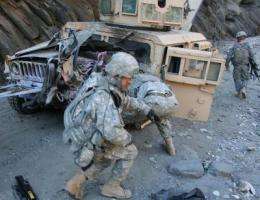
Bioengineers at Harvard have identified the mechanism for diffuse axonal injury and explained why cerebral vasospasm is common after an IED explosion. (NOTE: PI Kit Parker is NOT in this photo.) Credit: Photo courtesy of the U.S. Department of Defense.

Bioengineers at Harvard have identified, for the very first time, the mechanism for diffuse axonal injury and explained why cerebral vasospasm is more common in blast-induced brain injuries than in brain injuries typically suffered by civilians.

The research addresses two major aspects of (TBI), with significant implications for the medical treatment of soldiers wounded by explosions.

Two papers, published in the journals (PNAS) and PLoS One, provide the most comprehensive explanation to date of how can be translated into subtly disastrous physiological changes within the brain's neurons and vasculature.

"These results have been a long time coming," says principal investigator Kevin Kit Parker, a Professor of at Harvard's School of Engineering and Applied Sciences (SEAS) and a major in the U.S. Army. "So many young men and women are returning from military service with brain injuries, and we just don't know how to help them."

When the brain encounters a jarring force, such as an exploding roadside bomb, the delicate tissue slams against the skull. The result, if the patient survives, can be a temporary concussion, a more dangerous , or long-term TBI, which can even lead to the early onset of Parkinson's or Alzheimer's diseases.

Inspired by Parker's own military experience, the Disease Biophysics Group (based at SEAS and at the Wyss Institute for Biologically Inspired Engineering at Harvard) has taken up the cause. Using cutting-edge techniques—essentially creating a living brain on a chip—biologists, physicists, engineers, and materials scientists collaborate to study brain injury and potential targets for treatment.

Now, researchers in his group have identified the cellular mechanism that initiates diffuse axonal injury, offering urgently needed direction for research in therapeutic treatments.

Their studies show that integrins, receptor proteins embedded in the cell membrane, provide the crucial link between external forces and internal physiological changes.

Integrins connect the structural components within the cell (such as actin and other cytoskeletal proteins) with the extracellular matrix that binds cells together into tissue. Collectively, this network of structural and signaling components is referred to as the focal adhesion complex.

Parker's research has demonstrated that the forces unleashed by an explosion physically disrupt the structure of the focal adhesion complex, setting off a chain reaction of destructive molecular signals within the nerve cells of the brain.

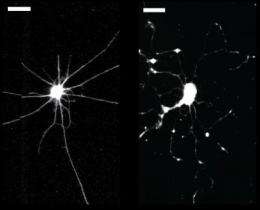
Inside the neuron, integrins normally mediate the activation of the proteins RhoA and Rho kinase (ROCK). When the focal adhesion complex is disturbed, the Rho-ROCK signaling pathway goes haywire: it directs the motor protein actin to retract the cell's arm-like axons, disconnecting the neurons from each other and collapsing the cellular networks that constitute the brain.

"Our research has shown that abrupt mechanical forces, such as those from a blast wave and transduced by integrins, can result in neural injury," says Matthew A. Hemphill, who with Borna Dabiri (S.B. '07) and Sylvain Gabriele, is a lead author of the paper in . Dabiri and Hemphill are currently graduate students at SEAS, and Gabriele is a former postdoctoral fellow in Parker's lab.
Harvard bioengineers identify the cellular mechanisms of traumatic brain injury
Enlarge

Left: A healthy neuron, with its dendrites and axon intact. Right: The damaged neuron has retracted its arms, breaking essential connections with its neighbors. Credit: Photo courtesy of Matthew Hemphill, Borna Dabiri, and Sylvain Gabriele.

Adds Dabiri: "Encouragingly, we also found that treating the neural tissue with HA-1077, which is a ROCK inhibitor, within the first 10 minutes of injury, reduced the number of focal swellings. We think that further study of ROCK inhibition could lead to viable treatments within the near future."

A second direction of research in Parker's lab has solved another mystery in TBI, explaining why cerebral vasospasm, a dangerous remodeling of the brain's blood vessels, occurs more commonly in TBI caused by explosions than in other types of brain trauma.

"Until now, other researchers looking at TBI focused on ion channels and membrane poration, and it was generally accepted that cerebralvasospasm was only caused by hemorrhaging. It turns out that it's much morecomplicated than that," says Patrick W. Alford, a former postdoctoral fellow in Parker's lab and lead author of the paper in PNAS. "Integrins and Rho-ROCK signaling appear to be players in both diffuse axonal injury and cerebral vasospasm."

As reported in PNAS, the forces exerted on arteries are different during an explosive blast than during blunt force trauma. Subarachnoid hemorrhage, which can occur in very severe head injuries, is known to cause vasospasm, but Parker's new research shows that the unique force of an explosion can also cause vasospasm by itself.

The blast from an explosion creates a surge in blood pressure, which stretches the walls of the blood vessels in the brain. To study this, Parker's team of bioengineers built artificial arteries, made of living vascular cells, and used a specialized machine to rapidly stretch them, simulating an explosion. While this stretching did not overtly damage the cellular structure, it did cause an immediate hypersensitivity to the protein endothelin-1.

Endothelin-1 is known to stimulate vascular cells to absorb calcium ions, which affect actin—the same protein involved in the retraction of axons.

In the 24 hours following the simulated blast, the vascular tissues hypercontract and undergo a complete phenotypic switch, disrupting the overall function of the tissue. Both of these behaviors are characteristic of cerebral vasospasm.

Most importantly, as in the neural tissue, the Rho-ROCK signaling pathway plays an important role in the behavior of actin and the cells' contraction. Parker's team found that inhibition of Rho soon after the injury can mitigate the harmful effects of the blast on the brain's vascular system.

"We have established a toe-hold as we try to climb up on top of this problem," says Parker. "In many ways, this work is just the beginning."

Provided by Harvard University search and more info website

5 /5 (5 votes)  

Filter


Move the slider to adjust rank threshold, so that you can hide some of the comments.


Display comments: newest first

hush1
Jul 23, 2011

Rank: 5 / 5 (1)
http://medicalxpr...une.html

The latest of the one of tens of thousands of published research papers focused on aiding, inducing, and encouraging the building blocks of a promising self healing mechanism(s).

Having the brain 'clear, 'clean', and 'rebuild up' after itself, (somehow the word "pruning" has found its way as the descriptor for the scarcely researched focus), promises a noninvasive approach.

The colleagues aren't going anywhere, at least collaborate.
It's not about the laurels at breakthroughs in progress. It is about the people regaining what was lost. The patient.

You know hierarchy. The less of that, the faster the progress.
Case in point: ECEH.
Telekinetic
Jul 23, 2011

Rank: 5 / 5 (1)
I'm afraid that nature never prepared her creatures for the traumatic forces of roadside bombs. Even a career in the boxing ring or football field is devastating enough to the brain. A fall from a bicycle without a helmet is enough to end it all. It's the saddest thing to see soldiers, young adults, face the rest of a long life with debilitation. The answer lies in the ending of wars, and short of that, wars fought without people on the battlefield.
hush1
Jul 23, 2011

Rank: not rated yet
Yes. Forbid such "careers". Practice accidents. Airline pilots and stunt professionals 'practice' accidents all the time. Make the practice a science. Falling from a bike is the most natural behavior in the beginning. No one tells the person:
Falling is inevitable. So let's condition you to fall in a manner that renders the impact you encounter the least harmful.

Cases in point:
Cats falling on all fours.
Race drivers hitting a barrier without the driver changing a single variable or force (except counterintuitively giving more gas - [acceleration] without changing direction [loss of steering]). A conditioned counter-intuitive response for the minimum harm to the driver.

Either 'science' or study thereof (instinctive, innate reaction or conditioned reflex) is not worth anyone's time or health.

The saddest of all life forms: Humans.
pizawl
Jul 25, 2011

Rank: not rated yet
I would like to have a look at these papers. Links?
Rank 5 /5 (5 votes)
Relevant PhysicsForums posts

More news stories

Now we know why old scizophrenia medicine works on antibiotics-resistant bacteria

In 2008 researchers from the University of Southern Denmark showed that the drug thioridazine, which has previously been used to treat schizophrenia, is also a powerful weapon against antibiotic-resistant bacteria such as ...

Medical research created 14 hours ago | popularity 3.7 / 5 (3) | comments 0 | with audio podcast

SUMO wrestling cells reveal new protective mechanism target for stroke

Scientists investigating the interaction of a group of proteins in the brain responsible for protecting nerve cells from damage have identified a new target that could increase cell survival.

Medical research created 20 hours ago | popularity 5 / 5 (1) | comments 0

How serotonin receptors can shape drug effects, from LSD to migraine medication

New findings by researchers carrying out experiments at the U.S. Department of Energy Office of Science's Advanced Photon Source (APS) help explain why some drugs that interact with two kinds of human serotonin ...

Medical research created 22 hours ago | popularity not rated yet | comments 0 | with audio podcast

Preventing blood poisoning

Peptide molecules derived from the body's natural immune system can help boost the body's defence against life-threatening blood poisoning, joint University research has uncovered.

Medical research created 22 hours ago | popularity 4 / 5 (1) | comments 0 | with audio podcast

New mechanism to prevent type 2 diabetes in obese individuals

A new Montréal study conducted by Dr. May Faraj, associate research professor at the Université de Montréal and invited scientist at the IRCM, along with her research team and medical collaborators, shows ...

Medical research created 22 hours ago | popularity not rated yet | comments 0 | with audio podcast


AIDS science at 30: 'Cure' now part of lexicon

Big names in medicine are set to give an upbeat assessment of the war on AIDS on Tuesday, 30 years after French researchers identified the virus that causes the disease.

For combat veterans suffering from post-traumatic stress disorder, 'fear circuitry' in the brain never rests

Chronic trauma can inflict lasting damage to brain regions associated with fear and anxiety. Previous imaging studies of people with post-traumatic stress disorder, or PTSD, have shown that these brain regions can over-or ...

Melon focus headband turns to Kickstarter for rollout plans

(Medical Xpress)—What if the quality of your work depends more on your focus on the piano keys or canvas or laptop than your musical or painting or computing skills? If target users can be convinced, they ...

Temporal processing in the olfactory system

The neural machinery underlying our olfactory sense continues to be an enigma for neuroscience. A recent review in Neuron seeks to expand traditional ideas about how neurons in the olfactory bulb might encode information about ...

Individuals who drink heavily and smoke may show 'early aging' of the brain

Treatment for alcohol use disorders works best if the patient actively understands and incorporates the interventions provided in the clinic. Multiple factors can influence both the type and degree of neurocognitive abnormalities ...

College women exceed NIAAA drinking guidelines more frequently than college men

In order to avoid harms associated with alcohol consumption, in 2009 the National Institute on Alcohol Abuse and Alcoholism issued guidelines that define low-risk drinking. These guidelines differ for men and women: no more ...