The brain co-opts the body to promote pro-social behavior
July 7, 2011 in Psychology & Psychiatry

brain

Enlarge

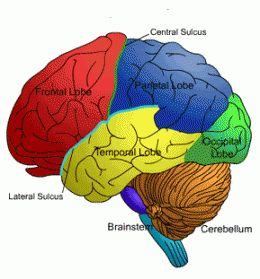
Brain diagram. Credit: dwp.gov.uk

The human brain may simulate physical sensations to prompt introspection, capitalizing on moments of high emotion to promote moral behavior, according to a USC researcher.

Mary Helen Immordino-Yang of the USC Brain and Institute and the USC Rossier School of Education found that individuals who were told stories designed to evoke compassion and admiration for virtue sometimes reported that they felt a physical sensation in response. These psycho-physical "pangs" of emotion are very real — they're detectable with brain scans — and may be evidence that pro-social behavior is part of human survival.

Immordino-Yang's hypothesis, borne out thus far by her research, is that the feeling or emotional reactions in the body may sometimes prompt introspection, and can ultimately promote moral choices and motivation to help or emulate others.

"These emotions are foundational for morality and social learning. They have the power to change the course of your very life," Immordino-Yang said.

Her article appears in the July issue of Emotion Review.

In one instance cited in the article, a participant responded to a story of a little boy's selflessness toward his mother by reporting that he felt like there was a "balloon or something under my sternum, inflating and moving up and out." While pondering this physical sensation, the participant paused for a moment and considered his own relationship with his parents. Ultimately, he voiced a promise to express more gratitude toward them.

Researchers noted similar reactions to varying degrees in the test's other participants. Immordino-Yang's team has performed about 50 of these qualitative analyses in Beijing and at USC. The researchers provide the emotional story, then record the participant's reaction, and also use scans to record the physiological response.

"It's a systematic but naturalistic way to induce these emotions." Immordino-Yang said. After being told an emotional true story during a private, taped interview, the participant is simply asked to describe how he or she feels.

Immordino-Yang said she isn't surprised at the findings, though she is excited by them.

"We are an intensely social species," she said. "Our very biology is a social one. For centuries poets have described so-called gut feelings during social emotions. Now we are uncovering the biological evidence."

Future analysis of the data her team has gathered will focus on discovering to what degree culture and individual styles and experiences influence these reactions, as well as how they develop in children and how they can be promoted by education.

Provided by University of Southern California search and more info website

4.3 /5 (8 votes)  

Filter


Move the slider to adjust rank threshold, so that you can hide some of the comments.


Display comments: newest first

hush1
Jul 08, 2011

Rank: not rated yet
Kudos. You are on to something. Tracing the origins of 'triggers'.
Rank 4.3 /5 (8 votes)
Relevant PhysicsForums posts

More news stories

Study reviews readmissions in inpatient psychiatric facilities

(HealthDay)—Most Medicare beneficiaries treated in inpatient psychiatric facilities (IPFs) exhibit characteristics associated with hospital readmission, according to a report prepared for the National Association ...

Psychology & Psychiatry created 18 hours ago | popularity not rated yet | comments 0

Skydiving is never plane sailing

Skydivers show the same level of physical stress before every jump whether a first-timer or experienced jumper, say Northumbria researchers.

Psychology & Psychiatry created 19 hours ago | popularity not rated yet | comments 0 | with audio podcast

Kids, especially boys, perceive sadness of depressed parents

Children of depressed parents pick up on their parents' sadness—whether mom or dad realizes their mood or not.

Psychology & Psychiatry created May 17, 2013 | popularity 4.5 / 5 (2) | comments 1 | with audio podcast

One in five U.S. kids has a mental health disorder, CDC reports

(HealthDay)—As many as one in five American children under the age of 17 has a diagnosable mental disorder in a given year, according to a new federal report.

Psychology & Psychiatry created May 16, 2013 | popularity 2 / 5 (4) | comments 1 | with audio podcast

Bach to the blues, our emotions match music to colors

(Medical Xpress)—Whether we're listening to Bach or the blues, our brains are wired to make music-color connections depending on how the melodies make us feel, according to new research from the University ...

Psychology & Psychiatry created May 16, 2013 | popularity not rated yet | comments 0 | with audio podcast


AIDS science at 30: 'Cure' now part of lexicon

Big names in medicine are set to give an upbeat assessment of the war on AIDS on Tuesday, 30 years after French researchers identified the virus that causes the disease.

For combat veterans suffering from post-traumatic stress disorder, 'fear circuitry' in the brain never rests

Chronic trauma can inflict lasting damage to brain regions associated with fear and anxiety. Previous imaging studies of people with post-traumatic stress disorder, or PTSD, have shown that these brain regions can over-or ...

Melon focus headband turns to Kickstarter for rollout plans

(Medical Xpress)—What if the quality of your work depends more on your focus on the piano keys or canvas or laptop than your musical or painting or computing skills? If target users can be convinced, they ...

Temporal processing in the olfactory system

The neural machinery underlying our olfactory sense continues to be an enigma for neuroscience. A recent review in Neuron seeks to expand traditional ideas about how neurons in the olfactory bulb might encode information about ...

Now we know why old scizophrenia medicine works on antibiotics-resistant bacteria

In 2008 researchers from the University of Southern Denmark showed that the drug thioridazine, which has previously been used to treat schizophrenia, is also a powerful weapon against antibiotic-resistant bacteria such as ...

23 dead in initiation rites in South Africa

(AP)—Twenty-three youths have died in the past nine days at initiation ceremonies that include circumcisions and survival tests, South African police said Friday.